
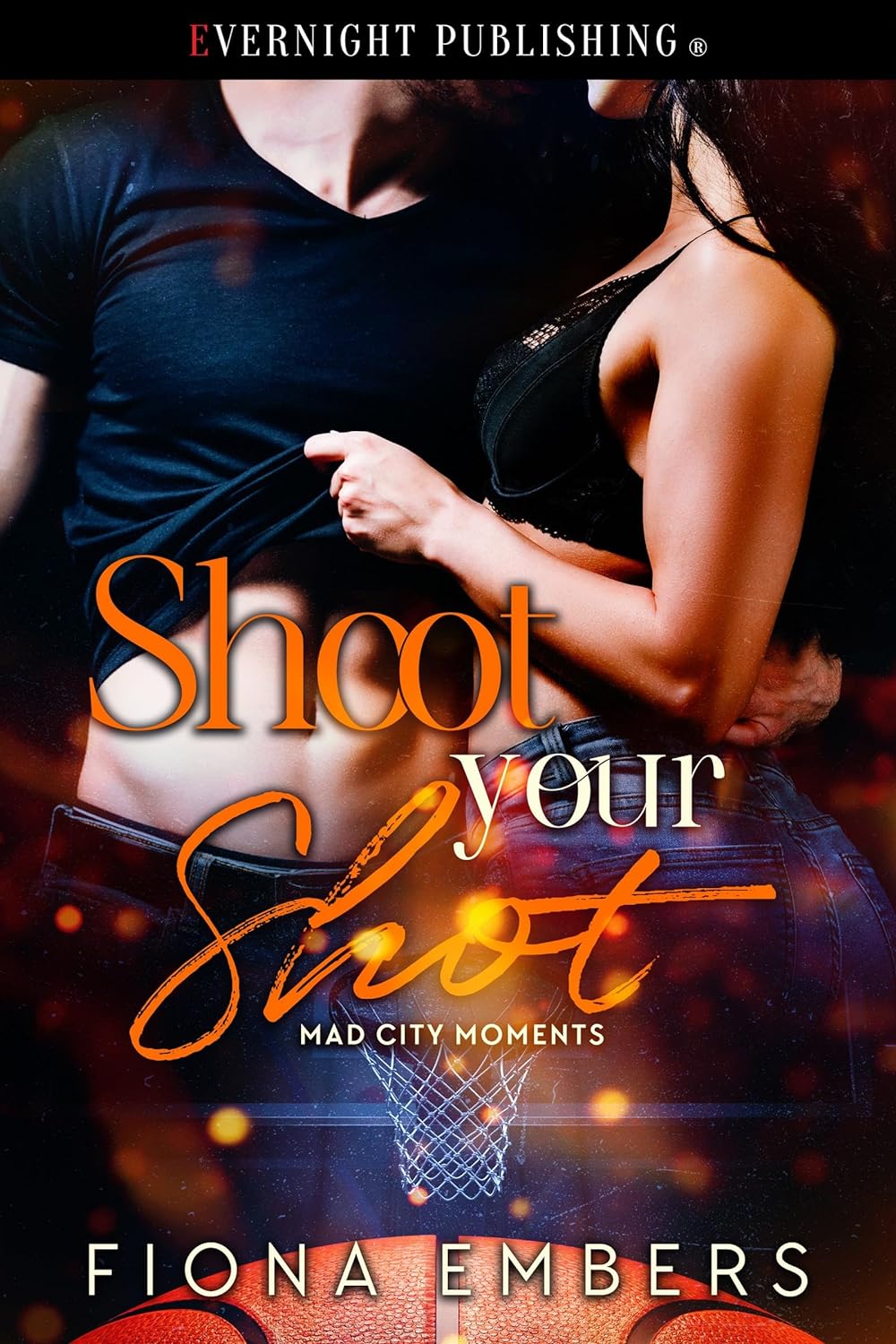
Shoot Your Shot
Roxie Nowak is a former basketball player, with a great job in tech and her own swanky place. She doesn’t date, because what’s the point? Men always want someone petite, pillowy, and pastel—everything that Roxie isn’t—so she sticks to casual hookups, and life is good.
As a hot lawyer and a romantic to boot, Chris Dunn should have no trouble finding love. But a gaping hole at his center, left by childhood hurts, prevents him from having the type of relationship he seeks. He knew Roxie years ago, when her basketball career ended, and she inspired him to take the reins to his career.
When Chris moves back to town and into Roxie’s building, their friendship and mutual attraction deepen. They finally give in with blinding intensity, unaware just how combustible the mix of her avoidance and his insecurity can be—until one vindictive ex-lover lights a match.
Dabney: You’ve read this plot before. Hero is sure women can’t/won’t really love him (he was rejected in the past and it HURT) so now he’s sworn off love and sticks to sex only relationships. He meets the woman of his dreams but HE STILL JUST CAN’T TRUST, so, even though she’s clearly the one and she HAZ FEELINGS, he continues his rakish ways until–SNAP!–love finally becomes the thing he realizes he truly deserves and wants.
Except, here, it’s a she.
Not a plot we see much in romance. Lisa, what did you think about the story of Roxie?
Lisa: Roxie absolutely reminded me of Dee from It’s Always Sunny in Philadelphia, only way more confident and MUCH less of a hot mess. I love seeing role reveals like this – I loved seeing Roxie hook up with other dudes to wash the feeling of TRUE LOVE out of her mouth – only to feel bad about ignoring Chris.
Dabney: I can’t decide if she’s a mite too self-destructive for me. Like, WHY run from true love? is it only her conviction that men just dig her for sex? (This is a plot I’m seeing more in contemporary romance and, in some ways, it seems very retro to me.) And I have to say I found the whole men like to bang Roxie but not seriously date her because she isn’t small and blonde a bit much. I’d hazard that the same men who seek Sydney Sweeney look alikes to be their OTP are equally DTF same. I had a hard time buying that Roxie, just because she’s tall and brunette, could only find men interested in only hooking up.
But I’m ancient. Lisa, am I missing something here?
Lisa: Well, they’d gladly do the same thing to Ms. Sweeney – trust me, I know of men who are the types of dudes who would do what they do with Roxie but ply their wares upon young blondes. Yeah, that’s a small blemish on the books’ credibility.
Dabney: The thing is, except when she was being an idiot, I really liked Roxie. She’s smart, very good at her job, has a wickedly sharp sense of humor, and, in general, is one of those people you meet in a book that you’d totally like to grab a drink with. What did you think of her?
Lisa: Honestly, she’s probably my favorite romance heroine of the year so far because of all of those things.
Dabney: I also liked Chris. I’d be happy if my kid brought him home as a friend or a date. He’s smart, full of zingy quips, and is cleary deeply loyal to those he cares for. I liked him so much that, when Roxie refused to cut him slack for any of his missteps, I thought she was being overly extra.
Lisa: Chris is smart, normal and super fun – definitely an excellent hero.
Dabney: This is certainly, for a book that is less than 225 pages long, chockablock full of sex, all of which involves Roxie. She has sex with four different guys and all of the scenes are detailed. Which is fine because Ember writes excellent sex scenes. And, props to her given her dedication to writing Roxie the rake’s many hookups judgement free, she manages to show that, when it’s sex and love, it’s a different and better kind of sex.
Lisa: Oh yeah, this one borders on a hot rating for a reason. And I liked the detached fondness of all the hookup sex versus what happens with Chris, which feels more real, so to speak.
Dabney: My biggest complaint is, especially given how short this book is, Roxie’s insistence on HAVING THINGS HER WAY ONLY. Chris was clearly deserving of her trust, love, and great blow jobs–I got a bit bored of the endless stream of NO Roxie defaulted to.
Lisa: I found it more psychologically complex; she was clearly punishing herself here.
Dabney: I think I needed more words to understand that Roxie was complex as opposed to unnecessarily self-destructive. That said, I suspect she’s a heroine that will resonate with many.
This is a very modern romance and I liked that about it. I’m here for a romance novel’s casual sex enthusiast being female. Once Roxie opened up her heart a bit, the power dynamic in the book seemed fab and fair. The sex scenes are focused on female and male pleasure in erotic and realistic ways. Those who are willing to forgo traditional assumptions about women looking for some good D rather than love will find Roxie and Chris’ story appealing.
Lisa: If it breaks down the walls surrounding stigma attached to romancelandia slut shaming, I’m all for it.
Dabney: It’s a B read for me. Roxie took too long to let herself fall for very kind Chris and the book seemed padded with more sex than plot. But, overall, it’s a fun, sexy read.
Lisa: Going a little higher with a B+ because I really liked hero and Heroine alike – the sex was enjoyable and I can’t complain that too much was enough.
Maybe because it is so far outside my own experience, but I rarely buy the whole “I’ve been hurt so I’m only in it for the sex” trope. It smacks of not being over the person who hurt you. I can more easily get someone having other reasons for not being interested in a relationship: focusing on career, happy with the freedom as a single, haven’t met anyone who makes them want to change their lives, etc. In my, albiet small anecdotal experience, people generally want committed relationships (whatever that means, I have poly friends) and seem to remain hopeful of finding it. Lord knows I had a couple of doozies including a bad marriage, but I was always sure I wanted a forever commitment. I’ve always wondered why this trope is so popular in contemporary romance.
I’m really tired of the “I’ve been hurt so,(fill in the blank) behavior”. I am annoyed when heroes trust no women because they were hurt when the girl whose pigtails they pulled cried rather than realizing it was twu luv (or some such nonsense) or when either hero/heroin ae like, “I’m just doing hookups because I can never be hurt like that again.” What the hell kind of privileged life have you led that you can’t handle any pain? Everybody gets rejected in life – we aren’t invited to a party we wanted to attend, don’t get into the school we hoped to, or have struggles fitting in somewhere. It just feels so immature. I only find it acceptable in YA.
In this book, avoiding intimacy is portrayed as normal which, for a swatch of people under 40, I think it is. It does strike me as somewhat depressing but I feel like it represents the way many now see romance.
I’m very careful about who I let into my life because my entire family treated me as an evil pariah, partly because I’m an atheist while they’re all devoutly religious, and partly because I didn’t enthusiastically support my father’s remarriage a few months after my mother died of cancer. That was one reason I uprooted my life and started a new one in Canada. I rented a basement apartment from a woman who was very kind to me and who told everyone I was like a daughter to her… until I’d saved enough to buy a place of my own. I won’t go into the details of what she did, but let’s just say I went from daughter to disowned.
These aren’t the only losses I’ve experienced, just the major ones. So now I’m not in a hurry to risk getting hurt again. It’s not that I’ve led a sheltered, privileged life and therefore can’t handle any pain. It’s that I feel (and this is my personal feeling, others are free to disagree) that I’ve gone through enough already. I don’t refuse to make friends or have relationships, but I’m extremely cautious. So I can understand someone else feeling this way. That said, I’m completely against past trauma being used as an excuse to ill-treat people or to malign an entire gender, especially because it’s been done to death in fiction.
It’s true we all deal with emotional pain in different ways and I’m certainly not saying it isn’t valid to protect oneself. I’m just not sure it’s a great romance trope unless it’s sensitively explored and realistic. So often it simply a past lover cheating and then leaving, which is very painful but I don’t buy it alone as reason to eschew every commited relationship. I was in an emotionally abusive first marriage where I was serially cheated on and it was bad, Plus, as an adult I found out my father whom I was very close to had cheated on my mother on more than one occasion. That hurt more than my husband cheating on me, I think. But I guess I never believed everyone was like them and after some therapy I jumped back in. Yes, I was cautious, but always open to finding love and it worked for me.
I think a lot of romances which use this trope are not set up to explore or change the mentality of someone who has experienced traumas significant enough or numerous enough to make this person avoid all intimate relationships. Therapy would not be an option in HR, and often isn’t mentioned in other sub-genres either. So the result is behavior out of proportion to the initiating event (hero’s mother cheated on his father, therefore hero distrusts all women) and which often comes across as immature.
When this trope is done well, though, I love it. LaVyrle Spencer’s Morning Glory is a great example of this – because of their pasts, both the hero and heroine are afraid to get close to anyone, but I found their reactions very realistic, and the slow buildup of trust and intimacy between them was all the more meaningful and emotional to me.
I should have been clearer that I was talking about tropes (which is why I mentioned YA) as opposed to real life. Psychology, in reality, is complex – life doesn’t take place in a vacuum, and we often don’t realize (or know) what all went into making a particular event particularly emotionally impactful. My complaint is that in a novel, authors often have heroes/heroines hate all other men/dancers/lawyers, etc. because one person one time did a bad thing. And yes, that makes it seem like the characters never had anything else bad happen to them ever, and therefore, they never learned to cope with typical life problems. A good writer gives nuance to all that pain. Morning Glory certainly did – both leads had bad childhoods and difficult events in adulthood and had been rejected by society at large. One event didn’t form them – their whole lives did. That’s true of all humans – we are formed by our everything, not just a piece here or there. So, for me, it is lazy writing when I see the trope that someone did me wrong ONE TIME, and so I can never love again
I see a lot of women around me who have a problem with committed, living together relationships because both they and the men fall into a weird pattern of „she is in charge of food, cleaning, …“ which they abhor, while men keep apologizing but never actually take responsibility for part of the chores, because this just doesn’t seem important enough. And then the fights about it.
Add a successful career, where again, too often, men have a problem with success, or simply with not coming first.
This is superficial stuff, but exhausting. So, the choice of living with a guy who doesn’t help, constantly fighting or living alone falls to living alone.
This is how I read the reason behind the trope, and this is why I get it, that women also decide to just go for the good times.
This is what I see a lot of: what relationship avoidance or breakdowns boil down to. Well put!
I totally agree. The thing is, I haven’t read many books with this trope that have what you’re describing as the underlying problem. It almost always is the past lover cheated, or simply left. I totally agree thare are reasons to be exhausted with relationships, but I have rarely seen the kind of nuance you’re talking about in romance novels with this underlying trope. I do see it in real life, but even then, there is most often (in my limited experience) an deep down desire for commited relationships, even if it’s friendship. I think most of us are wired to connect on some level.
I would like to read that instead of „ men only like petite blondes“ – I guess I substitute these silly reasons by those that make sense to me and see whether the development in the book makes me believe they now want a relationship.
I totally agree that most humans needconnection. Just not necessarily committed love in a 1-1 relation. Other long term friends count as well.
IMO this book is an exception in that it does very well with explaining what’s afoot, etc.
I want more books like this! I agree that the focus on her being a Tall Brunette as motivation for life choices is disappointing if the author never tries to dig deeper into it; I can totally believe that the character might think this was her deal, but the book itself agreeing with her seems like a flaw. Still, though. Thank you guys for reviewing this, because I hadn’t heard of it, and now I definitely want to read it. I almost never genuinely identify with romance heroines, and this sounds so much closer than the usual.
It’s very sex and female positive. For me, it seems so clear that disconnecting sex and love isn’t the ideal plan for Roxie–or for anyone–but I know that is just me. And, to be fair, Roxie realizes that sex AND love is better than just sex. It just takes her a bit.
Sometimes it’s less about believing that the disconnect is better and more about believing that the combination is not possible for you. For me, I realized that I didn’t like how men treated me in relationships and that I didn’t know how to get them to treat me differently, and actually decent men were never interested in me, so looking for love seemed pointless; but I also didn’t want to be celibate, so.
It’s very clear that many women feel as you do and this book represents them AND a path to finding love.