
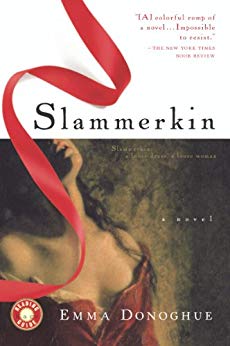
Slammerkin
A slammerkin is a loose dress, and also a loose woman. Emma Donoghue, author of Room, based this book on the true story of a girl who was executed in 1763 for murdering her mistress, and who apparently did it from a longing for ‘fine clothes’. While this wasn’t exactly a pleasant read, it was always an interesting one.
In the mid-1700s, Mary Saunders lives with her mother and stepfather in a cellar in London. Mary is quick-witted and attractive, plus she’s been educated to the point where she can read and figure. But she never fits in. She straggles like a loose thread in the tapestry of her blended family, she dreams of pretty clothes far out of her reach as one of the working class, and at fourteen, she refuses to either become apprenticed to a seamstress like her mother, or to go into service. An argument over this – what other choices do girls have? – leads to her running into the street at night. She sees a ribbon-peddler and asks how much a red ribbon costs.
The peddler demands a kiss, and takes far more. Months later, when Mary’s pregnancy is discovered, her mother throws her out and makes it clear she’s dead to them. A group of soldiers find her, but after they’re done with her, someone finally offers help. Her savior is Doll Higgins, a prostitute who tells Mary that she doesn’t have too many options other than selling it, especially if she needs to pay for an abortion. Besides, the soldiers have infected Mary with the clap, so the baby would be born diseased anyway.
This is only the start of a journey that ends on a scaffold, and since the book begins with Mary in prison, waiting for her execution, it’s clear where she’s heading. But at the same time I couldn’t look away. For one thing, Mary has all the resilience of youth. She takes pleasure in what she can – the colorful dresses she buys with her earnings, visiting Vauxhall with her new friend Doll, and watching a public execution with an excited crowd.
For another, the book is rich in period detail, and Emma Donoghue’s writing is beautifully evocative. And finally, it’s clear that Mary does have chances to save herself. Her talent with a needle doesn’t go unnoticed in London, and later she leaves for Monmouth, where she becomes apprenticed to a dressmaker called Jane Jones who grows to think of Mary as a daughter. But there are two things from which Mary can never escape – her past as a prostitute and her dreams of a future where she’ll live a life of ease and wear the beautiful clothes she makes. Towards the end, I was anxiously turning pages, wondering how the tragedy would unfold, and what would catalyze Mary’s final action.
The characters are all flawed. Mary, despite being sinned against, has a streak of self-destructiveness. And while I sympathize with wanting more than what you’re told is your lot in life, I couldn’t see how she hoped to gain luxuries other than through continued prostitution, which she’s inured to after a point. She’s simultaneously a teenager and a woman old before her time.
Even Jane Jones, who is often kind to her, causes a cringeworthy moment. Abi, a black maid in service to the Jones family for eight years, is inspired by Mary’s determination to earn and keep her own money. So Abi approaches Jane Jones and asks if she can be paid for her work.
Jane is bewildered. Why would you want money, Abi? What do you possibly need that we don’t give you? Abi ends up… well, not exactly happy, but at least she’s no longer working for people who treat her like this. She has a chance for something different, and she takes that chance.
Slammerkin is bluntly realistic about the fact that some intelligent, ambitious girls’ struggles were not rewarded with victory, and most sex workers weren’t Kitty Fisher. People are products of their time, and behave accordingly. It’s bleak and bitter and poignant. I can’t say this book put a smile on my face, but there wasn’t a moment when I wanted to put it down.
Buy it at: Amazon/Apple Books/Barnes & Noble/Kobo
Visit our Amazon Storefront
Recent Comments

It was incredibly sad and compelling. I’d check out another of her books, but I need to be in the right frame of mind for it (braced for grief and despair, I guess).
Frog Music is a little less heartbreaking! No spoilers, but it ends more happily.
Oooh, my second favorite Donoghue book (Frog Music is my absolute favorite)!