
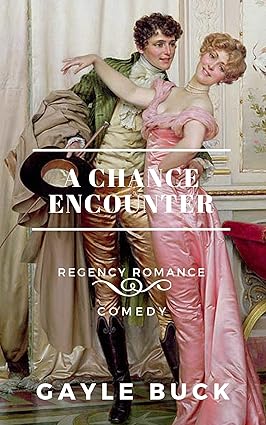
TBR Challenge – A Chance Encounter
This month’s theme – It Came From the 1990s – prompted me to trawl through my collection of nineties Signet Regencies. Gayle Buck’s A Chance Encounter dates from 1991, but unfortunately, it doesn’t hold up as well as some of the other traditional regencies I’ve read dating from that period.
On reaching his majority – and on what he fears is his last day of freedom – Edward Dewesbury, Viscount Humphrey, procures a special license and then goes on a bender and gets massively drunk. He was betrothed at the age of five to the baby daughter of his godparents, the Ratcliffes, but sadly, Augusta has grown up to be a spoiled brat who constantly brags about how she has only to click her fingers and her tame viscount will come running. Humphrey (he’s usually referred to by this name) has no thought of going against his parents wishes, no matter how much he dislikes his bride-to-be, so he’s heading home to fulfil his obligations, his one stipulation that the wedding take place right away – no build up, no big congratulatory parties.
Still three sheets to the wind, he’s driving along a country lane on the way to his house when a moment’s inattention causes him to narrowly avoid running down a pedestrian – who has to jump into a ditch to avoid being knocked over. Humphrey brings his carriage to a halt immediately and goes to apologise, helping the young woman out of the ditch. He takes her up with him and then has the brilliant (he thinks) idea of carrying her off to Gretna Green to get married. After all, if he’s already married, he can’t marry the awful Augusta, can he?
Vicar’s daughter Joan Chadwick is not at all pleased at this suggestion and does her best to persuade Lord Humphrey of the ridiculousness of his plan. He’s still set on the idea and refuses to let her down until they reach the inn where he’d planned to stop for the night – but as he sobers up, he realises what he’s done by insisting Joan remain with him and what trouble it could cause for her. There’s only one thing an honourable man can do. That it still means he won’t have to marry Augusta is a definite plus – and he has a special license in his pocket so they can tie the knot immediately.
The book gets off to a decent – if predictable – start and the two leads are likeable, despite Humphrey’s drunken high-handedness and refusal to let Joan leave. They spend a few hours getting to know each other a little, and there’s clearly a spark of attraction there, although it doesn’t really get the chance to become much more. Joan is a sensible, good-hearted young woman who is down-on-her-luck; her father died eight months earlier, and although he was respected and well-liked in their village and Joan had hoped this would translate into one of the parishoners offering her a home, that did not transpire. Feeling uncomfortable remaining there as a constant reproof to her father’s flock, Joan went to stay with family friends while she looked for paid employment, even though she knows she is not well suited to be a companion or governess. Being offered a completely different life from the one she’d expected comes as a shock, of course, and she knows she should refuse the viscount’s more considered proposal of marriage. Yet life as the wife of a wealthy nobleman is a far more tempting prospect than the life of drudgery before her – and marriage is infinitely preferable to having to endure the shame of the scandal that will attach to her name after she has spent so long in the company of a single man. Joan accepts Humphrey’s proposal and they are married straight away.
After the brief ceremony, Humphrey realises that he can’t just present his marriage as a fait accompli to his parents, and that Joan needs a little time to accustom herself to her new circumstances, so he decides to take her to his grandmother’s for a short visit.
Lady Cassandra is one of those formidable grande dames so often encountered in historical romance – the older woman who has been there, done that, and who doesn’t give a stuff for convention or what anybody thinks of her. She suggests that Humphrey and Joan should delay giving news of their marriage and instead say they are betrothed as a way of easing Humphrey’s parents into accepting that he will not be marrying Augusta. Joan, in particular, doesn’t like the idea of lying, but they both agree to go along with it. As it turns out, Joan’s reception is even worse than she – and Humphrey – had anticipated, and she’s made to feel very unwelcome when they arrive at the Dewesbury estate. Humphrey does his best to protect her from the worst of it, but his parents behave like spoiled brats – his father flounces off to shoot whatever he can on the estate and his mother is very frosty; she does come around fairly soon, but only because she jumps to the wrong conclusions about Joan. Lady Ratcliffe is a snooty cow, Augusta is the same and Lady Cassandra is later revealed to have engineered the whole situation for her own amusement. The best of them is Lord Ratcliffe, whose quiet understanding and dry humour help to balance out the childishness of the other supposed adults.
My biggest problem with the book is that there’s hardly any romance in it. The portion of the novel that takes place at the Dewesbury home is by far the largest (probably three-quarters), but Joan and Humphrey spend hardly any time together so they don’t get to build on the getting-to-know-you phase they’d begun the night they met. From that first twenty percent or so, they seem well-suited – Humphrey is a decent chap and Joan has a backbone and a good sense of humour – but while there are a couple of nice moments where a casual touch engenders a frisson of attraction, there’s no real chemistry between the pair so the romance is perfunctory at best. And at times – this is a criticism I’ve levelled before at older romances – Humphrey feels more like a secondary character than a romantic hero.
Perhaps A Chance Encounter might have worked better for me had I realised it was more a comedy of manners than a romance (although even that’s stretching it a bit), but as a romance it was disappointing.
Recent Comments



Mary Balogh has a book called A CHANCE ENCOUNTER from 1985, a very different book than the Buck. It’s one that I think has held up pretty well.
If Humphrey has just turned 21 and he’s been betrothed to Augusta since he was 5 and she was an infant, how old is she now – 16? 17? No excuse for being a spoiled brat, but somewhat understandable as she is so very, very young. Must admit, however, that Humphrey’s logic about wanting the wedding to take place ASAP even though he doesn’t want to get married and he doesn’t like Augusta totally mystifies me.
I don’t have that Balogh and I’ve already read the 90s published books by her that I own, so they weren’t eligible for the challenge.
I think his reasoning was – I’m going to have to go through with it because they’re my parents and I can’t let them down, but I’m buggered if I’m going to go through all the wedding preparations and be ‘on show’ for the whole day while my bride leads me around by the nose.
I think I read most of the Signet Regencies back in the day, and I vaguely remember this story. There were several other books that had a similar set up… Drunk Lord avoids marriage to unwanted fiancée by marrying someone else on a whim. Not my favorite trope. Gayle Buck was an okay author and there were a couple of her books I did enjoy, but I don’t think this was one of them. Thanks for the trip down memory lane.
I read a couple of other books by her that I quite liked, too, so I hoped I’d like this one. Alas…