
TBR Challenge: The Curtain Rises
When you’re as old as I am, a prompt like “back in my day” isn’t as easy to fulfil as it might seem. Yes, it offers a lot of scope, but that scope also makes it difficult to choose a book to fit, and for the same reason – too many “my day”s over too many decades! After a lot of thought and much too-ing and fro-ing through my Kindle library, I decided to return to the Warrender Saga by Mary Burchell – a thirteen-book series set in the world of classical music written in the 1960s and 1970s. Classical music is probably my first love (I discovered Beethoven long before I discovered romance novels!), and Ms. Burchell’s way of writing about the world of music and musicians resonates very strongly with me.
The daughter of a country doctor, Nicola Denby moved to London to work as a secretary, where she met and fell in love with Brian Coverdale, a hugely talented viola player poised on the brink of a career as a soloist. They’ve been seeing each other for a few months when they agree to talk about planning a future together when Brian returns from the Canadian tour he’s about to embark upon. Sadly, that never happens because Brian doesn’t return. He’s taken seriously ill and dies while in Canada.
The Curtain Rises (book four in the series) returns readers to the operatic world as a grieving Nicola takes up a position as personal secretary to her aunt-by-marriage, Gina Torelli, one of the world’s foremost operatic sopranos. La Torelli has been living abroad for the past few years and is about to make a much-heralded return to the London concert stage and to Covent Garden. With her Festival Hall concert fast approaching, she is having a hissy fit about the fact that her favourite conductor, Oscar Warrender, is not going to be conducting for her because he has another engagement. Her agent informs her that instead, the orchestra will be in the capable hands of Julian Evers, a rising star of whom Warrender speaks highly and who, it turns out, was the conductor of the orchestra Brian had been touring with. Her aunt is not happy, and when she meets Evers for the first time, she tries to lord it over him, but Nicola quickly sees that behind Evers’ quiet and charming manner lies a backbone of steel. Nicola likes him immediately; he’s well able to deal with her aunt’s fits of diva-ish behaviour and is clearly a very hard-working and talented musician. As Nicola is showing Julian out at the end of the meeting, he mentions to her that although they’ve never met, he knows her face; she must be the girl in the photograph Brian had shown him and had spoken of so often. Eager to hear something – anything – of the man she’d loved who had died so far away, Nicola asks Julian if he’d be willing to talk to her about Brian; he agrees and they arrange to meet for dinner that evening.
Julian clearly thought highly of Brian’s musical talent and it comforts Nicola to hear it, but then they move on to other subjects and Nicola is a little surprised to find herself enjoying Julian’s company a great deal. But the next day, a devastating comment from her aunt to the effect that Julian was responsible for Brian’s death changes everything.
The story is that Brian was unwell, but that Julian didn’t care and pushed him so hard into performing that he inadvertantly caused Brian’s death from pneumonia. Nicola makes sure that Julian knows that she knows the truth and makes a point of reminding him of what he did at every available opportunity. I will admit that she sometimes seems overly cruel – especially as the author makes it very clear that Julian is carrying a lot of guilt over what happened and that he is genuinely smitten with Nicola – and that her resentment and insistence on blaming Julian is perhaps a little melodramatic.
But its also clear that Nicola is as attracted to Julian as strongly as he is to her, and that she is struggling with guilt because of it. She is essentially fighting her growing feelings for a man who has treated her with nothing but kindness and affection by trying to actively hate him for something her rational mind knows wasn’t something he could have had any control over.
As in the other books in this series (and as in so many of the romances written in the sixties and seventies), the story is told only from the heroine’s perspective, so the hero can seem like a secondary character. Yet for all that, Julian is likeable and sympathetic – the first beta hero of the series – and he willingly puts up with a lot for Nicola’s sake, prepared to endure her dislike if it means she will not be hurt further. And Nicola is flawed but emotionally believable as her feelings for Julian see-saw back and forth until she can no longer avoid facing the truth of them. I loved the moment when she finally admits to herself that she loves him – the way it’s tied into her seeing Julian as both a man and an artist is masterful:
As she watched that thin, sensitive, intensely lively face in the light from the conductor’s desk it seemed to Nicola that she was seeing him fully for the first time. Here was the artist as well as the man, not only directing a great work, but living it and loving it as though he and it were a part of each other.
I have to say, though, that the real highlight of The Curtain Rises is the character of Gina Torelli, who is so brilliantly written that she simply leaps off the page. She’s everything you’d expect a diva to be – arrogant, temperamental, vain and self-absorbed – but she’s also kind, funny, generous, sharply intelligent, self-aware – and totally unique. Operatic divas are so often written as one-note characters, dramatic, selfish and cruel, but Torelli is fully three-dimensional and very real. I understand she makes guest appearances in some of the other books in the series, so I’ll definitely be on the look-out for those!
Once again, Mary Burchell’s love for and understanding of music and musicians – and opera especially – absolutely shines through in this story and is one of the things that keeps me coming back to these books. I’ve yet to find another author who writes about classical music with the same amount of love and knowledge.
The Curtain Rises was a quick but enjoyable read, and while the romance is tame by today’s standards, the strength of the characterisation and the skill with which the author depicts the heroine’s emotional conflict and emotional honesty makes it well worth reading.
Note: I’ve categorised this as an historical romance, even though it would have been a contemporary when it was first published, because calling it a contemporary just doesn’t feel like a good fit.
Recent Comments




My daughter trained in classical music—so this is on my TBR!
Me, too, and I worked in the music business for a number of years. This series is worth checking out for the classical musicians among us – Burchell writes about it better than anyone else I’ve read.
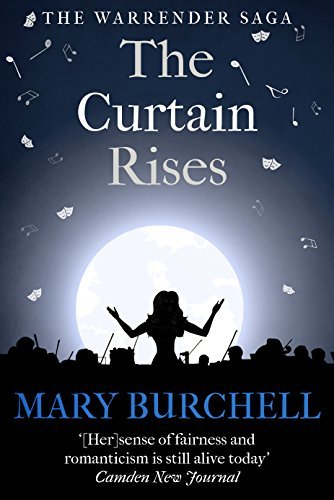
The cover is misleading, isn’t it—a woman conducting the orchestra?
I thought that at first glance, but I think it’s meant to be Torelli lifting her arms triumphantly at the end of an aria :)
But the singer would not be facing the orchestra. She would be facing the audience. If you look the shape of the raised arms and hands, her back is to the audience. Anyway, since she is not the lead character, why is she on the cover? Somebody has not been paying attention. Well, the book is priced at $1.50. I should not complain.
How can you tell she’s not facing the audience? And she’s not holding a baton, which was what clued me in! I believe Torelli appears in several other books in the series and is obviously a popular character – and I imagine whoever designed it had to find a way to make the cover look “musical” and keep a female on the cover in line with the other books – Nicola is a secretary so I don’t think an image of her sitting in front of her typewriter would have worked ;)
Honestly, it’s not one of the most mis-matched covers I’ve seen!
We could write books about books with mismatched covers! They’ve gotten better, but an entire section could be devoted to that era of serious novels with cartoon covers. Not romance, but my personal worst offender was a science fiction novel with no female characters, where on the cover a woman in a steel bikini was running away from a reptilian creature. No reptilian characters in the book either, sigh.
I would say the cover is misleading. The designer thinks of meanwhile many female conductors. When the book was written there were none.
The old cover simply shows a man behind a woman holdig flowers. Very neutral.