
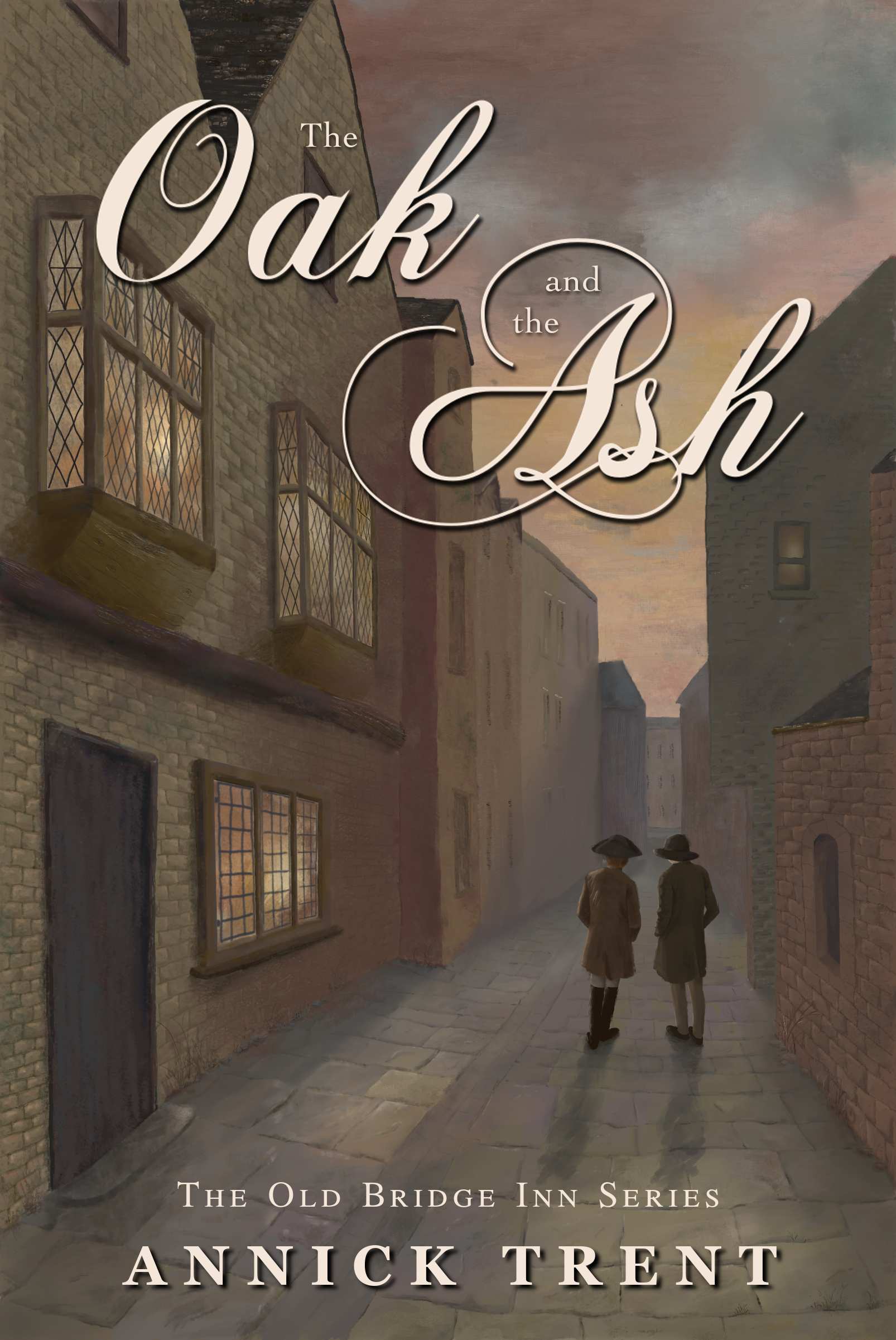
TBR Challenge – The Oak and the Ash
The prompt New Year, Who Dis? kicks off the 2025 TBR Challenge, so I chose to read a book by a new-to-me author. The Oak and the Ash is the third book in Annick Trent’s The Old Bridge Inn series, but there are no overarching plotlines so each of the books in the series stands alone. It’s that rare historical romance in which neither lead is an aristocrat, and it’s set in the late Georgian era, which is also something of a rarity in historicals. It’s a lovely, quiet read that takes the time to explore how a relationship between two working class men of this period could actually work, and it features some insightful social commentary, especially around the new laws designed to repress the growing enthusiasm for radical change in Britain that were enacted in the wake of the revolution across the Channel.
Surgeon-apothecary George Evans is on his way back to London (from Dorset) and has stopped to spend the night at an inn, when the quiet evening he anticipates is interrupted by a dark-haired, smartly-dressed man asking George to accompany him to nearby Dunstan Lodge to attend his employer, the Earl of Warbury. Weary from a long day of travelling, George will be damned if he’ll go out of his way to bandage some gentleman’s bruised finger or provide a remedy for his indigestion, but then the man – Mr. Moorecott – quietly reveals that there are actually two patients, both with gunshot wounds. George quickly bundles the necessary equipment and supplies into his bag, and the two men depart in haste.
Arrived at the small hunting box, George discovers that the earl’s opponent, Mr. Thurlow, is in a bad way and that getting out the bullet lodged in Thurlow’s stomach is a matter of urgency. While the quietly competent Moorecott arranges somewhere for George to operate, George quickly attends the earl, who has suffered a graze to the upper arm. With Moorecott’s help, George extracts the bullet and cloth fragments from Thurlow, and George can’t help but be impressed by the other man’s calm and steady demeanour.
With the combatants out of danger, Moorecott offers George a bed for what’s left of the night, and goes to watch over Thurlow.
George ends up staying at the Lodge for a few weeks, where he and Moorecott – Noah – strike up an easy friendship, spending quiet but companionable evenings together talking and reading together. But this comes to an abrupt end when Thurlow insists on returning to his home in London. As that is where George is bound eventually, it makes sense for him to accompany Thurlow and his son, and it’s with regret that both men realise this is the end of their time out of time together. There’s a real sense of simmering attraction beneath their friendship and of a longing for something more, but Noah knows that, once back in London, he will have little time to pursue a friendship with George. Still, he seeks George out anyway and the two of them find reasons to continue to see each other.
George and Noah are thoroughly likeable, decent men, and I appreciated that they are both confident and assured in their abilities and in themselves. I enjoyed the slow-build friendship-to-romance between them, but a relationship is not an easy thing between working people of this era; not just because George and Noah are both men, but because Noah’s position as valet to a nobleman means he’s at his employer’s beck and call. One of the things the author does so well here is to convey exactly how little time a servant – even an ‘upper’ servant like Noah – had to themselves and the extent to which Noah’s life is not his own. He and George have to snatch what time they can to be together and make the most of every moment.
The tender romance is set against an interesting background of the scientific exploration and social unrest prevalent at the time. Noah is a keen amateur meteorologist (the author has clearly done their homework on this, but there’s a bit too much weather-geekery in the book!) while George writes and edits pieces for radical newspapers and pamphlets – or used to until his main outlet, The Southwark Reporter, shut up shop owing to the threat of the severe penalties being meted out for those running such operations. Places such as reading clubs, worker’s libraries and improvement societies, all of them designed to foster education among the working class, are losing members who fear being caught up in accusations of sedition, and many of those that continue to operate have had to enforce strict rules forbidding all political discussion in the face of increasingly restrictive laws against “disloyal assembly”. It’s all integrated into the story extremely well, and so is the thoughtful portrayal of queerness among the lower classes.
For around two-thirds of the book, the story is a quiet slice-of-life affair, with ordinary people going about their ordinary business – until the other shoe drops and puts George in a situation that could cost him his livelihood and reputation – even his life. It’s something of an abrupt turn, but it’s a good contrast to the earlier part of the story and thoroughly brings home the reality of the systemic inequality of the time and how helpless the ‘common’ folk were against the rich and powerful. But the ending is very satisfying, and the background is interesting and clearly well-researched, which is something I always enjoy in an historical romance. I can’t deny I’d have liked a little less detail about the meteorological experiments (I admit I glazed over once or twice) but I enjoyed The Oak and the Ash and will look for more from this author.
Recent Comments


Just finished reading it. A good working class m/m romance with the aristocracy on the periphery and the class conflict is realistic and well done. I like radical politics and science geekery and I probably would have given it a B+.
I’m glad you liked it. I loved the politics, but could have done with a bit less weather geekery, hence the B :)
I read Book 2, Beck and Call which is actually set before the events in Book 1. This too is about the “downstairs” people, the valets and maids to the lords and the ladies. Rather a slow moving novel without much dramatic tension.
To my big surprise I found it on Hoopla. I am reading it now. The cover is nice—very atmospheric.
I saw this on your GR list and was hoping there’d be a review here soon. I could use a nice historical for a change, so I’m putting this on my TBR list! Thanks for the review.
I think you’ll enjoy this. I haven’t read the other books in the trilogy (book 2 is f/f), but this works fine on its own.