
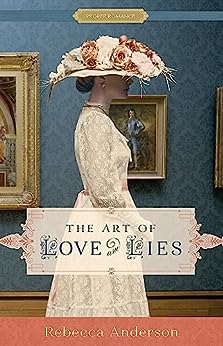
The Art of Love and Lies
The Art of Love And Lies is a genteel, well-researched novel about art forgery and true love, and all of it’s based around a real-life incident of art fraud. The end result is lovely romance, but some research issues kept it from getting a higher grade.
Rosanna Hawkins has a unique job – she painstakingly reproduces famous works of art as parlor replicas which hang in the homes of the average citizen. Her boss does not respect her, though she is the daughter of a gentleman, and does not treat her art as anything but fungible. As part of her job and at the insistence of her boss, Anton Greystone, Rosanna attends a large art showing in Manchester, trying to scout Michelangelo’s The Manchester Madonna, which she plans to replicate next. Romance unexpectedly arrives in the form of the exhibit’s head of security, Inspector Martin Harrison.
But criminality may threaten to ruin their romance; someone is stealing art from the exhibition and planting evidence there that implicates Rosanna. Determined to clear her name, Rosanna and Harrison team up to find out who the real culprit is before a priceless masterpiece is stolen forever.
The Art of Love and Lies knows its art forgery history, and does a good job when it steers into a version of the genuine heist which occurred at the very art expo Rosanna attends. But some historical wobbles popped out as quite noticeable to me.
To wit: Rosanna and her sisters are the daughter of a gentleman and are Landed Gentry. And yet their father encourages them to work instead of marrying and has no problem with Rosanna living in a boarding house.
Rosanna is a smart if slightly snobbish heroine, and I liked Harrison just fine. Their romance is very sweet and well-handled, although th mystery is initially not really mysterious, and leans heavily on their missing obvious context clues. There is an eventual plot twist, though, that makes up for this.
I do, however, have to protest that while it’s perfectly possible for Rosanna to be skilled enough to make several copies of famous paintings in quick succession, the paint on her canvas wouldn’t instantaneously dry, especially without proper curing or glazing.
And yet The Art of Love and Lies is a perfectly nice book that’s good enough for an evening’s diversion.
Recent Comments



I’ve seen many reviews saying the same thing! I guess just needs one to suspend their belief….a lot :)
Yeah, that’s about the only thing you can do with this one!
I am being contrarian here: Jo March in Little Women (which is set in the 1860s)goes to NY by herself and lives in a boarding house to pursue a writing career. She approaches editors/publishers independently to get her work published. Jo’s mother comes from an influential family and parents are supportive of her ambitions.
So, why can we cannot imagine a similar set up for the heroine of this book? Her family is affluent but we do not know how her father made his money. We do not know to which rung of the social hierarchy he belonged. While English aristocratic values were rigid, women in the 19th century rising middle class were allowed to professionally pursue creative work.
For me, what required suspension of disbelief in the story is the heroine’s confidence that she will make a good living, good money as an independent artist. She is an anonymous artist and a young up and coming one at that. I am an artist myself and I know how art economy operated then and continues to operate now. For every Picasso, there were many male and female artists who toiled in obscurity and lived an economically precarious existence. Conveniently for our heroine, suddenly there is a royal request for a portraiture!
LMA also based Jo’s experiences on her own, but we have to suppose Rosanna is of the genteel middle class to make this work, and the book never specifies anything about her social standing – which is another strike against it.
You bring up some fair points – and it’s even worse because she’s literally just copying art so far, though she’s doing it very well.
To my surprise, I found this book on Hoopla and I am reading it now. The story is set in 1857. Lisa is right—the parents want their daughters to work even though her father does not even know what exactly she does. It is bit of a stretch and too progressive for that period.
Oops, saw this comment last, sorry!
Rosanna’s father and mother are INCREDIBLY incurious and absolutely do not show proper Victorian parent hypervigilance. They’re OK with the boardinghouse nonsense and basically shrug and go “oh yay, you’re painting!” without realizing what she’s doing for money. The art history part is great, everything else is eh.
Not having read the book, I cannot tell which historic period the novel is set in. It the story took place in late Victorian period, it was possible for a daughter of a landed gentry (especially if the family is impoverished as many were with the fall in agricultural prices) to work and also live in a respectable boarding house. If the story took place in the early 19th century, such a scenario was unlikely.
As for drying time for an oil painting, not having read the book I don’t know how quickly the paintings dried. But drying time is much dependent on the kind of surface and oil used. If the painting was done on an unprimed oil paper with linseed oil as the medium, it would dry very quickly within a few hours.
It’s 1880s I think. But I don’t get the impression that the family was impoverished from reading the review – maybe Lisa can confirm.
It takes place in 1857, actually. The family wasn’t impoverished as far as I can remember.
Answered your question below: it takes place in 1857, so earl mid- Victorian period if anything.
She’s definitely not painting on paper: she’s oil painting on replica canvases, which ae swapped out for other canvases.
* Early mid-Victorian.
This is a LOVELY cover.
It truly is!