
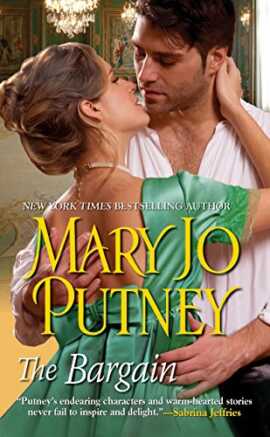
The Bargain
First published in 1989 as a Regency, this rewrite of The Would-Be Widow brings us the story of a beautiful and wealthy young woman who weds a dying soldier in order to secure her inheritance. This is an intriguing premise for a love story, especially since the man in question suddenly makes a complete recovery and decides his new wife will suit him just fine – if he can only convince her they are made for each other.
Lady Jocelyn Kendal must marry by her twenty-fifth birthday or lose almost everything to a haughty, somewhat despised aunt. But Jocelyn is nothing if not picky and, although she’s had nearly four years to make her choice, only one man has come up to scratch – a handsome duke who would enjoy a discreet affair, but not a marriage. Still, Jocelyn holds out hope that she can change his mind.
Major David Lancaster is indeed dying. Having taken severe wounds at Waterloo, he is bedridden, a slave to the opium-based laudenum that keeps the awful pain at bay. His main concern is not with dying, but with his younger sister, a governess, who may or may not have a secure future after he’s gone.
Through a common friend, Jocelyn and David meet and decide it would be mutually beneficial to marry – the conditions of Jocelyn’s father’s will can be met, and David’s sister, Sally, will be taken care of with a generous amount settled on her by Jocelyn.
However, through the efforts of Ian Kinlock, a dedicated (and sexy) Scottish surgeon, David miraculously recovers, leaving Jocelyn not with widowhood, but with a live husband and a now-fading chance at happiness with her longed-for duke.
If The Bargain were a fabric, it would be soft, smooth, and flawlessly woven. If it were a sculpture, it would be curved, rounded, with no sharp edges or unsightly protrusions. David and Jocelyn like and respect each other immediately and their affection and mutual admiration continues to grow throughout the book. Their dilemma of whether or not to stay married rings true as both David and Jocelyn confront their individual demons and it is not until Jocelyn comes to terms with her sad and confused childhood that she realizes where her own subconscious motivations have brought her – and what they have nearly cost her.
Ian and Sally, as well as other characters who appear in many of Ms. Putney’s other books, are completely drawn and likable. I am a huge Mary Jo Putney fan and am in complete and total awe of her writing abilities and the emotions her words can generate in me. This author is one of the best the romance genre has to offer; I’ll read anything she writes with enthusiasm and high expectations. Having said that, while The Bargain is a good book and I enjoyed it very much, it is neither as as compelling a read as The Rake nor as The Wild Child, two marvelous keepers. Still, I liked the characters in The Bargain and couldn’t help but smile at the sweetness shining through from both Jocelyn and David. If I met a man such as David in real life, there is no way I would ever give him up.
Please give this book a try. I cried some and smiled some, and I’ll bargain you will, too.
Recent Comments

Am slowly making my way through several of this author’s work and have to say this was my favorite back in the day when I first read it; and I think it remains my favorite. It contains relatively little of the melodrama in so many other Putney works, and the secondary romance between Lancaster’s sister Sally and the doctor who saves his life (Ian Kinlock) is pretty much perfect.
Is it truly a subtle rating?
I’ll have to go back and look LOL!
No, it’s a warm rating. There are several instances of specific details, including two on-page instances of sex. None of it happens until the very end of the book but it’s there.
I wondered. Thanks!
Thanks for the reminder! This one and Rake were favorites for character development of a both man and woman, fully integrated in the love story, and the obstacles on their way to happiness were really convincing to me and convincingly overcome. ( her book that is perfect for me is Petals in the Storm. )
Very many of her books were enjoyable at the time, but had a bit too much drama, or too easy solutions for too heavy problems, so they suffered on reread.