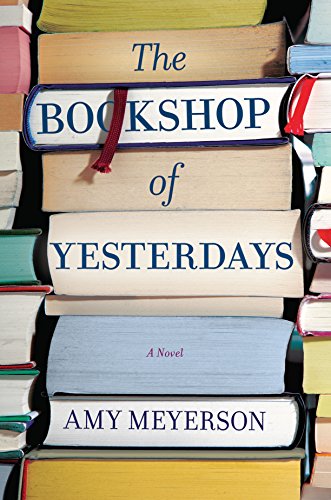
The Bookshop of Yesterdays
Amy Meyerson’s The Bookshop of Yesterdays is a melancholy and tender cozy mystery in which the author gives us a fun, twisty story to follow – which ultimately sinks under the weight of its own implausibility.
Miranda Brooks has long lived in the shadow of her beloved Uncle Billy Silver’s eccentric charm. He was the kind of guy who would give her a puppy without consulting her parents first – and have her go on a scavenger hunt to get it. His largesse, combined with his irresponsibility and spontaneity especially frustrates his sister – Miranda’s mother Susan. Billy and Susan have a falling out on Miranda’s twelfth birthday which results in a permanent estrangement between Billy and the rest of the family. When he neglects to pick up any of Miranda’s messages and doesn’t appear at Prospero Books, the bookshop he owned, Prospero Books, Miranda pushes him from her mind and the family continues to go on without him.
Miranda doesn’t hear about or from Billy again for sixteen years. By then she’s established herself as an eighth grade history teacher in Philadelphia, where she lives with her boyfriend, the personable and somewhat frat-boyish gym teacher Jay, and hangs out with her lifelong best friend, Joanie, whose developing career as an actress also threatens to pull the two of them apart. Miranda feels unable to connect with her new students after a career of substituting and worries she’s a bad teacher, and wonders if Jay is the right man for her even as they try to make a life together. In the middle of a booze and pot soaked moving-in party, her mother calls – Billy has passed away, and Miranda’s life is about to change.
Miranda travels back to California to settle and claim her inheritance. She learns that Billy has left her two things in his will; a riddle – the first of many – in the form of a copy of Jane Eyre, and his stake in Prospero Books. Teacher Miranda has no idea how she’ll manage a business, let alone what Billy means in giving her the book, but holding the key to the shop she can’t resist checking it out.
She soon discovers that the place has seen better days. It’s teetering on the brink of bankruptcy and burdened by both the downturning market and the low profit of used book sales, not to mention the complicated system that Billy established to keep things afloat. Trained by Billy’s high-handed, book-loving, neurotic and jaded manager, Malcolm, to understand it all, she moves into Billy’s apartment and begins to become a part of the bohemian life that Billy once lived.
As Miranda spends the summer trying to lead the store to solvency, the clues begin to mount at her feet. Ultimately torn between moving back to California and striking something up with Malcolm or going back to teaching and Jay in the fall, Miranda begins to fall in love with Prospero as much as her Uncle did. Learning about the other love of Billy’s life, Evelyn, her long-dead aunt, is just the tip of the iceberg. As Miranda begins to meet more and more of the people who were important in Billy’s life she comes closer to understanding what drove him – and closer to understanding the argument that tore Susan and Billy apart so many years earlier.
If you love metafiction at all, then you’re bound to love The Bookshop of Yesterdays. Shaded with notes of Shakespeare’s The Tempest (any fan of the play will likely notice the parallels from this brief description), it takes the reader through a twisty trip through literary quotes and motifs like a kitchen sink Thursday Next. Meyerson accurately captures what it’s like to run a small-town bookstore slowly being eclipsed by a world of e-literature; you can smell the dust on the shelves and feel the crackling leather of the hardback volumes in your hands. The frustrated relationships Miranda maintains with her mother and father feel very true to life, and there is an excellent third act twist that’s largely unpredictable.
Miranda and Billy are both compelling in different ways, even with their flaws, as is Susan; but most of the minor characters don’t get a lot in the way of deep development. Even Malcolm, who is as important to the story of Prospero Books as Miranda, doesn’t feel like a fully fleshed out character but a series of clichéd stereotypes.
But the flawed realism of the characters is set against a plot that’s so implausible that it feels like it was draw up by a room filled with screenwriters. Which brings me to my main gripe – the ideas that underpin the book are super preposterous. Loving The Bookshop of Yesterdays will require turning off your brain a bit.
If you think too much, you’ll start wondering how Billy did what he did with the kind of illness he had; why he counted on certain books staying where they were in the shop when he died when it was quite likely that they might have been sold or removed during the course of his absence and death; even why he felt the need to hide behind his inscrutable riddles to the end when being direct with Miranda might have improved matters. Would you set up a scavenger hunt for a once-beloved niece whom you also never felt the need to speak to for sixteen years even when you were dying?
The author thinks Billy’s intense emotional rebellion and deep grief for his One True Love is compelling and charming, when sometimes it’s quite repellent. The narrative infantilizes him for it, and a third act reveal only reinforces the fact that his lack of clarity has unnecessarily complicated numerous lives. The number of characters who have to lie to our heroine so that Billy can preserve his self-aggrandizing manpain-filled last wish is very high.
There is also, sadly, the slightest hint of intellectual snobbery here that ensures the conclusion to the Malcolm/Miranda/Jay triangle is painfully telegraphed, and so is Miranda’s eventual choice between California and Pennsylvania.
The good parts of The Bookshop of Yesterdays are very good, but you will have to swim through the twee and the bad parts to get there. If you think the destination’s worth the journey, then more power to you.
Buy it at: Amazon/Barnes & Noble/iBooks/Kobo
Recent Comments