
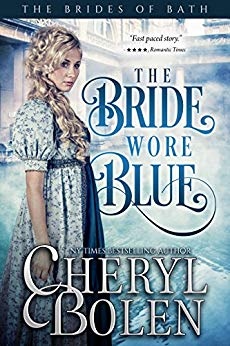
The Bride Wore Blue
Originally published in 2002, The Bride Wore Blue is the first in Cheryl Bolen’s Brides of Bath series, and while the rest of the books could only improve from here, I won’t be checking them out. This was a tepid story with a helpless heroine and some irritating moments to break up the boredom.
In the prologue, Felicity, the sister of a viscount, is traveling to meet the man she is to marry. Then the coachman sees a man lying in the road, and after Felicity insists they stop to help, they find the man has been beaten and robbed by highwaymen. Felicity takes the man into the carriage and tears up her petticoat for bandages.
On the basis of this, the man, Thomas Moreland, falls in love with her; he “worshipped the very earth she trod”, we are told. Once he recovers, Thomas goes to India, makes a fortune in trade and returns to England. In Bath, he sees Felicity again, except now she’s been in widow’s black for four years. Nevertheless, she’s still young and beautiful, and Thomas is determined to win her hand, except she’s one of the ton and he’s a Cit. So he pays her brother’s gambling debts, then tells Felicity about it and asks that, in return, she sponsor his sister into society. She doesn’t recognize him as the man she saved and he doesn’t tell her anything about that.
It makes no sense to me that he’d keep this a secret, but if he didn’t, there would be no Big Misunderstanding later. Thomas is rich, handsome, and kind to everyone. He even becomes the secret benefactor of an Adorable Urchin called Jamie who can’t walk properly.
Thomas remembered the ill-formed bones of young sailors he had observed as a younger man. Was not the disease of rickets associated with lack of sunshine and lack of the sunshine fruits? “Tell me, Jamie, do you like oranges?”
No, rickets can’t be cured with Vitamin C! It’s one thing to have fat-shaming, women who shriek their dialogue, a one-dimensionally eeevil villain, and a lot of ‘tis, ‘twas and methinks (all of which are in this story). But there is no excuse at all for making such a basic mistake. The difference between rickets and scurvy is not a matter of opinion, and could have been ascertained from ten seconds on the Internet.
But back to the characters. Felicity is one of the weakest heroines I’ve ever read about. Firstly, she’s slow on the uptake. The moment her vivacious younger sister claims to be sick with a headache that keeps her from attending a ball, I knew the sister would sneak out, but Felicity doesn’t twig to this until she finds the sister’s empty bed. So she sends for Thomas, bursts into tears and throws herself into his arms. That’s not the only time she dissolves into sobs, either.
Then Thomas is assaulted by some random mugger, who steps on stage for the sole purpose of making Felicity remember saving Thomas, and then departs with his author-given job done. Felicity looks at the blood and faints. Finally, towards the end of the book, she’s stupid enough to go off with the villain and allow him to slip her a roofie, so she has to be saved by Thomas.
That said, I liked the fact that she was loyal to her husband’s memory, and it felt like a nice change from the usual unhappy first marriage. The story makes it clear that her husband was brave and kind and that she enjoyed being married to him. Then we get to the end, and she tells Thomas “That she loved him like she had never loved Michael.”
Why? I don’t get this. What’s wrong with loving them both equally, unless a woman is only allowed true love and a wonderful relationship with one man? And the story never even shows why her late husband, a captain in the army who was respected by his men and who loved her dearly, didn’t deserve the same depths of emotion that she feels for Thomas. I guess we’re meant to take it for granted that of course she didn’t love him as much, he wasn’t the hero. Perhaps he’s better off dead than in this story, poor guy.
People from other countries are depicted with even less respect. Italians, we are told, smell of garlic (and the sole Italian character, who speaks with a stereotypical accent, is a minor villain). Thomas claims a “Hindi woman” would be murdered by “her own kind” if she lived with an Englishman. He spent years in India but he might as well have been in Manchester for all the difference that makes, though fortunately this means there were no references to the Kama Sutra. Ultimately, The Bride Wore Blue is a dull, annoying read, and the lack of conflict, aside from the villain’s meddling, makes the story so light it’s practically airborne. You’re better off reading something – anything – else.
Buy it at: Amazon/Apple Books/Barnes & Noble/Kobo
Visit our Amazon Storefront
Recent Comments

Citrus juice was first given to all sailors on a British ship is 1794, but it wasn’t until after 1800 that this became general practice.
I don’t mind small historical anachronisms (if the hero is a doctor in 1820 and washes his hands regularly, yay!). But getting facts so completely wrong is a different matter.
The book sounds like one big old ugh. And would regency era medicine have ever caught on to the sunshine/vitamin c cure for scurvy by then? Also no thanks to yet another weak tissue paper heroine.
Thanks for slogging through this one, Ms. Perera. I did some research, and it appears that the publisher Harper & Appleton is Ms. Bolen’s own company. For those who aren’t aware, there’s a misconception that self-published work always appears under the name “Amazon Digital Services” or “independently published.” In fact, anyone who buys an ISBN can give a different name to their self-publishing “company.” Just a fun fact of the day.
The disappointing thing is, the premise of “The Bride Wore Blue” actually sounds interesting. The heroine finds a mugging victim in the middle of the road and tears up her petticoat to bandage him? I’ve read this cliché before, but sign me up! But alas, according to your thorough and thoughtful review, it all goes downhill from there.
In regard to the heroine being a widow with a happy marriage, that’s sad the author had to kind of ruin it by saying she never loved him the way she loves the hero. Ouch to the first guy! Like you said, I think there’s this pressure in romance to only let a heroine truly love one man and one man only in her still young lifetime. Even in the larger world, loving more than one person is often regarded with suspicion. For a real life example, the actress Meryl Streep is somewhat famous for being happily married to the sculptor, Donald Gummer, for decades. But what a lot of people are shocked to learn (myself included!) was that she was once madly in love with the actor John Cazale (Fredo from “The Godfather”), lived with him happily, and was going to marry him- but the poor fellow died from a combination of lung and bone cancer after making only five movies. Some people actually criticized the grieving Ms. Streep for taking up with Mr. Gummer so soon after her first love’s death, but I read she was quite elegant about it. And she made it clear to her soon-to-be husband Donald that she loved him, but she would always love John too. Her second love, in other words, was not a replacement or superior model to her first love. (Indeed, she was at some award ceremony not too long ago where she became teary eyed when Mr. Cazale was mentioned. So the love is still definitely there.)
For a remarried widower handled more respectfully, I recommend “Tempest” by Beverly Jenkins. Sadly, I think romance heroes are often given more leeway to love again than heroines.
“People from other countries are depicted with even less respect.” This was very true in old romance/Gothic/Victorian literature as well.
Ah yes, the Italians. Everyone’s favorite go-to villains, and incidentally, probably one of the few groups left that the PC police don’t mind kicking down. I read a good line about that once, something like: “Italians: just white enough for SJWs to pretend they’re oppressors, just brown enough to kick around without feeling guilty about it.” Just something to think about…
No references to the Kama Sutra? I’m wondering why Ms. Bolen didn’t go for broke. At least we might have gotten some steamy sex scenes out of it.
As someone who has been with the same person for almost 35 years, it is my hope that, were I to die, my spouse would remarry and live in love again. I just say, for the sake of the kids, wait at least a year before bringing a new partner into the fold. #truth
Good advice, Dabney. When I was still living at home in the Middle East, my mother died of cancer. My father was dating again within a month, and within five months he’d remarried. That’s one of the reasons I’m now in Canada.
(Incidentally, in our culture there’s also an expectation that a widow or widower wait a year to show respect to the dead person’s memory, but when people asked my father why he wasn’t waiting, he told them it was God’s will that he remarry..)
I know of three families that happened–all, interestingly enough, when a mom died too young of cancer–and in all, the adult children became estranged from the dad. Children need time to mourn, even when they’re in adults.
Ms. Perera, thank you for sharing your story. Please accept my condolences.
Ms. Grinnan, that’s a good point about adult children needing time to mourn. And a year sounds like a good minimum. But I think it can be a little different when there are no children involved. According to what I read about Meryl Streep, she married Donald Gummer only about six months after her first love’s death, but the circumstances sort of made sense. First, Meryl Streep and John Cazale didn’t have children, so it wasn’t like Ms. Streep had to worry as much about hurting someone’s feelings. Second, and this is an iffy one, but Ms. Streep and Mr. Cazale weren’t actually married. This isn’t to say long-term partnerships can’t be equal to official marriage, but culturally- then and now- a mourning period for a deceased boyfriend/girlfriend probably isn’t expected to last as long as for a spouse. (Not making a judgment here, just an observation.) Third, Mr. Gummer was a good friend of Ms. Streep’s brother, so there was already a connection. It wasn’t like she just took up with a stranger in a whirlwind romance. Fourth, by all accounts, Ms. Streep took amazing care of her first love for a long time while he was so sick. Not that this is an excuse to shorten the mourning period, but it wouldn’t surprise me if they had discussions about the topic of moving on.
Incidentally, I know of a couple without children who both agree they would remarry in a heartbeat because they would get too lonely, and for them, it makes sense. But it doesn’t mean they don’t care about each other. And I know others who are adamant about never remarrying. In short, I think you have to look at things on a case by case basis.
Anyway, it’s an interesting discussion of love, family, politics, and culture. Thanks for your replies!
Totes agree about it’s a different deal if there are no kids.
I was deeply, passionately in love in my early 20s with a man who left me for the woman he then married. I genuinely believed I’d never love anyone that much again. Meeting my husband a couple of years later made me realize that he–my spouse–was a much better partner for me and that I’d likely have been less happy in a marriage with True Love #1. But, I’d never say I’ve only ever had one great love. I’ve profoundly loved three men–my first boyfriend is on this list–and, in some ways, I still do.
“Children need time to mourn, even when they’re in adults.”
Absolutely agree. There is nothing weak or shameful about grief, and children who are coping with this should not be pressured to accept a new person in a parent’s life.
A friend’s mother has a saying, “Men don’t mourn, they replace.”
“In regard to the heroine being a widow with a happy marriage, that’s sad the author had to kind of ruin it by saying she never loved him the way she loves the hero.”
And this was so unnecessary. When I read a romance, I’m prepared to accept that the hero and heroine will love each other by the end of the story. If the author is confident that she has depicted this well, there’s no need to put down another relationship to make this one look good in comparison, any more than the hero needs to tell the heroine she’s different from or better than all the other women he knows (which is meant to be a compliment, but usually comes across as him holding a low opinion of women in general).
“No references to the Kama Sutra? I’m wondering why Ms. Bolen didn’t go for broke.”
I’m grateful for small mercies! Also, thanks for doing the research about the publisher, because I wondered why no one had caught the mistake with rickets. But there probably *was* no one except for the author.
“When I read a romance, I’m prepared to accept that the hero and heroine will love each other by the end of the story.” Absolutely! As I mentioned in my earlier post, I thought Beverly Jenkins’s “Tempest” portrayed a second marriage respectfully. The plot, if I remember correctly, was that a widower in the American West advertised for a mail order bride because he needed a mother for his young daughter. As a doctor, he wasn’t always able to watch her and also thought a woman’s influence would be good for her upbringing. Upon arriving at the scene, the heroine sees the late wife’s portrait in the parlor and actually insists that the hero leave it there. This shocks him, but the heroine says 1) she’s not going to be threatened by a ghost, 2) his first wife must have been a special lady who is deserving of a memorial, and 3) it’s not good for a father to hide his daughter’s mother’s portrait and pretend she didn’t exist just so the second wife won’t feel offended. I may be embellishing this in my mind, but I think that was the gist of it. And I was impressed with how Ms. Jenkins handled this delicate subject.
“Also, thanks for doing the research about the publisher, because I wondered why no one had caught the mistake with rickets.” You are welcome! I am always curious about publishers- traditional, indie, and self-published. When a self-published author creates a name for her company, it can throw readers for a loop. But the whole rickets vs scurvy is one of those things that could be easily researched on Google- no trips to the library required.
““No references to the Kama Sutra?… I’m grateful for small mercies.” Even Wikipedia (not always the most reliable source) says “the Kama Sutra is neither exclusively nor predominantly a sex manual on sex positions,” and yet I have seen a few HR novels reference it as though it is. I can see where the misrepresentation would get annoying. So yay that “The Bride Wore Blue” at least didn’t perpetuate that stereotype?
It can be tough to balance an individual character’s interest in an aspect of foreign culture versus completely steamrolling over it for personal use. And the line between the two can be highly subjective. Yoga, for example, is often seen as mere exercise in the West- divorced from its spiritual origins. Some people find this casual use of yoga deeply offensive. Others shrug it off. On that subject, I’ve never cared for the term “cultural appropriation” as it’s one of those buzzword terms that is often used to bully people with dissenting opinions about the appropriateness of borrowing, altering, expanding upon, appreciating, incorporating, or otherwise using aspects of other cultures- without leaving room for nuance or discussion.
In your opinion, Ms. Perera, would it be automatically wrong for a character in a romance to be inspired by the Kama Sutra? For me, I suppose it depends on how the author presents this interest. (I.e. Is it handled respectfully?) For some, such a reference from a character outside of the culture would be inexcusable. I think this is quite a complex topic that gives writers and readers a lot to think about.
Tempest got an A review, and it looks like that was well-deserved. With your recommendation as well, I look forward to reading it.
“In your opinion, Ms. Perera, would it be automatically wrong for a character in a romance to be inspired by the Kama Sutra?”
I’m not Indian (I’m originally from Sri Lanka), so I can’t really say – and am reluctant to speak about this topic in case it causes another backlash against this site. I do agree that the incorporation of foreign cultures into a story can be very interesting, though, and it’s great that we have so many ways to learn about and appreciate those cultures.
“I can’t really say – and am reluctant to speak about this topic in case it causes another backlash against this site.” Definitely do not blame you here.
“I do agree that the incorporation of foreign cultures into a story can be very interesting, though, and it’s great that we have so many ways to learn about and appreciate those cultures.” And it’s so much easier now than in the past. Historically, information about faraway places was quite limited. People were really excited when Japan, with its isolationist history, became a little less of a mystery. I realize there are a lot of politics to unpack here, and I don’t want to get into it, but circa the early 1900s in the West, Japan was all the rage- complete with expositions and cool imports like beautifully painted fans and paper lanterns. Sure, treating elements of another culture as a “fad” is often regarded as taboo now, but imagine people’s excitement then to have even a limited glimpse into an unfamiliar culture. It must have been awe inspiring in the era before the internet or even widespread cross-cultural communication.
Have fun reading “Tempest!”
I’ve mentioned it before, but the fact that I have a British first name and a Portuguese last name is evidence of incorporating aspects of a foreign culture into one’s own. And I don’t have a drop of British or Portuguese blood. I know this because my uncle traced our family tree back for about twelve generations to check if we had any white ancestors (nope).
(Incidentally, he was very pleased about this. He was much less pleased when I went to university in the States and dated white guys – there went our pristine brownness!)
Of course, for a lot of people it’s different when it’s a Third World country’s people using something from the colonizers, rather than the other way around. So there’s this to take into consideration.