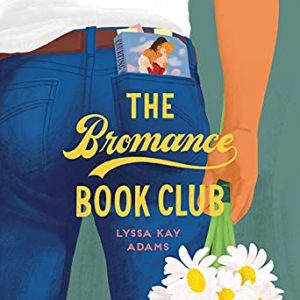
The Bromance Book Club
Narrated by Andrew Eiden and Maxwell
Caulfield
There was quite a bit of pre-publication buzz about The Bromance Book Club, and the synopsis – a guy woos his wife with the help of romance novels – sounded intriguing, but I’d be lying if I didn’t say that what really prompted me to pick it up for review was the name of the main narrator, whose alter-ego is a very well-known, very popular and extremely good narrator of contemporary romances.
Baseball star Gavin Scott has been happily
(as far as he knows) married to Thea for three years. They dated only briefly
before they married after discovering that their twin girls were on the way,
and have settled into their lives as parents and partners, a life in which
Gavin’s job sees him frequently away from home and oblivious to the effect his
absences and the demands his profession make on Thea are having on their
marriage. Things come to a head one night when Gavin learns that Thea has been
faking orgasms for practically the entirety of their marriage; he takes it
really badly and, furious and upset, moves into the guest room before leaving
the house the next day and holing up in a hotel.
It’s here that a group of his friends and
teammates find him, totally shit-faced and full of self-pity, a few days later,
and decide an intervention is in order. It seems that most or all of them have
been in similar situations in the past, and have mended and rekindled their relationships
by using romance novels to help them to better understand the women in their
lives:
“ Romance
novels are … entirely about how want to be treated and what they want
out of life and in a relationship. We read them to be more comfortable expressing
ourselves and to look at things from their perspective.”
Gavin is, of course, very sceptical about
this, but having no better ideas, decides to go along with it. The book chosen
for him – Courting the Countess – is a Regency romance featuring a marriage
in trouble, excerpts of which are dotted throughout the novel and which the
author uses to good effect to illuminate Gavin’s situation. He’s got a lot of
work to do, not least of which is persuading Thea to give him a chance to win
her back and then finding a way to get around her defences so they can
reconnect with each other – and he’s only got a month in which to do it.
The
Bromance Book Club is full of wry humour as the
author plays around with romance tropes, and it’s very meta in places with plenty
of inside jokes. But there are times when that just doesn’t work and the words
coming out of characters’ mouths sound like something out of a lesson on
feminism and gender studies:
“Modern
romance novelists use the patriarchal society of old British aristocracy to
explore the gender-based limitations placed on women today in both the
professional and personal spheres.”
Says one of member of the club. (They’re
all professional athletes, btw.)
“The
backlash against the PSL is a perfect example of how toxic
masculinity permeates even the most mundane things in life. If masses of women
like something, our society automatically begins to mock them. Just like
romance novels. If women like them, they must be a joke, right?”
Says another.
I’m not saying I disagree with either of
those statements. But in context of the novel, they sound like completely
unsubtle tub-thumping on the part of the author and don’t feel true to the
character voices at all.
I really liked Gavin, who is a decent bloke
trying to do the right thing and a wonderful mixture of sweetness and strength.
Thea’s bombshell and subsequent request for a divorce hit him completely out of
the blue, but he’s willing to learn, to really think about what has driven Thea
to the place she’s in and to do whatever he needs to do to make things right.
But I found it hard to warm to Thea, who is, to start with, completely
unwilling to try to find a way to compromise. Regardless of the fact that she
and Gavin had two young children to consider, it’s all about what she wants. I’m not saying that she doesn’t
have a point; she had no real time to come to terms with what her life would be
like as the wife of a professional athlete, she felt ‘unseen’ and that she’d
gradually submerged her personality into the perfect WAG – and there’s no
question that Gavin was oblivious to what was happening – possibly deliberately
ignoring Thea’s unhappiness because he didn’t want to have to deal with it. But
on the other hand, she never broached the subject with him, never gave him an inkling
that all was not well with her, and with the best will in the world none of us
is a mind reader.
But the author does a good job of exploring
the reasons behind Thea’s reluctance to trust Gavin again, and of showing how
they both have issues they need to address individually as well as as a couple
if they’re going to repair their marriage and move forward together.
And… this may be a small thing but it
bugged me because it’s the basis for the whole book; we’re told that Gavin
realises Thea has been faking it in bed because on one particular night she
doesn’t, but we’re also told that before they married, they had a healthy and successful
sex life, implying that Thea had orgasms. If he can tell the difference between
O and no-O well enough to realise she’s not faking it on the night everything
falls apart, how did he not notice before?
Andrew Eiden is an experienced, talented
performer and is one of my favourite narrators, although up until now, I’ve
only ever heard him as the alter ego I mentioned at the beginning. But regardless
of the name he’s using, he delivers a performance that’s every bit as good as
I’ve come to expect from him. His pacing is excellent and he expertly
differentiates between all the characters, providing believable voices for the
female cast by means of a slight rise in pitch and softening of timbre, and his
interpretation of Gavin is spot on, capturing the many facets of his character
perfectly. I was particularly impressed by the way he renders Gavin’s stammer –
as the parent of a child who stammers, I really appreciated his naturalistic
approach and lack of exaggeration. The ‘story within a story’ chapters from Courting
the Countess are read by British actor Maxwell Caulfield (whom I
vaguely remember as something of a teen heartthrob back in the eighties!),
whose clipped, upper-crust tones are perfect for its aristocratic hero and
heroine.
In spite of the issues I had with some
aspects of the story and writing, I did enjoy listening to The Bromance Book Club. Andrew Eiden’s performance really delivers
on the emotional content of the story as well as its more humorous aspects, and
both performances considerably enhanced the story and my enjoyment of it.
Recent Comments