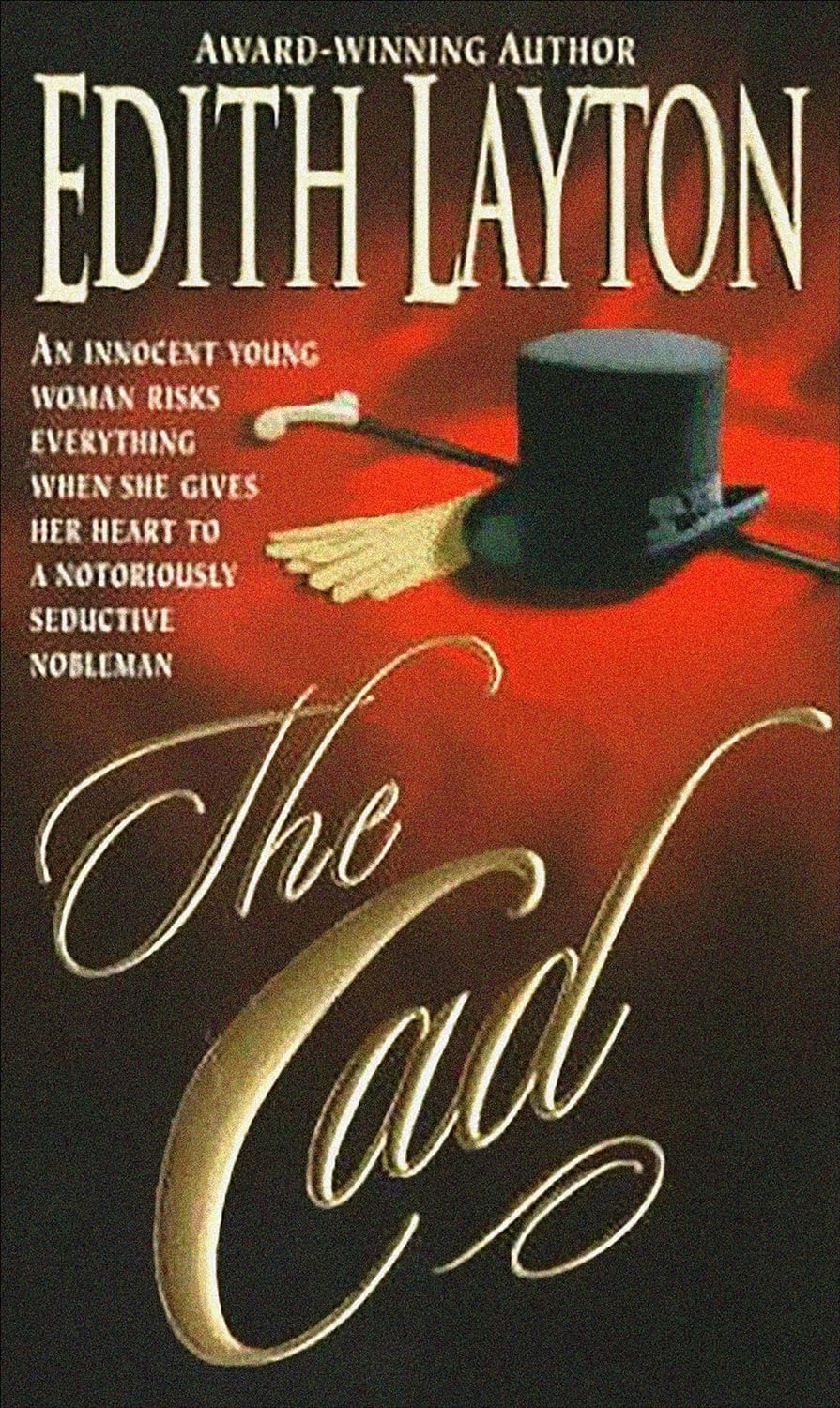
The Cad
The Cad begins wonderfully, as a Cinderella story with a twist. Well-born but impoverished, beautiful but disfigured Bridget is eyed by the rakish Ewen, Viscount Sinclair at a ball. Instead of having a wicked step-mother and step-sisters, Bridget has her beautiful but petty cousin Cecily, to whom she acts as unpaid companion, and her Aunt Harriet, who banishes her from the ball so that the Viscount can focus on Cecily. The Viscount, however, has eyes only for Bridget, discovers where she was sent to hide, and offers her carte blanche. She turns him down, and the fun begins.
If the Viscount can’t have Bridget as his mistress, he’ll have her as his wife. He begins a very creative courting of Bridget – completely above-board, and very seductive. Bridget is torn – why would this highly desirable but disreputable gentleman want her? She has no money, and believes a facial scar has ruined her beauty. Surely the man just means to dally with her, an idea her aunt encourages after she discovers the Viscount’s interest. In fact, when Bridget presents her aunt with Ewen’s marriage proposal, she is tossed out of the house.
She goes to Ewen, and the next morning while he is out securing a special license, she meets with his closest friend, who doesn’t believe Ewen is about to be married. Because of his history, his few friends are on the coarse side – surely Bridget is the latest in his string of conquests. Why indeed would anyone believe Ewen is about to marry Bridget when he’s known as a rake of the first degree?
It is this sort of disbelief that eventually destroys what began as a fabulous read. After a rushed wedding attended by few of his friends, Bridget and Ewen leave for his country estate, where they spend a brief but loving honeymoon. Still, Ewen is a mysterious one, and Bridget doesn’t have the time to get to know him beneath the surface. Then he is called away on the Regent’s work and Bridget is left alone. She is not treated with respect by anyone with whom she comes into contact; no one believes Ewen actually married her.
After about a hundred pages of their separation, I wondered what had happened to this read which had begun with such promise. The two are separated, and Bridget is faced with one situation after another which call into question her marriage and her faith in Ewen. These situations eventually became interminable to read.
In addition to the lengthy separation, the very nearly insurmountable situations faced by Bridget were incredibly depressing. They were also nothing but a house of cards. Had Ewen spoken to his staff before leaving for Town, they would have accepted her as his wife. She would not have had to endure the pain and humiliation she faced instead. Had Ewen spent five minutes telling Bridget his big secret, the encounter she later has with a mystery woman need not have occurred. In other words, a few well-chosen words would have made a third of the book moot. This is a different sort of Big Misunderstanding, but equally as annoying as the traditional kind.
Ewen was a haunting figure – so very different as a man than the youth who was destroyed by the mysterious woman. Discovering at the end of the book what he had been, and how he had been transformed, was sad. And Bridget was altogether a tragic figure, especially as she sits and waits for Ewen’s return. When the two were together, they became whole and healed and their story sang, but when they were apart, their song became too mournful for me.
I looked forward to Edith Layton’s return to romance with Harper after being dropped by Pocket last year. The Cad could have been a keeper, it was a keeper for at least the first half. But a very sad and hand-wringing middle reduced it to one of the most disappointing reads of the year.
Recent Comments