
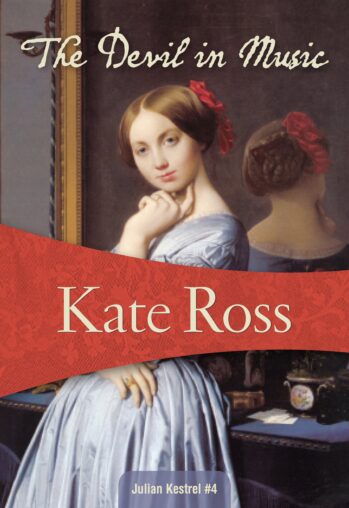
The Devil in Music
Twenty years ago, Kate Ross published the fourth (and last) of her Julian Kestrel mysteries, The Devil in Music. The entire series is strongly written and wonderful to read, but this last book contains an intricate mystery and adds depth to Kestrel’s character. It was a fantastic reading experience, though bittersweet, because I knew as I read that this would be the last visit to Julian Kestrel and his world. Kate Ross died in 1998, but the four books she left behind are a wonderful legacy.
Readers familiar with the first three books (Cut to the Quick, A Broken Vessel and Whom the Gods Love) will already know Kestrel as a somewhat mysterious English dandy in the early 19th century,with a penchant for solving mysteries. Kestrel is witty, urbane and at times rather distant as a character. One of the great delights of this series is that readers see Kestrel becoming more human and more real with each volume.
In this installment, Kestrel has left England in search of the solution to an Italian mystery. A powerful marchese was killed at his own villa and the crime hidden for four years. Now that the murder has come to light and it has become known that an English tenor being trained by the marchese is suspected of the crime, Kestrel thinks he may be able to lend some aid to the investigation. As is his habit, the well-traveled Kestrel manages to ingratiate himself with at least part of the marchese’s family and he starts digging.
The mystery itself winds its way through dark secrets, public family embarrassments, the world of music and Italian politics of the 1820s. The author does a wonderful job of setting up her backdrop, making the Italian-Austrian power struggles and other political issues of the day feel real and planting each of her characters firmly in their time and place. As in Ross’ other books, Kestrel seems at home both nowhere and everywhere while the other characters in the book – the marchese’s family, a British gentleman on the Grand Tour with his tutor, a renowned musician, and others all spring to life and interact with one another.
The complexity of the story as well as of the characters’ lives and choices makes for a rich tapestry. While the dysfunctional family dynamic and political tensions running through the story make for sometimes fraught reading, the love various characters have for music also plays an important role and brings a certain richness to the story.
Kestrel himself is in rare form with his ability to notice small details and exchange witty dialogue. However, what sets him apart as a character is his ability to not only understand human nature on a fairly deep level but also to accept and empathize with the emotions of others. By the end of this book, when many of the secrets in Kestrel’s own past get revealed along with those behind the murder in this story, I had to admire the hero Ross had created over the course of the series. This is the last book of the four and in my opinion, this book and Whom the Gods Love are the very best, but all of them are well worth reading.
Recent Comments




I recently reread the first two books in the series, read the third for the first time, and have now started on this last of the series. I am just so sad that Ms. Ross died so young, for her family, for her friends, and for us readers who don’t have more Julian Kestrel books to read. It’s clear that she meant each book to reveal more about who he was and how he came to be the man that he is. I found him a lovely character and would have loved to see his character arc over more books – this book was the last not because Julian’s story was complete but because Ms. Ross wasn’t here to tell it to us.