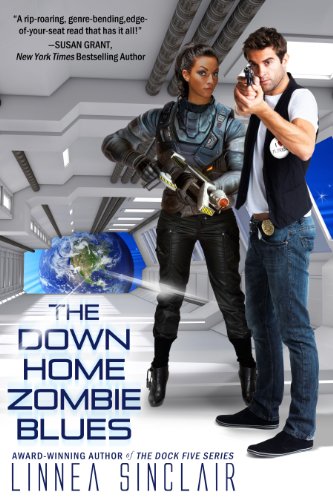
The Down Home Zombie Blues
In the three Linnea Sinclair novels I read before picking up The Down Home Zombie Blues, there is a similar set-up: Ordinary woman meets man who is somehow – technically, biologically, psychologically – enhanced and has super-human powers. Now don’t get me wrong. I loved each of these books and placed them on my keeper shelf, but I did wonder whether she would stick to what she knows works so well, or strike out for something new. I was delighted to see that she did the latter, and with great success.
Jorie Mikkalah is commander on a ship of the Guardian Force, a kind of intergalactic police force whose main duty is to hunt out and destroy what they call zombies, a biotechnical life-form developed more than 200 years earlier by their own scientists for purposes of maintenance in space, and since gone rogue. Zombies, due to their programming, are drawn to technology, so the Guardians are surprised that the latest nest they have discovered is on a nil-tech-planet called Earth. But no matter – they have an agent installed there, and the situation will be cleared up with Earth’s population none the wiser. Then all communication with the agent ceases, and Jorie and her team must PMaT (think “beam”) down to investigate.
Theo Petrakos, detective sergeant with the Bahia Vista, Florida Police Force, gets called to a very strange murder site on December 23rd. The victim is mummified, causes of death are unknown, and hidden in a cupboard his team find an odd technical device that looks like a laptop without any keys. Before taking it to the police station, he drops by his house and is first accosted by an attractive but weirdly-dressed woman who demands, in broken English, that he hand over the device, and then attacked by a large metal creature with three glowing eyes and huge metal arms that destroy everything in their path. He and the woman just about manage to kill the thing, and suddenly he finds himself beamed up to a spaceship straight out of Star Trek.He soon finds out he is deep trouble. The Guardians have had some very bad experiences when dealing openly with the inhabitants of low-tech worlds, or “nils”, as they disdainfully call them. Therefore they plan to relocate Theo on Paroo, another planet, without him contacting Earth again. Theo is determined not to go to anywhere but Bahia Vista, and when he finds out that the Guardians have lost their agent on Earth at the moment and are severely hindered in their operations as a result of this, he manipulates Jorie to propose him as a local guide and his house as a replacement base. What he does not expect, however, is that he will be equipped with an implant that can kill him if he proves disobedient.
The attraction between Jorie and Theo is instant and very strong. Both are mature characters (he is 43, she 39) whose last relationships ended quite disastrously, so each is wary of this new romantic interest. In addition, Guardians tend to be very condescending about “dirtsuckers” or “nils”, whereas Theo feels understandably upset about the implant. Then there is the problem of language and culture. English is amazingly like a foreign language that Jorie and her team speak, Vekran. (There is a funny little running gag about this amazing coincidence, and the author gives some hints about how it may have come about.) The languages are similar but not identical, and how Jorie and Theo slowly begin to understand about the other’s culture and values is beautifully handled. I often smiled when I read about the way that Jorie interprets our world. Theo uses a lot of concepts from Star Trek to make Jorie’s world more understandable to himself, and this also added to the fun.
Theo is instantly likable. Attractive, intelligent, highly competent, and when necessary, he is able to suppress most of his alpha instincts and work as a team player. He is also unique in Romanceland in that he is a Greek-American but no shipping magnate. Jorie is less approachable at first. She is very focused on her job, but once she is on Earth, she discovers a sensual side she did not know she had, enjoying food or the pleasure of a real-water shower. Although she does not always show it, she is able of strong empathy and sympathizes very much with Theo’s position.
The danger from the Zombies is immediate and tremendous (the derivation of their danger from originally beneficial functions of a biomechanic creation is just brilliant), and so Theo and Jorie can’t focus much on their burgeoning romance. What develops is one of my favorite romance situations, that of hero and heroine slowly getting to know and trust each other, falling in love, while they are busy with something else. Thus Jorie and Theo get more of a relationship than a sex life, which is fine with me. The sex scenes are well-written, but they are not given much space.
What else is there to like? I very much enjoyed Theo’s family, neighbors and colleagues, the scenes with them were both amusing and touching. The book contains some parallels to current real-life political situations, which were both moving and illuminating without taking easy sides. While the ending is very satisfactory, the characters don’t solve all their problems (and yes, there is at least one character who might star in a sequel). This solution is far more convincing in light of the magnitude of the problems than a too-facile all-around resolution.
The Down Home Zombie Blues is an excellent novel, especially for those who like a slow, character-driven romance, fast action alternating with the nerve-racking wait for the enemy’s next step, and fun with words and misunderstanding an alien culture. It did not quite touch my heart-strings like Games of Command, with its tortured hero, did, but it made me smile a lot, and I loved it nonetheless.
Recent Comments