
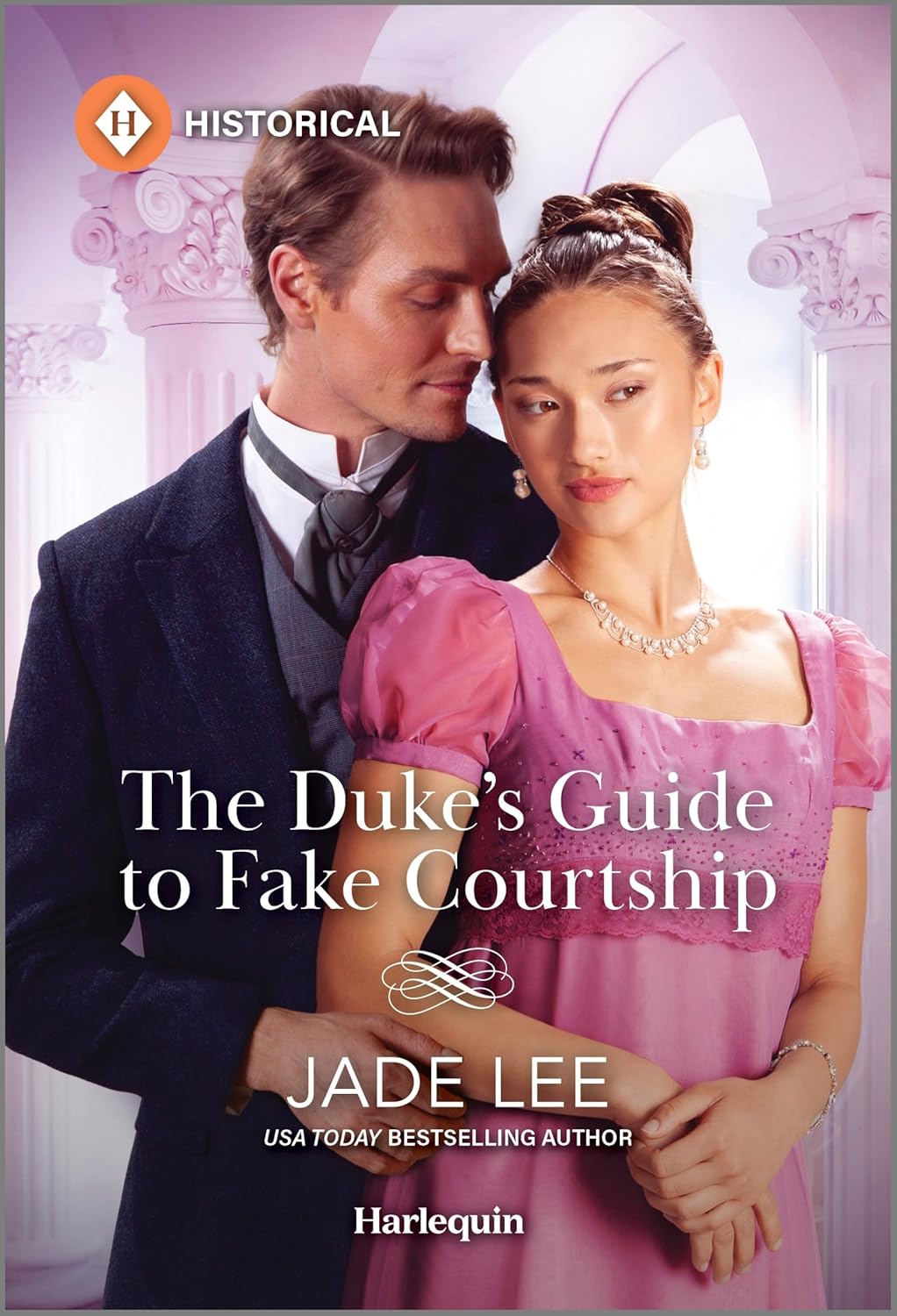
The Duke’s Guide to Fake Courtship
An uneven tone makes The Duke’s Guide to Fake Courtship slow going. Heavy subject matter – including abuse between servants, social snobbery, racism, attempted sexual assault, child murder and mental illness – clashes with light scenes of family, banter and flirtation. It’s much darker than the premise on its back cover suggests, but lacks the heft its themes deserve.
Monastery-raised sea-loving navigator and natural sailor Miss Grace Nayao Richards and bookish, math-loving Lucy Richards are sisters who aren’t related by blood. The two bonded strongly during their time together at a Buddhist orphan’s temple in India. Grace is the result of the youthful exploring days of The Earl of Wenshire, whose time in the East India Company brought her into being. Because Grace and Lucy refuse to be separated, the earl has agreed to take them both, plucking the girls from what was to be a devotional life (the other choice: a life of prostitution), and brought them to England, hoping to make them a part of the ton and find advantageous matches for them. Even before getting off the boat, Grace has begun courting Lord Domac, Cedric, Earl of Byrning, who seems keen to propose. But she barely settles into London life before the Earl’s cousin steps in, telling her to reject Cedric’s proposal.
Declan, Duke of Byrning, is close to his cousin, Cederic. So his interference in Cedric’s courtship of Grace is initially driven by his hectoring mother, who snaps that Grace’s status as a biracial by-blow means she’s not suited to be the bride for an earl. But then he finds out that his cousin’s desire to marry Grace is mainly driven by his need to gain enough money to buy a boat and start a career as an exporter. Declan is aghast. Cedric presents Declan with an ultimatum: save the family’s name and give him ten thousand pounds to fund his dream, or he marries Grace for her money and besmirches the already-stained title of Byrning.
Of course, as Declan gets to know Grace, the more he likes her, and the more strongly opposed to the match he becomes. Thus when the opportunity to end Cedric’s suit presents itself thanks to a racist modiste, seemingly rough treatment from Cedric, a brawl at a ball, and a torn dress, Declan proposes. Grace rejects him, so he suggests a fake courtship to save her reputation and increase her popularity among the ton. Surely it won’t turn into real attraction and love!
Of course it will, but the reader will have to ride a rollercoaster to get there. For every Bridgertonian moment of light banter and courtship, there’s a moment where the romance will break down for a lecture – usually delivered sternly by Grace to a fumbling Declan about a topical issue.
We know Declan is a Good Guy at heart because right from the beginning he can’t fathom the racism of others. He cares about his cousin and Grace, and even his mother and while there are hints of a debauched life previously lived (his mother awakens him from a roaring hangover when the book begins), he’s a likeable, ethical lead.
Grace is your classic do-gooding modern heroine stuffed into a corset. When she’s not helping a fellow society miss post near-rapine and punishing the woman’s attempted rapist right in the middle of a crowded party by calling him out and then and beating him up (!!) with self-defense skills she learned from the temple monks, she’s intervening in the abusive caste system of household servants. She is physical and daring and Not Like the Other Girls. Her idol is real-life pirate queen Ching Shih, and she sees herself as made of Sterner Stuff. This–which I liked–does not prevent her from melting like butter for Declan, who makes her feel safe and protected.
All of this would be sweet, and nice – I mean, Declan’s an imperfect guy constantly in trouble with the House of Lords who knows if he marries this girl it’ll be even worse for him politically, and she acts out of a desire for other’s happiness. But then there’s a big door stopper for Grace and Declan that is gothic in tone and actually shocking: Generations of Byrning men are afflicted with life-ruining, violent tempers. What Declan’s father did under its influence is truly dark and ugly and won’t be revealed here but is brushed off with a shrug. This is problematic in that Declan shows similar symptoms of having such a temper but the book doesn’t really explore the true possibilities of this inheritance.
This is not the only problem. Lucy and Grace’s shared secret (which I won’t reveal here) which seem like peanuts, compared to Declan’s. The racism the families show towards Lucy, is treated comedically which is jarring. Then again, many of the conflicts – the Byrning Legacy, the fake courtship, the Big Secret, the many social scandals they stir up – only seem important for a chapter or two before the next crisis begins or a previous one is revisited.
What did I like? The romance would be sweet if those big secrets weren’t hovering over the tome. The racism that Lucy and Grace face is well-handled. The Earl of Wenshire is a sweetheart, even when he’s used as a convenient plot device to stop Declan from seizing Grace’s booty premaritally. The rapport between Declan and Cedric is hilarious. Cedric himself is a huge highlight even though he’s a rogue because he’s right, Declan IS a stuffed shirt. Cedric’s presence made me excited for the second book, where it seems he’ll be paired with mathematical, reputation-concerned Lucy. However, even with these pluses, the book is a failure. Lee has written many a winner in the past. The Duke’s Guide to Fake Courtship, however, is not one of them.
Bonus moment of WTF: when Declan introduces Grace to masturbation mid-book, he informs her that this is ‘something other women teach each other.’ In polite society in Regency Era England?! Dear Lady Whistledown, I never thought it would happen to me…
Recent Comments



There was one late-point conflict that came out of nowhere and drove me bananas and I will elaborate in spoilers for the curious.