
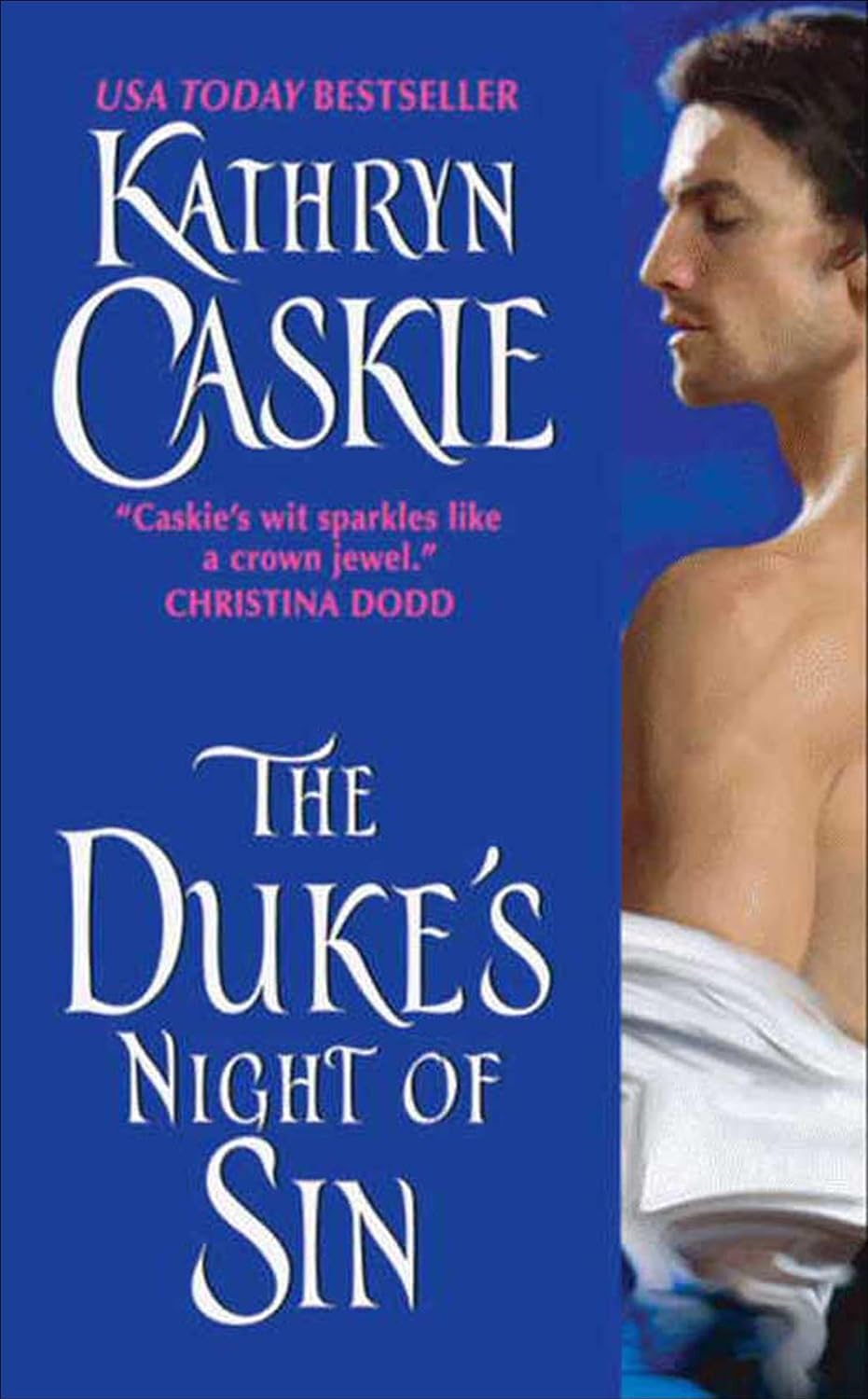
The Duke’s Night of Sin
The Duke’s Night of Sin begins with an author’s note on the unusual weather in 1816 Britain as a result of a volcanic eruption. Fascinating, I thought – I had never heard of this occurrence, nor its socio-political implications. No way would this be a wallpaper historical! Unfortunately, I was wrong. The food riots and shortages were only mentioned in passing, but the characters spent several chapters stranded in a snowstorm, huddled together naked for warmth. Thanks for the attention paid to historical climatology there.
Our story begins with an anonymous amorous encounter: the new Duke of Exeter, Sebastian Beaufort, and Lady Siusan Sinclair, have sex without either knowing who the other is. He believes she is a courtesan he had arranged an assignation with; she decides to go along with it, since she’s feeling lonely as she marks the one-year anniversary of a death. Immediately afterward, though, he realizes that she isn’t the woman he was supposed to meet, and she realized how bad it would be if this were to become public. So, she flees, and takes a temporary position as an instructor for young ladies in the “leisure arts” — basically, society’s rules.
Sebastian’s ward, his late elder brother’s illegitimate daughter, is a student at the school, and he hears about the new teacher’s lessons. He’s concerned that the school is focusing too much on foolish things, and not on true learning that may help her later in life, so he pays a visit to the school. But he introduces himself under one of his secondary titles, and so Siusan doesn’t know who he is… and yet the two are, of course, drawn to each other.
The plot is riddled with logical fallacies, weak contrivances, character inconsistencies, and nonsensical behavior. None of it made sense. There’s a running theme of the “Seven Deadly Sins,” of which Siusan and her siblings each have claimed one. (Siusan is sloth, something I picked up more from the little quotes about idleness and laziness that preface each chapter, than I did from her characterization.) They are apparently wicked and wanton and wild, and all disowned by their alcoholic father until they can restore honor to the family, or something like that. There’s a lot of talk of honor and respectability, but nothing to back it up. I want to know why either of them, so puffed up on restoring their family’s honor, would a) arrange a tryst in the library during one’s own debut ball, moments before being announced; b) have sex with a total stranger, who clearly thinks you are someone else; or c) make such a huge freaking deal about it all after making these poor decisions in the first place. The crux of the climax is built around a plot hole so huge that it collapses in on itself. If any of these characters had an ounce of brains or practicality, they’d have sorted things out in the first five pages — but that wouldn’t make a very good story, would it?
Really, though, if you just take the characters at their word, you might find something enjoyable in this book. There is admittedly a bit of discernable character development in Siusan, and her fondness for her students was nice. Just don’t think too much about anything else — the characters certainly don’t.
PS- I have no idea why the heroine is “Siusan” and not “Susan.” Okay, it’s Scottish, which she is, but there are a million Scottish names that could have been used instead that wouldn’t have distracted me and had me thinking “See-OOO-san” every time I saw her name.
Recent Comments
