
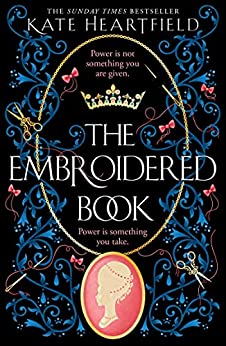
The Embroidered Book
Twisting the tragic tale of the Habsburg dynasty (which gave the world Marie Antoinette), The Embroidered Book throws potent magic into the existing pile of family tensions, political chess playing, and romantic complications. A few clunky turns of phrase, awkward pacing and a weak magical subplot keep this one from a higher grade, but the worldbuilding is fun, with characters worth caring for.
Empress Maria Theresa of Austria plans on using marriage instead of never-ending war to ensure the safety – if not the happiness – of her thirteen living children. She is not doing this out of altruism of course; she wants Austria to regain its land and political favor, and believes her children will be the perfect pawns in achieving this objective. Thus, two of her girls – Maria Antonia and Charlotte (Maria Carolina) – are destined for politically delicate foreign marriages. In these girls’ cases, however, that destiny is blighted by change – the unexpected death of their sister, Johanna, which means that Charlotte must fill in for Johanna in Naples and France must settle for Antonia instead of Charlotte.
Iron-willed Charlotte’s marriage to the merry, womanizing Ferdinand, King of Naples, is awkwardly forged. They are not attracted to each other, and he demands non-stop procreation. Charlotte will go through eighteen pregnancies during her lifetime, producing seven children who make it to adulthood, and will live to see Napoleon’s invasion – but first she will take on a daring affair and try to gain entrance a secret magical society, along with her lover, Sir John Acton, as well as leading Italy to enlightenment.
The problems of Maria Antonia – redubbed Marie Antoinette by the French – are well known to even history neophytes. While Charlotte had been trained her whole life to participate in the French court, Marie was not; she is only fifteen and not prepared for the harsh spotlight cast upon her, she suffers from homesickness, divided loyalties, scorn and gossip. She becomes a notorious scandal and has an impassioned affair with Count Fersten.
It seems as though both women are destined for unhappy lives, but a secret binds them together. In their childhood, they discovered the titular embroidered book, which belonged to their governess. Using the spells within, the sisters teach themselves the dark sacrificial magic it holds, creating, among other things, enchanted portraits through which they can speak. But magic has a price. Are they willing to pay it?
This is a solid piece of historical fiction that perhaps binds itself too strongly to the movement of history. Sadly, the most disappointing facet of The Embroidered Book is its use of magic. The magic the sisters practice is incredibly painful and sacrificial; important artifacts, memories and even blood itself must be sacrificed to encourage the existence of magical artifacts or a piece of good luck. The problem with that is that the inclusion of magic does little to sway the bend of history in any unique way. The sisters cannot save others with it, rewind time, or poison their enemies. The most interesting use of it surrounds the secret magical society Charlotte encounters.
Much of the book is about Charlotte, whose story is lesser known, and although, by the mid-point, the narrative lean becomes more evenly distributed between the sisters, hefty chunks of Antoinette’s life story are skipped to get to the Big Sweeping moments (the birth of her son, the affair of the necklace, the storming of the Bastille, the execution). But the sisterly connection – close in real life – remains paramount.
Also – points off for some too-modern turns of phrase. I doubt either princess used four-letter words in courts where their every word was attended to. But The Embroidered Book is worth a read due to its strong historical research. Perhaps it would have worked better without the magical components, but it’s still compelling.
Recent Comments


I’m not sure how well this novel might work for me but Empress Maria Therese is a fascinating historical figure.
She really is, and deserves a novel of her own.