
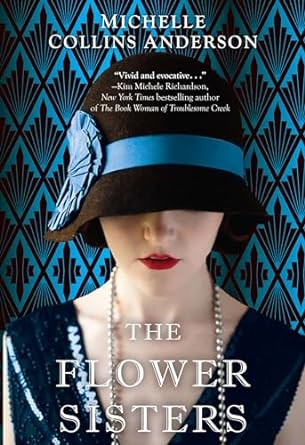
The Flower Sisters
Dual timelines are common in historical fiction, and The Flowers Sisters does an excellent job of making five different points of view and two decades fly by like they’re no big deal. The novel loses some points for predictability, but the storytelling and characters make it all worthwhile.
It’s 1928 and the titular Flowers sisters – identical twins Violet and Rose – often hang out at the local dance hall to bop about to some jazz music and, if they’re lucky, land their swain of choice. They’re almost impossible to tell apart and are able to fool their friends and family with ease. Violet is outgoing and flirtatious; Rose, introverted and serious. But they both love jazz and boys. In Possum Flats, Missouri, in those heady pre-Depression days, it’s the ultimate way to have fun.
One night, Violet comes alone to the dance hall to gain the attention of the dissolute but handsome Dash Emmonds, a preacher’s kid cutting loose with little planned for the future, while Rose stays home sick in bed. Violet and Dash are having a good time together when the joy of the night is rent by a sudden explosion. The Lamb’s Dance Hall is flattened, hundreds lie dying and Violet is among the casualties. Dash’s life has been saved, though he doesn’t come away completely unscathed physically or mentally. Live will never be the same for the sisters, for Dash, or for the town in general.
Fifty years later, Rose works as a funeral director and has taken in her teenage granddaughter, Daisy, while her eternally-rebellious daughter Lettie (named after Violet) spends the summer in California with her latest boyfriend. Lettie fled Possum Flats the second she turned sixteen and continues to avoid the conservative home established by Rose and her late husband. Daisy is just as rebellious, hating the smells and sights at the funeral home, but she’s also ambitious and yearns to become a reporter. Trapped in Possum Flats, she lands a spot as an intern at the local paper, the Possum Picayune. After a few up-and-down days at the paper, Daisy becomes intrigued by the story of the Lamb’s Hall Dance explosion and starts to research both it and Rose’s seemingly-minimal role in that night’s events. Rose is opposed to Daisy’s digging, as she harbors a secret about what really went down the night Violet lost her life.
Rose, meanwhile, often sees Dash, who long ago took up his father’s ministry and preaches in the town. Dash, too, has a teenage grandchild – a grandson named Joe – who starts to develop an interest in Daisy after they meet-cute when he runs into her (literally) on his paper route. When Joe and Daisy develop a teen romance, Dash and Rose are aghast, and even more secrets from fifty years past threaten to surface – along with the feelings they have barely been able to suppress for decades.
You can probably guess the twist that’s waiting ahead for you in this one. But the book’s character work and its intelligent portraits of small town life end up captivating the reader anyway.
Of the many PoV characters, Daisy, Dash and Rose interested me the most. As a matter of fact, Anderson could have cut out a few perspectives here, but most of them are necessary.
The Flowers Sisters is a very ambitious tale, what with its many characters and multiple time frames (we also flash back to the 1940s and 1950s while peering at Lettie’s childhood) and its stylistic choices. Yet generally, in spite of these issues, these twists and turns were easy things to follow.
It’s not a novel for the faint of heart, however. The book gives an honest, close-up look at the embalming room and what takes place within it, so those with tender tummies need not apply. It’s also frank about the destruction caused by the explosion, which is based on a real-life event – the explosion of Bond Dance Hall in West Plains, Missouri in 1928.
The ending of The Flowers Sisters leans a little too hard on the cheese and pat conclusions, feeling like it’’s escaped from Touched by An Angel and standing kitty-corner to the honesty that came before it. (You can judge for yourself whether or not the heaven one character finds is the sort you’d enjoy). But in the end, it’s a beautiful, sprawling, smart, enjoyable book that, while delightfully flawed, is certainly worth reading.
Recent Comments

I’m wary of the enbalming part-yikes, but I’m in for the twins and twists and am giving this one a try!
Yep, those get a little explicit – you get some DETAILS – but if you can skim or stomach it’s great!