
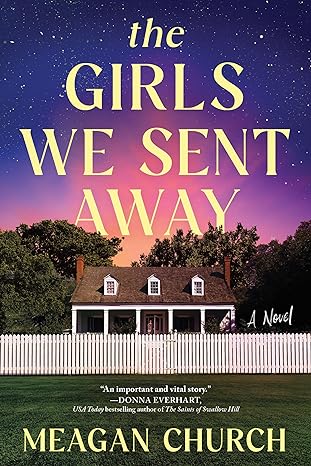
The Girls We Sent Away
The Girls We Sent Away is loaded with the realistic, sad stuff of life. It’s the kind of novel a post-Roe v. Wade world needs, but a couple of factors keep it from being an DIK.
It is the summer of 1964, and North Carolina native, astronomy fan and high school junior Lorraine Delford seems to have it all. A loving family, good grades, a summer job as a highly-vaunted lifeguard, a handsome college freshman boyfriend, and a plan to be named valedictorian and go to college, not just for a ‘decorous’ degree, but to join the burgeoning space program and walk on the moon. Then her boyfriend, Clint, gives her a promise ring, which leads to a night of passion on the floor of a barn.
When Lorraine becomes pregnant, her plans for her senior year are quickly derailed. Clint breaks up with her and goes on his merry way, and her parents shuffle Lorraine off to a home for unwed mothers. Her education is put on hold, and Lorraine must contend with the home’s mean politics, poor learning options and strict supervision. And yet a spark of hope blooms in her. She meets the handsome Allan, she finds friends in her roommates, Mirabelle and Denise, and works to achieve her dreams, even if it must be made through a GED. Yet she also grows attached to the baby within her. Can she keep her child and forge ahead? Or will other factors interfere and keep Lorraine from keeping the child?
The Girls We Set Away is a fairly depressing tale, and one teenagers all over the world continue to through to this day. It’s about the crushing, mundane weight of reality and of social expectations, and the hell they can play on an innocent kid.
Lorraine is immediately sympathetic and easy to like, her relationship with Allen is very sweet, and the book hands her a realistic, though not easy, card. The novel splits its perspectives between Lorraine and her mother and the dual PoVs feel very crucial, as Lorraine’s mother Betty has attained that ultimate level of housewife perfection that is supposed to be the era’s grand pursuit, yet is filled with poignant, bitter regret. She wants better for Lorraine and yet she’s pushing society’s morals and ethics on her daughter, unaware of the social revolution set to arrive in three years.
There are some problems with the narrative, in that, like life, many blanks are left behind, and many ties undone. We leave Lorraine building a future, scarred, in love, and hopeful. But a few missed plot points had me wondering how other characters made it out. Prepare to have your heart broken by this one; it’s a beautiful story, but you might need tissues.
Recent Comments




Your review makes me think about a novel from the late 70s: The Women’s Room by Marilyn French. The novel is about that coming transition you reference in your review – the wave of feminism (enabled by readily available birth control) that crashed into women’s previously very proscribed lives. I’ll never forget the scene where the main character loses her sh*t because someone (husband? kid?) obliviously tracks mud across a kitchen floor she’s just spent her entire day cleaning and waxing. Beyond the lack of appreciation by her family for what she’s just spent her day working on; is her realization that that clean floor is the pinnacle of what she as a housewife can aspire to for the rest of her life. It is the straw that breaks the camel’s back and she begins to take charge of her life at that point.
The Women’s Room might be a good chaser of a read after The Girls We Sent Away.
The Women’s Room is so powerful; I read it ages ago!
In my high school years (early-to-mid 1970s), it was not unusual for a girl to suddenly leave school mid-year to “go stay with her grandmother” or “go help her aunt for a while”. A few months later, she’d return. We all knew the girl had gone to have a baby—probably giving it up for adoption—but no one ever said a word. The girls came back, life moved on. It’s one of those phenomena my own daughters are always baffled to hear about. But when some people talk about the “good ol’ days”, they seem to forget that shaming, blaming, ostracizing, and ignoring pregnant teenagers was part of that.
God, this. It’s something my generation learned about through movies.
I went to an all-girl Catholic high school in the 1990s and I know of at least one girl who ended up taking time off to give birth. Never found out what happened to the baby.
While the guys just got to walk away Scott free . . .
There was a made-for-TV movie some years ago about a situation where the young man didn’t walk away. He was a gifted cellist but instead chose to be a husband and father rather than leave for study in a conservatory. It was heartbreaking for both him and his girlfriend, as they each had to give up their dreams, and it was impossible to envision a future where they’d both be happy. Wish I could remember the name of the movie or the young lead actor – IIRC, he was a cellist and actually played a piece (Bach cello concerto, maybe) in the movie.
This sounds like an interesting but perhaps “difficult” read for those of us who were very young in 1964 with the world around us exploding like a catherine wheel. The Beatles, Stones, Bob Dylan, Viet Nam, a polarising presidential election (LBJ v Goldwater), the Schwerner, Chaney and Goodman murders with the disruption and turmoil with the Civil Rights Movement. But, in particular, Lisa mentions the dichotomy of Betty’s wishes for/advice to her daughter and this struck a chord. My parents marriage broke up in 1964 in large part because my father refused to entertain the idea of her having a job outside of the home he insisted being kept in pristine condition, meals on table, etc. Finally, she rebelled, fueled by her alcoholism that partly resulted from her situation. But, to me, unlike Betty, she never said that I should grow up, get married, have kids and a nice house in the suburbs. Instead she said: get good grades, get a university degree and get a good job: you must be able to take care of yourself, by yourself! So, Lisa, your review stirred up some memories and I think I will have to add this one to the TBR pile.
Oh Elaine; this one is definitely going to strike some cords for you. Be prepared with tissues!