
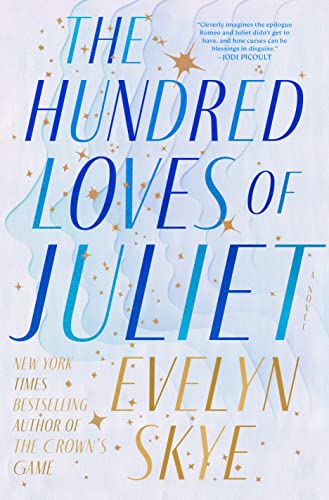
The Hundred Lives of Juliet
Do you believe in the power of cheese?
I do, and yet The Hundred Loves of Juliet doesn’t do too bad a job of making its storytelling interesting. Unfortunately it crashes into stale predictability and empty angst. I know author Evelyn Skye was inspired by her own husband’s illness and their beautiful, intense romance. I know this novel is her heart-and-soul, and I feel bad bagging on it. But when the narrative crash-lands into sappiness and fails to give its main heroine much of a personality, it’s hard to stand by and give the book a higher grade.
Helene is recently divorced from her vicious and cheating husband, Merrick. She is a writer, and has composed a string of romantic vignettes but has never managed to make a real novel of them. The hero is based on her childhood ‘imaginary friend,’ the handsome man of her fantasies. Deciding to finally craft a novel of her dream musings, she impulsively quits her job and heads to Alaska to write in seclusion. While there she has a chance encounter with humble fisherman Sebastien Montague – the man of all of her fantasies – and they are drawn together almost immediately. He seems to be the man of her dreams, but the tale he tells her is quite shocking.
For you see, the stories that pop into Helene’s head are not stories; they’re past lives she’s lived with Sebastien, who happens to be the real Romeo Montague in disguise. It seems that Mercutio’s “A plague o’both your houses” has actually yielded fruit – it’s a curse that doomed Sebastien/Romeo to eternal life after Friar Lawrence saved him from attempted suicide, and a destiny of jumping from locale to locale to hide his identity. Helene, meanwhile, is fated to reincarnate over and over again in various bodies across the centuries. Every time, she has no memories of her past lives. Whenever she and Romeo meet, Juliet is destined to die – whether by a sudden accident moments after they connect or months after their marriage. They have never lived a shared life long enough to conceive a child or for “Juliet” to make it to old age.
Helene is immediately determined to avoid this fate – after all, the fact that she has memories of these past lives must mean something this time out – but how can they break a centuries-old curse, especially with Merrick looming over them?
Your enjoyment of this novel will depend upon two things – your tolerance for the cheesiness of and how romantic a story you find Romeo and Juliet to be. This book will not be for you if you regard it as a story about rash emotions ruining lives and teenagers making bad, impulsive decisions; but if, for you, it’s the greatest love story of all time thwarted by crappy fate? Go for it.
This story is complicated by the fact that Helene feels stuck in a sort of emotional stasis. If you found out you were a victim of a centuries old curse gone wrong, wouldn’t you be weirded out? Want to get away from this guy proclaiming you are his truest love? Helene does not ask questions. And there’s also something sad about her creativity being the result of her hundreds of past lived lives versus anything she’s come up with organically. Authors draw from their real lives all the time, sure, but imagine realizing every single thing you’ve ever written has stemmed from something you lived but cannot remember. Skye does not probe Helene’s thoughts about this – she is too filled with fear and rapture in equal measure.
The Hundred Loves of Juliet wants you to cry so, so badly at the conceits it chokes up. It’s not enough that Helene is caught in a deathless love trap, she also has a dying father. The platitudes that spring up during conversations with her mother, sisters, and booger-obsessed nephew are cloying. While you feel terribly for Sebastien, who has been forced to actually develop as a person over the centuries, the new soul smell coming off of Helene makes you groan. Her personality is babyish and heedless, and his is morose and melodramatic. The fact that she isn’t given a similar opportunity to change and grow over the centuries deprives her of the development she needs to become the interesting person that poor tortured Sebastien is.
Skye’s prose is overwrought and lugubrious; as I said, Romeo is melodramatic. The last quarter of the book is unforgivable in both its sappiness, its fate-baiting and its deus ex machina Gary Stu behavior from Romeo. And yet it doesn’t quite reach D-level due to the flashback scenes, where Helene’s past selves are allowed to be bitter, angry, and disappointed, even if they are victims.
Again, I know this novel means a lot to the author. But The Hundred Loves of Juliet misses out on the staff of life and heaps on the pancake syrup.
Note: so much young accidental death. Also bonus points for guessing the mega-sappy name a certain character is given at the end of this one.
Recent Comments




I took a chance and read this anyway when it became available from my library, figuring it might not be as bad as you said, different strokes for different folks, etc. Sadly, it was even worse and I almost DNF’d several times. I think the last straw was when Sebastian rescued a baby polar bear who was stuck in the ice, turned his ship around, and brought it to shore to be raised and re-released into the wild. Could he BE any more unbelievably perfect? There was no chemistry between the MCs and the vignettes describing how the past life Juliets had met their grisly demise became almost comical after a while, I would have given it one or two stars on GR but I felt bad for the author so I didn’t rate it at all.
I forgot the polar bear part, that’s how crowded with ott instances this book is:
Fictional writers who have never actually completed a manuscript but who quit their jobs to live in the wilderness and work on the Perfect Novel are right up there with fictional writers whose agents help them through a dry spell by arranging for a long vacation in a beachfront cottage. But the idea of Romeo and Juliet + reincarnation is intriguing enough that I read the excerpt.
The start of the story lays out the premise clearly and shows the problems rising from it, but as Lisa said, Helene doesn’t have much of a personality. Sebastien muses that “she always has the same soul, twinkling with curiosity and wit”, but this is a case of telling rather than showing, because I didn’t notice any such traits in Helene. Unless you count this one :
I talk to my houseplants occasionally, but naming appliances, especially in this twee way, was a bridge too far. Just in case the story went on to introduce Tessa the Toaster and Mia the Microwave, I noped out of there.
It sounds very twee to me!
That, tragically, is Skye showing that Juliet/Helene is SUPER WITY OMG. Just imagine how the rest of the book goes.