
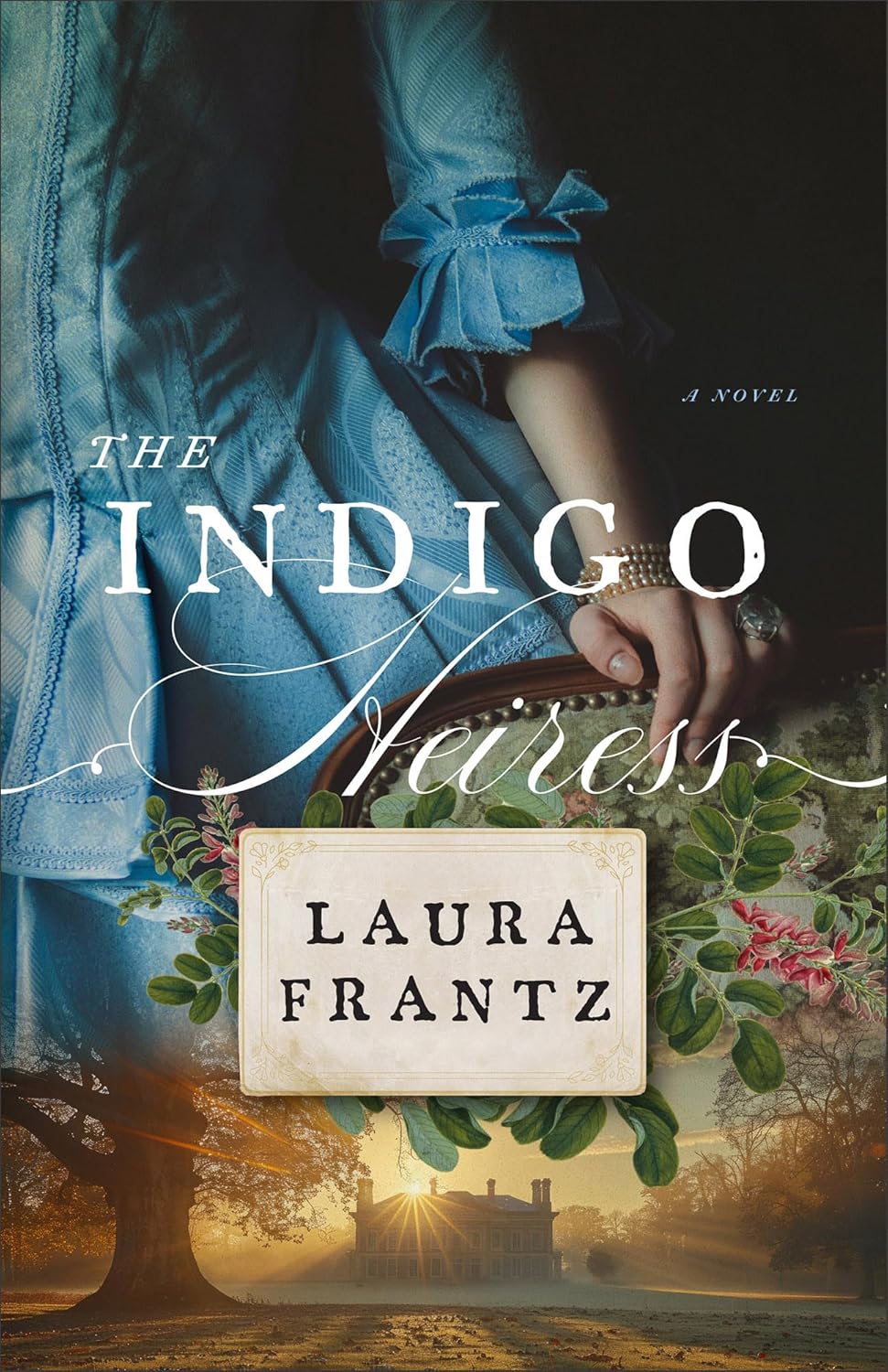
The Indigo Heiress
Laura Frantz has a solid grasp of history, and her inspirational historical romances are always enjoyable, even when they’re not perfect. The Indigo Heiress is at the high end of her oeuvre even with a few minor stumbles along the way.
Juliet Catesby is a Virginia heiress whose life ought to be all satin and roses. But her family and their businesses are struggling in the wake of her mother’s death. Juliet has learned to manage the family’s ancestral plantation, Royal Vale, on her own–her father spends all his time in Williamsburg trying to untangle the threads of their messy and ballooning debts. She knows that they’re running out of funds. On top of that, she has a secret: Juliet has quietly begun helping slaves pursue freedom in Philadelphia, including her own plantation’s slaves. This is something she considers her Christian duty, and something her mother made her life mission. Her father would frown on this if he knew, as he frowned on her attempt at teaching at the local freeman school.
The Catesbys grow plants for dyes, including indigo, their cash crop – to the point that Juliet is known as the titular Indigo Heiress. They export their wares through the tobacco-rich Buchanan family, who live in Scotland. When Juliet learns her father has arranged for one of his daughters to marry family heir Leith Buchanan to cancel the family’s debt, she’s aghast. Two-fisted, tough Leith needs a mother for his two small children, twins Cole and Bella – and he wants someone to go back to Scotland with him to help him raise them. Juliet anticipates that her more gorgeous, gently graceful younger sister Loveday will be married off to him. Instead, she’s aghast to learn she’s to marry Leith.
Juliet initially rejects Leith’s suit, a loveless marriage to be based upon appearances. But then Juliet and Loveday are caught in the middle of aiding a slave family to freedom by Royal Vale’s lazy, cruel overseer. The Cates girls make a daring escape to Leith’s boat, and Juliet agrees to Leith’s terms.
In Scotland, Juliet learns that more about her husband. Leith is the subject of murderous rumor thanks to the death of his previous wife, and Juliet is pleased to discover he has freed all of his own slaves. She settles into life in Scotland and they begin to make a family, but soon worries she’s being followed by a too-familiar face. With the Revolutionary War looming over them all, can love survive?
The best thing about The Indigo Heiress, is its smart, lives-by-their-principals and faith heroine and hero. Juliet is a great character, and so is Leith. Each are easy to love, flawed, human, moral people who live their Christian experiences, and their romance is a sweet slow-burner.
There is also a nice secondary romance between Loveday and Leith’s brother, Niall. Even the girls’ father finds something resembling true love. The novel manages combine social chaos, family antics, and world events in interesting ways, as well. Here, as in her other works, Frantz translates the past to the page well.
The book does have a few flaws, however. Bella and Cole are quite young when the book begins. Barely a year old, they embrace Juliet with nary a tantrum. Tiny Bella immediately calls Juliet ‘mam’ upon meeting her, which is something no motherless child would ever do for another woman. Frantz makes parenthood far too easy on Juliet; I wanted more storms and more tantrums, because mothering children, let alone those not of your making, is hard work. The book also has a number of (unnamable due to spoilers) dropped plot threads that put this below DIK level.
But these are really just quibbles. Overall, The Indigo Heiress is a fine read – inviting, involving and warm. If you enjoying inspies with admirable leads and an interesting historical context, Frantz’ latest is for you.
Recent Comments



I am looking at the cover and the tapestry on the chair is beautiful. I can’t quite figure out what the dark area is on her dress – maybe her hair or a shadow?
I agree that the cover is beautiful. For some reason, inspirationals often have lovely covers. As for the dark area on her dress, I think it’s just a shadow.
That’s what I think too!
My guess as to what it is, too.