
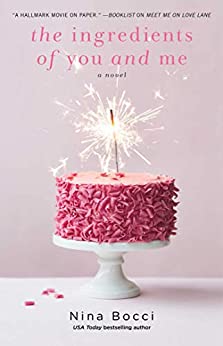
The Ingredients of You and Me
This was my first foray into Nina Bocci’s works, and overall it was a good one. The Ingredients of You and Me is the third book in her Hopeless Romantics series, but it easily stands alone as a good story about two modern adults making their way in the world.
Parker Adams is a sophisticated NYC girl known for her bakery, Delicious and Vicious, which makes baked goods with overly blunt messages (i.e. the “I really hate kissing you” special can be ordered for a break-up). She founded the bakery six years before and has poured her blood, sweat, and tears into the business during that time. But while D&V took off like she always dreamed, Parker has grown tired of the mean messages, and tired of long days at work followed by late nights spent inventing new dishes. So she takes the radical step of selling the business and prepares for some changes in her life, starting with a (temporary) move to suburban Pennsylvania, where some of her best friends live.
Part of the impetus for that life change involves – or involved – Nick Arthur, the guy she was secretly dating at the time she sold her bakery. He’s basically the definition of the perfect small-town bachelor. Nick is smart, funny, already a part of Parker’s friend group, and goes out of his way to be kind to the senior citizens of the town. When things started to develop between them over the previous summer, he and Parker kept their relationship a secret to avoid their friends’ well-meaning nosiness. And for a while it was going well, albeit strained by the distance between them and Parker’s long hours. But then, just as Parker gets the offer for her business, Nick abruptly stops calling her. By the time Parker moves to Hope Lake, PA, their interactions are downright icy.
Not even Parker’s chilly demeanor can hold up against images of Nick shoveling snow and caring for the town’s seniors, though. When she gets to town, she is quickly taken under the wing of Mrs. Mancini, a member of the Hope Lake Senior Citizens’ Club. Mancini wants Parker to help her, and many of the other women in the group, recreate recipes passed down in their families which have ambiguous measurements (e.g. one jelly jar of sugar). Not only does this project light Parker’s fire for baking again, but it also puts her in regular contact with Nick as he comes around to help the group with various handyman tasks. Soon enough they are back in the realm of flirtatious banter.
Although this should be a straightforward path to romance (under the watchful gaze of Mrs. Mancini), a wrench is thrown in the works in the form of Nick’s girlfriend Jillian, who he started dating almost immediately after things died off with Parker. Jillian is the textbook evil girlfriend, appearing perfect to Nick but quietly managing to control him and distance him from his friends. She starts complaining whenever he’s out for a guys’ night instead of staying in with her, and she obviously hates Parker with a passion, to all of which Nick is completely oblivious.
I’m of two minds regarding this book, which ultimately resulted in my compromising on a B- grade. On the one hand, the writing is very good, and secondary characters like Mrs. Mancini practically jump off the page. The story is also very well-paced, so that even when I was dissatisfied with the characters, I felt compelled to keep reading.
However, the problems encountered by Parker and Nick wrapped up so neatly in the end that any depth those struggles lent the characters was lost. It’s a common pitfall for series set in small towns to feel too-good-to-be-true, and unfortunately that happens here as everything falls into place for Parker and Nick; Parker gets her inspiration back, they start a community kitchen project, they’re adorably happy with their perfect friends from the previous books, who are getting married and having babies. I love a happy ending as much as the next romance reader, it’s part of what draws me to the genre. But even happy people get headaches, so the complete elimination of problems in Parker and Nick’s lives felt silly rather than sweet.
Having said that, I would still be interested in reading more books by Nina Bocci. I suspect that earlier books in the series – where groundwork is still being laid for conflict in future instalments – may not have the same overdose of perfection. And really, ‘too perfect’ isn’t so bad in this day and age.
Buy it at: Amazon, Audible, or your local independent bookstore
Visit our Amazon Storefront
Recent Comments

Bocci’s been up and down the curve for me – I haven’t tried this series yet, but I’ll take your advice and start at the head of the line.