
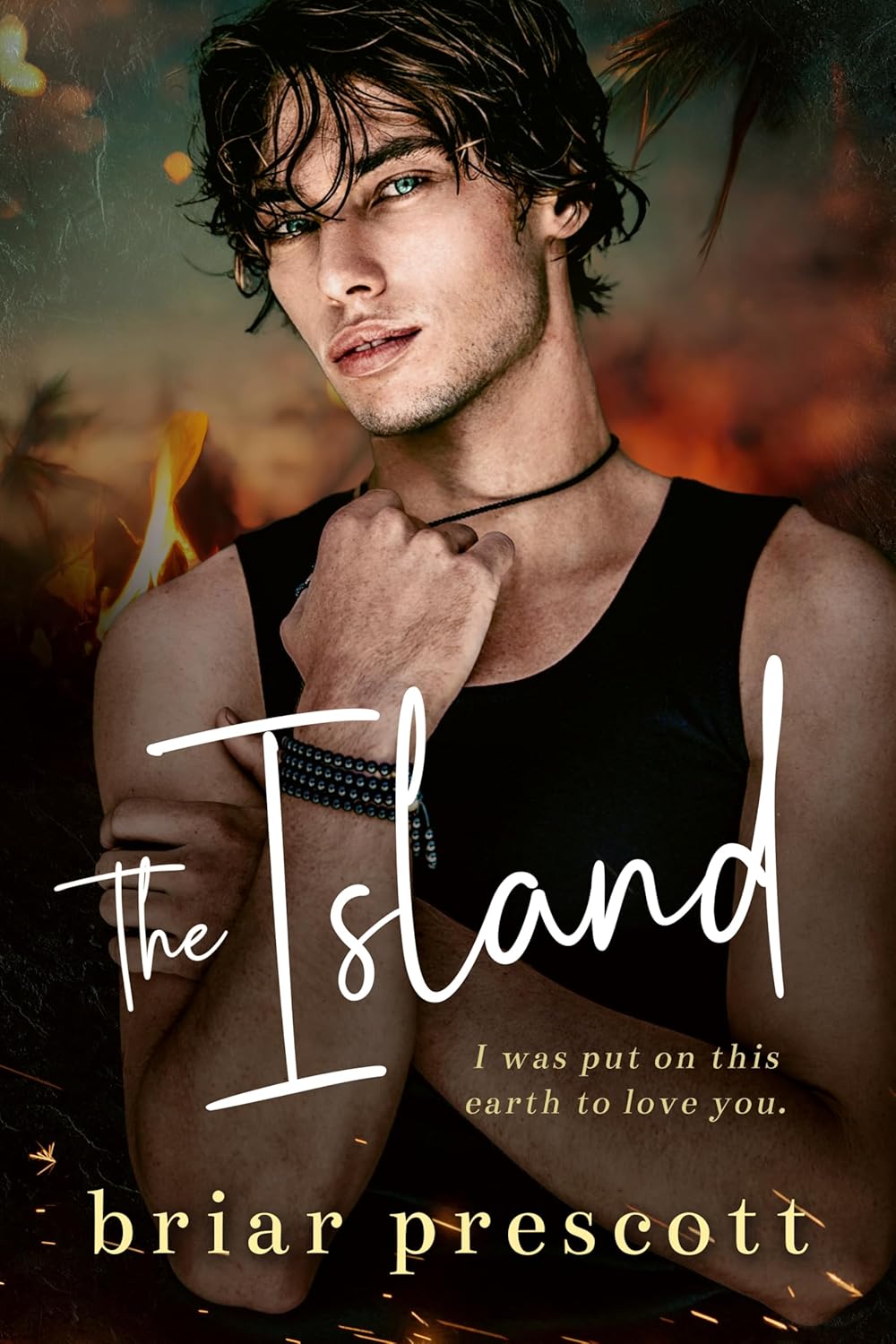
The Island
Briar Prescott’s The Island is an angsty childhood-friends-to-lovers romance featuring Olympic-level pining and an unrequited love that will tug at the heartstrings. I enjoyed it for the most part, although I have to say that it’s overlong (this is becoming a familiar refrain in my reviews of contemporaries lately!) and somewhat repetitive in the final section – and that I’d have given it a higher grade had it not been for some of the authorial choices made in the final third of the story.
The book is divided into three parts. In the first, we meet Dylan Lang, a lonely, only child who was taken in by his aunt (his mother’s half-sister) and uncle after his parents died. His aunt is a snob whose rigidity and insistence on maintaining her social superiority means that Dylan doesn’t have many friends and is absolutely not allowed to have anything to do with the large, chaotic and loud family with six kids, three cats and eight chickens – who move into the house next door when he’s ten. One afternoon, a soccer ball hits him as he’s walking past the house and knocks him down; seconds later, he’s staring up into the face of a boy of about his own age who introduces himself as Adrian and invites Dylan into the back yard to play. From here on in, and despite his aunt’s disapproval, Dylan and Adrian become inseparable, and Dylan is welcomed into the Olsen family with open arms. It’s exactly what he’s been longing for – to have his own place at the table, to have movie nights and people around him – and he finally feels that here is somewhere he belongs.
Things start to change when Dylan is fifteen and he realises not only that he likes boys rather than girls, but that he likes – loves – Adrian more than anyone else he’s ever met. Dylan is terrified of anyone finding out that he’s gay or about his feelings for Adrian – Adrian most of all – and of alienating the only family he’s ever really known, so he bottles up all those new and scary feelings and determines that Adrian will never know about them. Dylan will just have to love him from afar and in silence. But in the process of keeping his secret, Dylan starts to become more and more guarded around Adrian and his family. He can’t stop the pain of unrequited love, but he knows all too well the pain of being left behind and of being alone, so he’ll do everything he can do to keep all the Olsens in his life for as long as he can.
Dylan is dealt a further emotional punch to the gut when they’re both nineteen. Adrian meets Freya and Dylan finds himself with a front row seat to watching them fall in love. Freya is smart, kind and funny, and she very quickly understands just how important Dylan is to Adrian – and Dylan is… if not happy, then at least happy for Adrian that he’s found a good person to love and to love him back. But it hurts so much, and concealing the truth is becoming harder and harder each day. When Adrian and Freya appear to be in it for the long haul, Dylan realises he can’t bear to stick around and watch the man he loves building a life with someone else, so he applies to college in San Francisco and moves away.
When part two opens, it’s three years later, and Dylan is regretting his drunken suggestion of taking Adrian on a pre-wedding bachelor trip to Fiji for just the two of them. He’s decided it will be an ending, the moment when he finally lets Adrian go for good and gets over him once and for all. But fate has a cruel trick in store, and what should have been a luxurious holiday on a gorgeous Pacific island turns into the holiday from hell after their plane crashes and leaves them stranded on a remote and uninhabited island far from their original destination.
When their initial hopes of a rescue fade, they realise that survival has to be their priority, and with nothing to rely on except each other, they manage find a routine of sorts. Life is extremely hard and tempers sometimes fray, but their bond doesn’t waver as they keep each other going with banter and silly jokes when things are looking bad, and by simply being there. Days, weeks, months and then years pass, and Dylan still works hard to keep his feelings a secret from Adrian – so when Adrian starts showing signs that he’s attracted to Dylan, it turns everything upside down and inside out.
Part one of The Island is really good, with Dylan’s growing love for his friend, his anguish at knowing he can never have him, and his genuine desire for him to be happy above everything else, oozing from every page. The second is fraught with danger both physical – hunger, exhaustion, and the ever-present fear of injury – and emotional, as Dylan realises there’s no longer anywhere he can go to hide his feelings from Adrian. Then comes the emotional high of realising that Adrian wants him, too, and that he’s Dylan’s, even if only for a short while. But they don’t really communicate (even though they’re stranded for almost three years!) and Dylan’s instinct for self-protection is so ingrained that he persists in playing their sexual relationship off as casual, which clearly confuses – and even hurts – Adrian.
Still, I was enjoying the story – until part three, when it loses momentum and becomes too drawn out. Some things are done well – Dylan’s very real struggles with noise and crowds, and his and Adrian’s realisation that their experience has forever changed them – but there’s too much back-and-forth and miscommunication (honestly, I wanted to bang their heads together several times and scream at them to just TELL THE TRUTH!), and too much Freya. She is, refreshingly, not the stereotypical evil girlfriend so often found in m/m romance, but the author takes things too far in the opposite direction so she’s utterly perfect, and her presence – and the many reminders of how much Adrian and his family love her – detracts from Adrian and Dylan’s romance, and their figuring out if being together in the real world is what they both want.
I’m a big fan of Briar Prescott’s and I always look forward to new books from her, but I find myself assigning a middling grade to The Island. What’s good here is very good; the longing and pining – not just for romantic love, but to truly belong somewhere and to someone – Dylan experiences throughout is superbly articulated, especially in part one, and the harsh realities of survival on a desert island are brought to life very well. But while there’s a lot of mutual caring on display in everything Dylan and Adrian do to keep each other alive, there isn’t a great deal of romantic tension or sexual chemistry there, and I really wish there had been more honest communication about what they were doing and what it meant. The way that lack of communication persists until almost the very end, and the intrusive presence of Freya in the final section didn’t help to convince me that Adrian would have finally chosen Dylan had their plane never crashed – and that isn’t what I want to be thinking when I reach the end of a romance novel.
Also – I can’t deny that some of the writing is too flowery for my taste and veers into what I call ‘New Adult Navel Gazing’ territory, with lots of breathless short sentences and overblown sentiment.
I’m glad I read The Island because there’s a great deal to like about it and when it’s good, it really shines. But the good didn’t quite outweigh the not so good in the end, and it didn’t work as well for me as I’d hoped it would.
Recent Comments



Man, I was looking forward to a new Prescott book and am sorry to hear it falls apart at the end. The final part of a book makes or breaks it for me since that’s the part that will linger most in my mind. Going to skip this one.
The requirement that every book have a strong, positive female character is not helpful when they get shoehorned in, and is really counter productive in MM, IMO.
Yeah, reviews are fairly mixed overall, but most, whether positive or negative, make the same point about the last part.
I agree about endings – they’re the part that really stick with you, and this one just doesn’t work.
It’s too bad. When she’s good, she’s very, very good, IMO.
I always wonder how these crash outs in the final third happen. Do the authors not run their drafts by test readers?
When she’s good, she’s very, very good
Is why I couldn’t give the book lower than a B minus.
Most of the authors I read regularly do use alpha and beta readers and editors and proofreaders, but I think the trouble – sometimes – is that those early readers are friends or have become friends and aren’t always that great at pointing out serious flaws. In this case, it’s the final third of the book that’s the problem, and that would have meant major adjustments to part two, and maybe a change of emphasis from the beginning – so almost a whole rewrite.
I’m not speaking from any insider knowledge or experience about this particular book – just speculating.
At least the cover art’s good.
I think I’ll skip this for now. I have so many books backed up already and this seems a little iffy. Thank you for the review. I’ve really enjoyed Briar Prescott and I look forward to more books by her, but maybe not this one.
I had high hopes for this, but the last part really did have me scratching my head. I don’t think you’re missing out by not rushing to pick this one up.