The Key
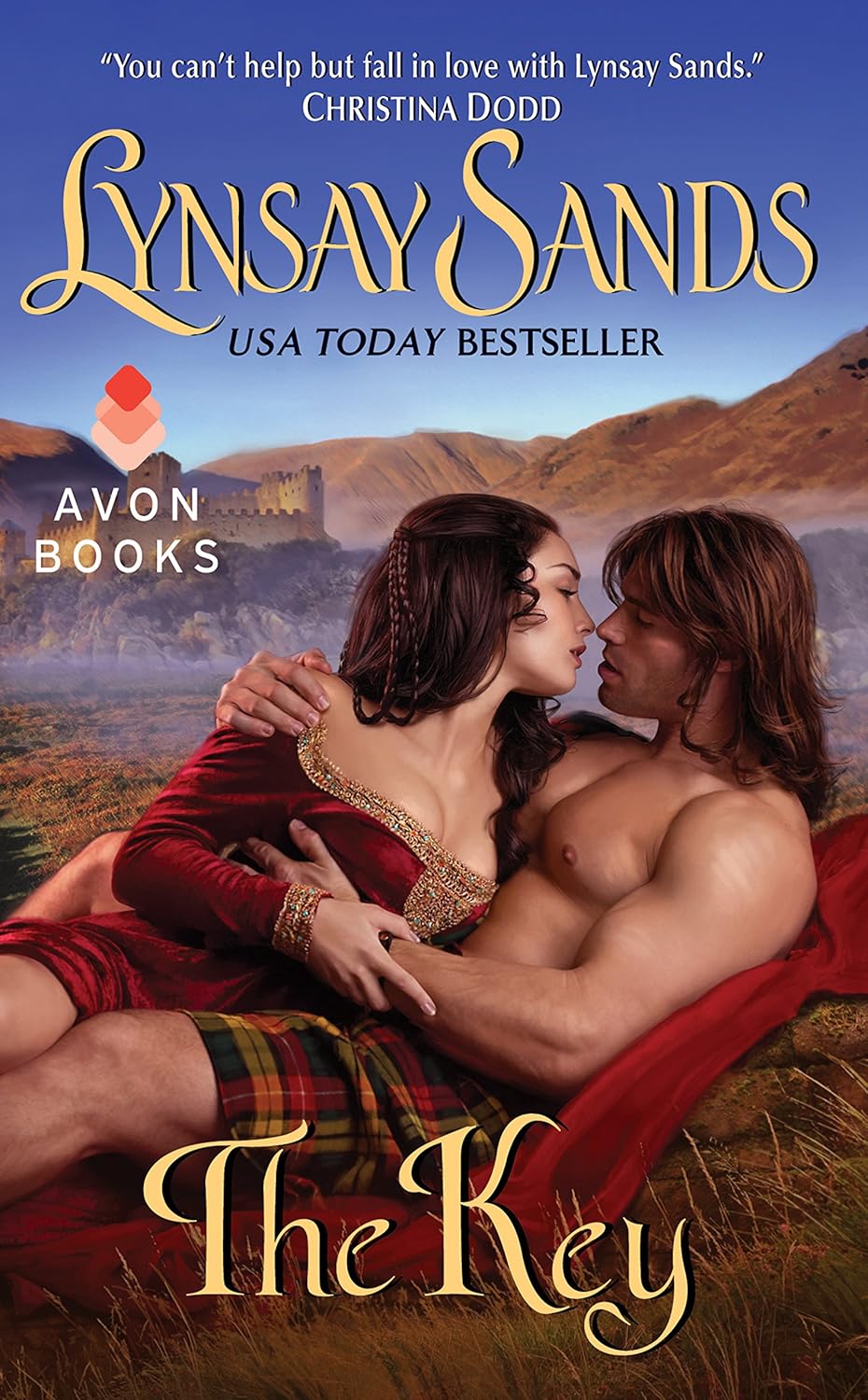
The Key refers to the key to a chastity belt donned by English Iliana Wildwood upon wedding Highlander Duncan, son of the Laird of the Clan Dunbar. While intelligent, handsome and ambitious, he only bathes twice a year. The wedding is in June, you see, and he’s not due for another bath until July. Lady Iliana, truth be told, likes to bathe several times a week. This odiferousness is the basis for conflict throughout The Key, and while it might seem an odd and flimsy basis for a romance, it works pretty well in this medieval romp.
In order to save herself and thereby her widowed mother from the evil Lord Greenweld, Iliana allows the King to arrange a marriage between herself and one of his allies. If she marries and is far away from Greenweld, her mother stands a better chance of fending off the ne’er-do-well herself, and perhaps can gain an annulment. Laird Angus, a wily sort, convinces his son to agree to the marriage – the tremendous dowry will help Duncan achieve his goals for the clan. Iliana and Duncan meet on the day of her wedding. She thinks she’s in trouble after her first whiff; after sitting on a bench stains her dress permanently, she’s certain.
After the wedding, isn’t there a bedding? Well, there is unless the heroine refuses the hero because she doesn’t want him soiling her linens with his filth. Duncan, too drunk at first to notice he’s slept through his wedding night, eventually discovers his wife’s “jewels” are locked up tighter than a drum. Though through words and touch he tries to convince her to give up the key, she refuses to do so unless he bathes. Besides raising his male hackles, Duncan has reasons why he’s dirty, why his clothes are dirty, why his Clan is dirty, and why the castle is dirty.
I won’t reveal all the reasons because it’s more fun to read the book and discover, but part of the reason Duncan and the castle are so barbaric is because Duncan’s sweet mother died when he was but a wee one. After her death, Angus was so desolate he let the place go to hell. Duncan has never known cleanliness and doesn’t “get it,” although he knows he likes the way his new wife smells and looks. He seems to think, though, that all the changes she’s making around the castle are only for herself. Eventually, Angus convinces him otherwise, and proves he’s still lusty (and surprisingly romantic) himself as he regails his son with stories of the joys of bathing with one you love.
When Iliana’s mother escapes the clutches of the evil Greenweld, there’s more than sweat and manure in the air – there’s danger, although the villains (both known and otherwise) are rather stereotypical. Author Sands does a fine job of showing a castle under seige, especially considering the book is a light read. She maintains the necessary balance between dark and light so that readers don’t come to this point and experience an abrupt change in tone. She does this because she’s created interesting characters in Iliana, her mother, Angus, and to a lesser extent, Duncan. Angus, in particular, is a wonderful secondary character – his scenes simply sparkle.
Lynsay Sands has a strong voice for the sort of coarse humor that often works well in medieval romance. One hilarious scene riffs off the fact that Angus constantly misinterprets his daughter-in-law’s fatigue as being related to her newlywed status. She’s tired alright, but from getting the castle in order. After a night in which her husband has been in and out of their room in frustration because he’s not getting any, Iliana and Angus have this exchange:
“I fear my husband had an excess of energy last night.”
His eyes narrowed at once. “He woke ye up last eve?”
“Aye,” she murmured, then seeing the anger begin to cloud his face added quickly, “I do not think ’twas deliberate. In fact, I know ’twas not. As exhausted as I was, ’tis sure I am I would not have awoken at all but for the fact that he could not find the entrance in the dark.”
“Could not find. . .?”
“Aye. But then there was all that in and out, in and out. . . It fair made me dizzy.”
In addition to the coarse humor, the strong medieval feeling comes through in the interplay between clan members and in Duncan’s aborted visit with his old mistress. Sometimes, however, the author takes a misstep. For instance, when Duncan’s sister Seonaid is attempting to learn how to be a lady from Iliana, Seonaid says, “Ye’ve no experience at socializing except with your parents.” “Ye’ve” is true to the period; “socializing” is not. Speaking of Seonaid – she’s betrothed to an Englishman who comes for her at the end of The Key. I hope Lynsay Sands tells their story next; Seonaid is as wild and unfettered as Duncan. Wouldn’t it be delicious if her betrothed were uptight and staid?
Iliana and Duncan’s path to love is fun to be a part of because the author has written such a funny story for them. Your eyes will be watering from laughter when you read the scene where Duncan tries to take a tumble with his wife only to be turned off when he discovers she smells as bad as he does. Falling in manure will do that to a Lady. What makes The Key work is the good-natured character of all the characters and the matter-of-fact manner in which author Sands approaches their story. It’s dirty, it’s smelly, it’s fun, and, yes, it’s romantic.
Recent Comments