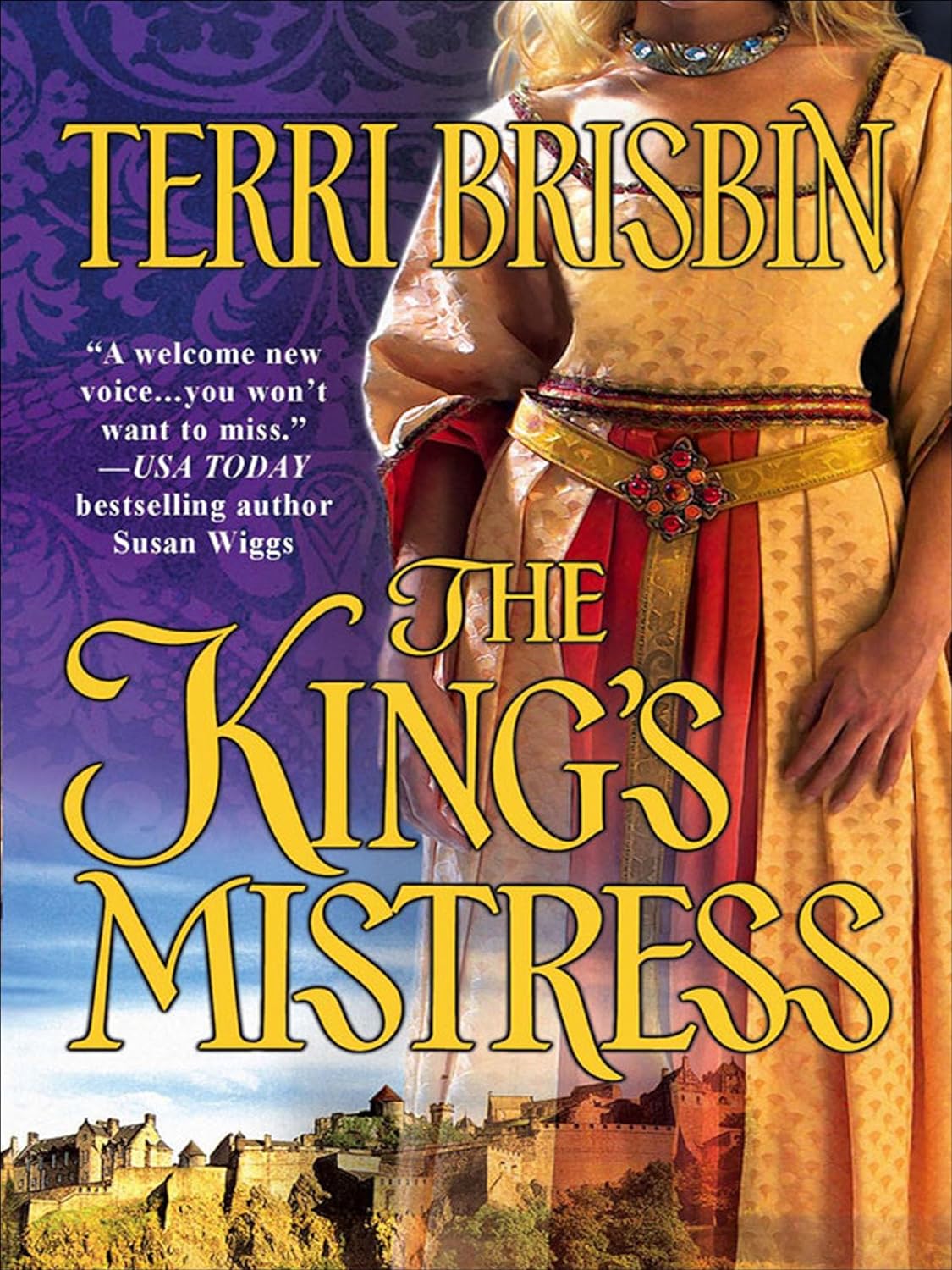
The King’s Mistress
An author faces a great challenge in writing historical romances featuring actual historical figures. When the author isn’t up to meeting that challenge, historical figures can be reduced to one-dimensional props or they can just as easily go too far in the other direction and end up overshadowing the fictional protagonists of the story. In her latest novel, Terri Brisbin strikes a good balance between the two and gives readers an enjoyable romance in which a real-life king plays a rather important role.
As the novel opens, Marguerite of Alencon, the pregnant mistress of Henry II of England, is distraught to learn he has banished her from his Court. Marguerite, who has royal blood and was raised with the assumption that she would marry a king, longs for Henry to put aside his wife and marry her. Instead, after Marguerite has her child, she is given as a bride to Orrick of Silloth, a lord in the north of England.
A minor northern lord, Orrick seems an unlikely choice to receive such favor from the King since he is hardly one of the great land magnates or power brokers of the Court. Still, Henry sees fit to give him both Marguerite’s hand in marriage and quite a bit of wealth and it is an offer no man could wisely refuse.
When Marguerite learns of the match, she is furious. She believes Orrick to be beneath her and even goes so far as to tell him that Henry has only set up this marriage as a means to humble her and that he will take her back before the marriage ceremony. However, Marguerite is mistaken and instead finds herself married to Orrick and traveling to his lands in the north.
Marguerite is no meek, saintly, or insipid heroine. Though somewhat naïve about court politics, Marguerite is intelligent and fiercely proud, even in the face of circumstances that make her an object of pity. She is also haughty and downright vicious at times – especially with Orrick. Fortunately for Marguerite, however, Orrick is no standard-issue alpha male with a desire to put her in her place, but is instead patient and compassionate. He realizes how Marguerite’s place in the world has changed and, since he cares about her, he tries to soften the blow as much as possible.
The romance between Orrick and Marguerite is an interesting one. As the story opens, Orrick is clearly a more sympathetic character than Marguerite, who is still unwilling to resign herself to her fate. However, though Orrick is kind, he is no weakling and the battle of wills between the two is more subtle than the stereotypical Alpha Male Meets Feisty Heroine power struggle. As a result, watching Marguerite and Orrick change in their attitudes toward one another is enjoyable.
Brisbin also does a wonderful job of evoking her setting. Henry II plays an important role in the story, and he is far from a one-dimensional prop. In addition, Brisbin uses a wealth of small details to show what life was like at court, in a monastery, and in a keep without inserting lectures that would distract from the plot, resulting in both an entertaining and informative story.
My only issues with the novel arose toward the end. Without going into detail, suffice it to say that much is left unanswered about Marguerite’s pregnancy. In addition, certain situations and characters are made to be just a little too “nice” for the sake of tying up loose ends before the story is over.
Still, even with those problems, The King’s Mistress is a fun and unusual read. Brisbin strikes a good balance between showing some of the harshness of Medieval life while not making the atmosphere too bleak for a believable romance. This is difficult to do, but always a pleasure when done well, as Brisbin manages here.
Recent Comments