
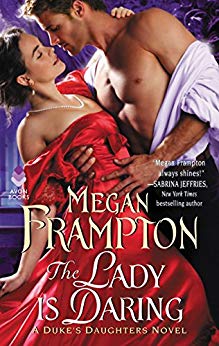
The Lady Is Daring
The Lady Is Daring is the third book in Megan Frampton’s Duke’s Daughters series, which features the romantic adventures of the daughters of the Howlett family.
Bennett, Lord Carson, is being pressured by his spendthrift father to marry an heiress – any heiress – and settle down. But Bennett has been frustrated at the altar twice so far, both by daughters of the Duke of Marymount, so he is not looking forward to a third attempt at matrimony. But since he wishes to keep his sickly mother in comfort, he’s willing to throw himself once more upon the marriage mart, which is filled with women hunting the unbeknownst-to-them strained Carson fortune.
Bookish bluestocking Lady Ida Howlett hates society and fantasizes about doing and seeing so much more than what the four walls of her library have offered her. Opportunity presents itself when she declares her decision to search for Della, their eldest sister, who ran off with their dance instructor and was subsequently seduced and abandoned by him before the start of the series. Impulsively, Ida decides to steal the first carriage she can find to track Della down. Unfortunately, a drunken Bennett happens to be inside of the one she picks.
Bennett – wanting to run away from the pressure to marry just as much as Ida – decides that her adventure sounds like his cup of tea. He suggests they enter into a marriage of convenience – which will protect Ida’s reputation and solve his money woes – while giving them the freedom to remain platonic with one another and eventually divorce when Della is found. She rejects this idea, and they pose as brother and sister while traveling. Along the way they begin to fall in love, a most unsuitable situation, for Bennett is grappling with a secret borne of his father, and Ida, knowing that she’ll be forced to marry Bennett when they return home, is ambivalent about her fate, secretly intrigued by marrying Bennett but not wanting to do so as she knows he’s not romantically interested in her. Or is he? What will happen when they find Della, and what will occur when they get back to London?
AAR staffers Lisa Fernandes and Shannon Dyer read – and were less than impressed with – The Lady Is Daring, and are here to share their thoughts on the novel.
Lisa: I see from your grade you didn’t like this one, Shannon. It worked a little bit better for me, and I found the romance and the mystery surrounding Della interesting.
Shannon: I usually love historical road trip romances, but this one really did not work for me. So much of it felt contrived, and I couldn’t bring myself to care very much about the romance or the mystery.
Lisa: What did you think of Bennett? I liked his wit and his vulnerability when it came to his mother, at least.
Shannon: I liked Bennett a little more than I liked Ida, but he’s far from the ideal hero. His love for his mother was quite evident, but that wasn’t enough to redeem him in my eyes. I found him incredibly whiny, and that’s not something I find attractive. He needed to grow up and get on with living his life in a productive way instead of complaining about how hard things were for him. I also got very tired of him referring to every unmarried young miss as a “Carson Hunter”. It was funny the first couple of times, but it got old fast.
Lisa: How about Ida? Did you find her to be just another wannabe bluestocking adventuress? Was she too anachronistic? I found her to be a little unnecessarily sharp-tongued and mean, and sometimes, she came off as a robotic.
Shannon: I love bookish heroines, but Ida was impossible for me to warm up to. She wasn’t a kind person at all, and her supposed intelligence was used more as a way to keep others at a distance than as a facet of her character. I got the impression she spent most of her time looking down on those around her, and while some occasional snark is most enjoyable, Ida’s constant sniping was pretty tiresome.
Lisa: What about their romance? I thought their banter was fun but found Bennett’s attitude toward Ida a note too condescending (how many times could the man call her ‘his little hedgehog’ ? It’s not the most charming nickname in the universe), and the development of their sexual attraction a little abrupt.
Shannon: Since I found both the leads pretty disagreeable, it was hard for me to become invested in their romance. You’re definitely right about Bennett being too condescending. I think the whole hedgehog thing was supposed to be endearing, but I ended up rolling my eyes after he said it two or three times. I found it difficult to believe these two felt much of anything for each other. Sure, the author told us it was true, but I never felt it.
Lisa: I think it’s because so much of their relationship centers around their snarkiness, offset by almost constant sexual activity. We get one scene where they have a meeting of the minds before they kiss, then it’s pure lusting. What about Bennett’s friendships with the heroes of the previous books? Were they just right or too awkward?
Shannon: I actually liked the way Ms. Frampton portrayed male friendships. The way the men related to one another felt completely authentic. I enjoyed the scenes that focused on those relationships far more than the ones centered around Bennett and Ida. What did you think of them?
Lisa: It was one of the highlights of the book for me; the author is quite good at portraying both sisterly and brotherly friendships. The road trip was a bit colorless and mainly seemed to serve as a sexual travelogue for Ida and Bennett. They did find Della a hair too easily, didn’t they?
Shannon: Road trips have a ton of potential to be fun and flirty, but this one was neither of those things. It felt like a plot device more than anything else, and I have to admit to kind of losing interest in the whole thing about halfway through. It did seem awfully coincidental that they were able to locate Della so easily, but I honestly didn’t care enough to be too bothered by it.
Lisa: How do you feel about Della as a plot device in general? Was her living out in the open in that tiny village with no escort a little too ridiculous for you? Did it mostly feel like they were just setting up for a series-ending romance where she gets married?
Shannon: It’s funny that you mention a series ending romance for Della, because that thought entered my mind a time or two. After all, that’s the way most historical romance series work, isn’t it? All five sisters will be happily married to men who are related in some way to Bennett. It’s a little implausible, but, when it’s done well, it’s kind of comforting to me in a weird sort of way. Unfortunately, I doubt Ms. Frampton will be able to pull it off, and I don’t think I’ll be continuing with this series anyway.
Lisa: What about the general quality of the writing? There were some definite incidents of info-dumping I found distracting; the book really doesn’t work as a solo read and perhaps would’ve had more impact with me if I’d gotten to read it alongside the others. How about you?
Shannon: This is the first book I’ve read by Ms. Frampton, and I think you might have a point about this not working very well as a standalone story. In general, I was able to follow the plot without any trouble, but I imagine I would have had a deeper understanding of the characters and their relationships if I’d read the previous installments. The writing itself felt pretty average to me. I’ve seen better, and I’ve seen worse.
Lisa: One of the novel’s saving graces was the relationship between the sisters Howlett. How did you feel about how the girls interacted?
Shannon: I did like the relationship between the sisters. I didn’t always think Ida was very nice to the rest of them, but I didn’t think she was nice to anyone, so at least there was some consistency there, I suppose. I like that the sisters each possessed her own unique character traits; if Ms. Frampton had written the romantic relationship with half as much charm as the other relationships in the story, this novel probably would have worked much better.
Lisa: What about Bennett’s mother – I found the resolution of her plotline to be so abrupt as to be offensive.
Shannon: I could have done without that subplot. It didn’t really do anything to move the story forward, and it kind of felt like the author inserted it just to fill space. The resolution was completely unrealistic, and could have been done so much better with just a little more research into how such a situation was likely to have been handled in that period of history.
Lisa: What’s your final grade? I’m giving this one a C; I liked the romance and characters to some degree but the entire affair felt a little bland and dull to me, with Bennett and Ida falling too easily into love and very little conflict coming between the two of them to make things interesting.
Shannon: This one gets a D from me. The secondary characters were interesting, and the mystery had some potential, but the central romance fell flat. Do you think you’d read something else by this author? I’m not sure I’ll bother.
Lisa: I’m actually going to give her a second shot; there’s potential there, and I am curious to know what sort of final scandal Della’s plunged herself into.
Buy it at: Amazon/Barnes & Noble/iBooks/Kobo
Recent Comments



In the title of this piece, the word “Is” should be capitalized because it is a verb,not an article or preposition, See below:
Title Case Capitalization
In general, the following capitalization rules apply
Capitalize the first word in the title
Capitalize the last word in the title
Capitalize the important words in the title
Important words in that last bullet generally refer to:
Adjectives (tiny, large, etc.)
Adverbs (quietly, smoothly, etc.)
Nouns (tablet, kitchen, book)
Pronouns (they, she, he)
Subordinating conjunctions (when less than 5 letters)
Verbs (write, type, create)
Title case is the most common title capitalization for book titles, headlines, articles titles, etc.
Words Not Capitalized in Title Case
Articles (a, an, the)
Coordinating Conjunctions (and, but, for)
Short (less than 5 letters) Prepositions (at, by, from)
Agreed. This should have been put in using the title as the author wrote it which did indeed capitalize the Is. I am going to change it.
No one cares, eLiZa
I dunno. I think it’s reasonable to point out to us when we get something wrong. Nicely, of course.
Well said, ladies. I’ve read and enjoyed books by this author, but this series hasn’t worked for me at all.
Thank you so much!
The prospect of an easy divorce seems to be a theme in historicals lately.
Oh, it always has been and I come across only a very few books in which the authors seem to understand that it wasn’t easy at all, far from it. Or that non-consummation alone wasn’t grounds for an annulment.
Grrrr – yes this plot device (marry me now and we will get divorced later when it’s convenient to us and the plot) is just so much rubbish. Excuse the length of the following but it’s from the Cambridge Family Law Practice here in the UK and really does set out the rules pre 1857. Please, authors do just a tiny bit of homework before writing stories based on false pretences and/or credulous fabrications.
“Way back in the days of yore, when the church was more powerful than the monarch, marriage was a church institution and so divorce was also the preserve of the church. Marriage was for life and divorce exceedingly rare, although the church would occasionally grant a divorce “a mensa et thoro” which enabled people to live apart if there had been significant cruelty, but not to remarry. (Henry VIII, of course, did whatever he wanted.) In the eighteenth and early nineteenth century, it was possible to get a divorce granted by Act of Parliament, but such an option was only open to the rich. The Matrimonial Causes Act 1857 was the first divorce law of general application.
The 1857 Act introduced divorce through the court. Men were able to “petition the court” for a divorce on the basis of their wife’s adultery, which would have to be proved, as would the absence of any collusion or condonation of that adultery. Women who wanted to divorce their husbands needed also to prove an aggravating factor of the adultery, such as rape or incest. The High Court in London was the only place to get your divorce, and proceedings were held in open court, enabling society to be scandalised by the personal details revealed during the process.”
It’s such an odd choice especially in pre-1850s England, as Elaine says!