
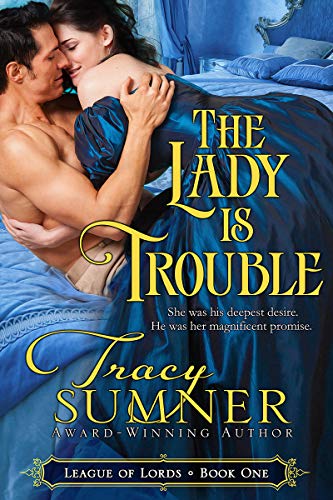
The Lady is Trouble
A scandalous miss and a proper lord – both of whom have formidable psychic powers – meet and clash in Tracy Sumner’s The Lady is Trouble. But the book’s exploration of those powers never gels properly with an anachronistically portrayed London, and the heroine’s seriously immature behavior ultimately gives the reader pause.
Julian Alexander, the eighth Viscount Beauchamp, is alarmed to hear from an ex that Lady Elizabeth Piper Scott (hoo boy), called Piper and nicknamed Pip – his obsession and charge – is performing as the medium Madame DuPre in London. Piper was being kept under lock and key in Gloucestershire so that the League of Lords – a group of noblemen with similar metaphysical or magical gifts founded by Piper’s grandfather – may learn how to manage her abilities to heal the psychologically wounded and see auras. Julian, too is a mentalist – he can touch an object and be sucked mentally into the universe of the person who last touched it. He knows how dangerous the world is for Piper.
Piper knows Julian’s going to be very angry with her, but really, how else was she supposed to get his attention? He hasn’t made contact with her in months, and she knows he’ll always rescue her from trouble because he’s unflappable.
So rescue Piper Julian does, but he still refuses to touch her, having vowed never to do so again after they’d shared an incredible night three years earlier – which is, Piper thinks, the real reason Julian has put her aside. When Piper points out that the League is her legacy and she should be a working part of the organization, they become partners. For her, it’s an attempt at diverting public opinion from the details of her scandalous past. For Julian, it’s a form of self-torture – Piper might have the power to relieve him of the gift that torments him daily, but he cannot parse the difference between wanting her and using her because of her ability to ease his burden. But for how long can Julian resist Piper? And can an orphan who sees dead people bring them together?
The Lady is Trouble is one of those novels that has too many good points to make it a failure but too many annoying problems to award it any more than a middling grade.
Maybe if the book’s supernatural and romantic elements had made a stronger fit for one another it could have worked better, but the supernatural elements of the book are cadged from better movies and books, and read more as an excuse for Piper and Julian’s romantic angst than true worldbuilding.
Piper is one of those heroines; impulsive, bratty, selfish – but she’s also good in the field and not entirely helpless. The hellion type. Julian is very formal when he’s not being anguished; dark and brooding with flashes of humor. Their banter is decent, the sexual chemistry all right.
But Julian is so married to his sense of control and he simply chooses to repeat his mistakes until Piper repeats her own, making him an uncommon frustration to the reader’s sense of
There are also some bobbles with the language. At one point Julian says “don’t. Go. There.” This was not in common parlance in 1860s England, though “dumped,” as odd as it sounds to the modern ear, was introduced in 1700s.
In the end, The Lady is Trouble proves to be an okay read, but not one to be highly recommended.
Buy it at: Amazon or shop at your local independent bookstore
Visit our Amazon Storefront
Recent Comments



Agree with Caz. Can’t see a single reason to read this.
You’re more generous than I think I would have been, Lisa! This sounds like a total mess. Plus the “feisty” heroine thing makes it even more of a nope for me.
I think the hero and heroine’s relationship stops the book from being a total failure, but you’ve gotta be patient to get there.
This is self-published, for those who are wondering. What I can’t get over is how the covers for independently published works seem to be getting better and better. This looks like it could have come from a mainstream romance publisher.
According to Ms. Sumner’s bio page on Amazon, she sold her first novel to Kensington. So she’s a hybrid author. Kudos to her, although it sounds like “The Lady is Trouble” could have had a lot of anachronisms smoothed over. Then again, when you throw in a paranormal element, it calls into question if this is supposed to be more like steampunk in that some of the era’s manners and morals are there, but anything that doesn’t suit the author’s creative vision is generally glossed over.
I’ll be giving this one a skip.
Yeah, I had a feeling the intent was to lean closer to steampunk conventions, but the social conventions are generally the same. Thus!