
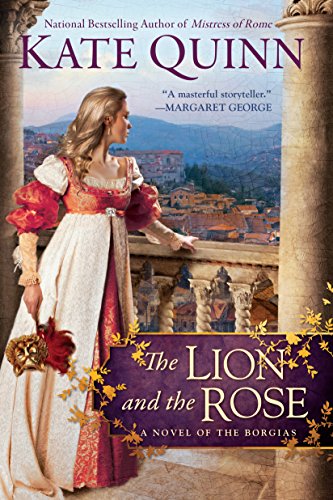
The Lion and the Rose
The Lion and the Rose is not a book I would ordinarily pick up, seeing as I’m not a huge fan of plots involving mistresses, and this is the story of a Pope’s mistress. However, being heartily sick of novels with titles containing words such as “ravishing,” “temptress,” and “scandalous,” I decided to take a chance on something that sounded more like a normal book.
As it turns out, I’m very glad I did take that chance.
The Lion and the Rose is a wonderfully written book. It is a historical novel about the Borgia family—more specifically, it is about Giulia Farnese, the famous mistress of Rodrigo Borgia (aka Pope Alexander IV). The story is told in three alternating viewpoints—that of Giulia, that of her bodyguard Leonello, who is a dwarf, and that of her cook Carmelina, who is an escaped nun. Both Leonello and Carmelina are fictional characters, but they fit seamlessly into the story.
The book begins in 1496 and goes into 1498—a very busy time in the Vatican. All the children of Rodrigo Borgia find themselves back in his city, and they stir up lots of trouble. His daughter Lucrezia avoids her husband and her marriage vows, his sons Cesare and Juan enjoy themselves by carrying on with their brother Joffre’s wife, and a serial killer begins raping and murdering women, leaving them with their arms splayed out as though crucified.
In the middle of this mess sit Giulia, Leonello, and Carmelina, each offering their own unique perspective on the goings-on. Giulia worries about “her Pope” and his inability to see how boorishly his children behave. Leonello concentrates on the murders—his friend Anna was among the first killed years ago, and now that her killer seems to have reappeared, he seeks vengeance. Carmelina is dealing with upheaval in her kitchens and the stress of being an escaped nun, knowing she could easily be dragged back to the convent should anyone discover her secret.
The Lion and the Rose is, on the whole, a really good read. It’s busy enough to keep you interested, yet calm enough to keep you from feeling overwhelmed. There are a lot of historical details which I loved reading about—for instance, did you know that Giulia Farnese was known as the Bride of Christ? (I thought that was very witty!) The romance that developed between Giulia and Leonello toward the end felt rather abrupt to me, but considering that this wasn’t a regular romance novel, I wasn’t too upset by that. Additionally, Carmelina and her apprentice had their own not-quite-secondary romance going on, which was very well laid out. This is not a traditional romance novel, as I said, but there are strong romantic elements.
All this praise aside, however, there were a few things that bothered me about The Lion and the Rose. They didn’t have anything to do with the writing, really, but rather with the type of book it was, and the way fact and fiction were interwoven throughout the novel. As I mentioned earlier, this is not the sort of thing I would usually pick up on my own. I don’t generally go for books where Googling one of the main characters could bring up spoilers. I do love historical novels—just not when their protagonists (or antagonists) are very famous.
Giulia Farnese, for example, is a notable historical figure. Many details are known about her life, and so I can be pretty certain that she did not fall in love with her dwarf bodyguard. Giulia Farnese was a real person with real thoughts, and in spite of loving her character in this book, I know that that character is not the real woman. I felt like some sort of line had been crossed here—how could Ms. Quinn presume to know what went on in Giulia Farnese’s head at all of these moments?
It’s very possible that everyone else who reads The Lion and the Rose will not be bothered by this problem at all. Perhaps they’ll just be swept away by all of the intrigues going on in the Vatican, and they won’t even stop to worry about how much of this book is fact and how much is fiction. All I can say is that I, personally, was a little unsettled by the thought of living inside a real, historical person’s head.
That won’t stop me from seeking out Ms. Quinn’s other books, however. Writers of her caliber are too rare to miss out on.
Recent Comments


I know this is an old review but I’m contemplating reading these :) it doesn’t bother me because that is primarily what HF is. If you don’t read a lot of HF you may not be used to it.
That concept is so common today in historical fiction. It’s interesting someone was bothered by it back then.