
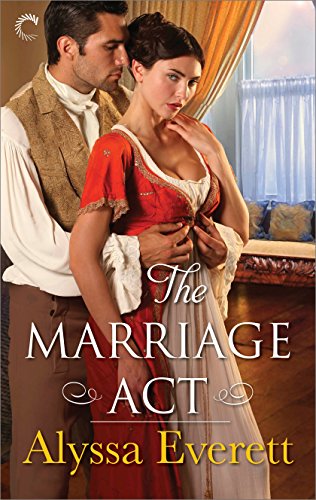
The Marriage Act
Alyssa Everett is one of my favorite authors, one I know I can rely upon to provide me with a well –written and engaging story, well-developed characters and a satisfying romance. She describes her latest book, The Marriage Act as being somewhat “edgier” than her previous ones, and I can see why, because the two protagonists are imperfect characters who sometimes do and say things that are unpalatable. That is not to say that they are unpleasant characters; just that their imperfections make them seem that much more human and the way Ms Everett has written them makes their sometimes less than perfect behaviour easy to understand and even (on occasion) to sympathise with, which is not something many authors can successfully pull off.
The story opens with John, Viscount Welford, in the middle of proposing to the beautiful seventeen year old Caroline Fleetwood, daughter of the Bishop of Essex. A former pupil of the bishop’s, John is an intelligent and rather serious young man who is poised to take up a career in the diplomatic service. He fell for Caroline more or less at first sight, and had hoped to court her at length so that they could get to know each other, but he is shortly to travel to his first posting, and wants things between them were settled sooner rather than later. He is thrilled when his proposal is accepted, and arrangements are made for a speedy wedding so that they can be married before leaving to take up residence in Vienna.
What John does not know is that Caroline has accepted him only because she is desperately in love with someone else, and on the morning of the proposal received a letter from him refusing to elope with her. In her selfish naiveté, she believes that the news of her engagement will make him jealous and bring him around, and she gives no thought to how such actions will affect anyone else. At the time, all she sees is that John is too old for her (he’s twenty-six) and that he’s cold and stiff-necked. She doesn’t intend to actually go through with the wedding – but time flies, she is swept up in all the preparations and before she knows it, it’s her wedding night.
Caroline finds pleasure in her new husband’s lovemaking, but after the consummation – confused, upset and perhaps a little tipsy – she runs away intending to meet the man she loves. Fortunately for her safety and her reputation, John catches up with her and brings her back. Utterly furious and not a little sad and disappointed, he takes Caroline back to his Surrey estate and then leaves for Austria. Alone.
Shortly following his return to England five years later, John is approached by Caroline, whom he has not seen in all that time. She has received news that her father is seriously ill and may not have long to live, and she wants to go to visit him. But she can’t go alone – because she couldn’t bear to tell the father she loves so dearly that she had made a mess of her marriage, she has led him to believe she has been living in Vienna with her husband for the past five years. So she asks John if he will accompany her – and to act as though they are happy and very much in love. The idea of deceiving the bishop, of whom he is very fond, doesn’t sit at all well with John, but he nonetheless agrees to Caroline’s request.
If ever there was a story that proved the adage “what a tangled web we weave/ when first we practice to deceive”, this is it, as the consequences of Caroline’s – admittedly massive – initial falsehood come home to roost. The first interactions between her and John are difficult; recrimination hangs in the air like the Sword of Damocles, they are both resentful and angry and can’t stop themselves saying the hurtful things they are thinking. In Caroline’s eyes, John is just as cold and inflexible as she had believed him to be five years earlier, although she is rather surprised to realise that he is not as old as she had thought and that he’s also a very attractive man. And even though he thinks Caroline is even more beautiful now than she was before, John still sees her as dishonest, flighty and irresponsible, with no concern for whom she might hurt with her lies and incapable of admitting her faults.
As the couple begins to spend more time with each other, they gradually come to see that they were wrong in their initial assessments of one another, and that perhaps it’s time to attempt to repair their relationship. The thing that impressed me most about the story is the fact that Ms Everett doesn’t take the easy way out and have them bury the hatchet straight away or hit the big red reset button. Too much has happened between them for them to be able to go back and start again; they need to pick up where they are now, and make things work from there – and it’s hard. In the early days, John and Caroline take one step towards each other and two steps back; they are still nursing hurts and grievances and still find it difficult to stop needling each other and assigning blame. I will admit that, as a hero-centric reader, I was more inclined to John’s point of view, and actually, couldn’t quite see how it was that Caroline gained her impression of him as being so uncompromising and tyrannical. A man whose bride runs away on their wedding night is entitled to be mad as hell, and it seemed to me that Caroline had formed almost all her opinions of him based on that one event.
In fact, I wanted to smack some sense into her more than once because she so often jumps to the wrong conclusion and does it deliberately, even as she realises she is cutting off her nose to spite her face. However, speaking as someone who has, regrettably, been guilty of such a thing, I completely understood where she was coming from even as I wanted to scream at her to stop doing it! And that’s another impressive thing about the book – even when I hated what one or other of the characters did or said, the author was showing me exactly why they were doing or saying it, so that even as I was thinking “ouch!” I understood their motivations. Their reactions and responses feel so real precisely because they’re messy and not always the right thing to say or do – and it’s a brave author who is prepared to have her characters come across as less than perfect.
So – having heaped all that praise upon the book, why isn’t it a DIK? It came very close, but ultimately, Caroline’s initial selfishness and her unpleasantness towards John – who had done nothing to deserve it – went a little too far for my taste.
That said, don’t let it put you off reading it, because it’s very well written and there is plenty of heat between the protagonists. In fact, the sex scenes are a bit steamier than in Ms Everett’s other books; they’re not overly explicit, but these two could set fire to the sheets, and I do like a slightly uptight hero with a naughty streak where it counts ;)
I really enjoyed The Marriage Act even though it’s not always an easy read. There is a strongly drawn cast of secondary characters and a very well-done secondary storyline featuring John’s younger half-brother; and I liked the way John’s backstory is drip-fed through the book so that the reader gets to know him at the same time Caroline does. I’m a sucker for a good second-chance romance, and this is one of the best I’ve read.
Recent Comments




I really enjoyed this book too, and I adored John in particular. I found Caroline very frustrating however, as she seemed so determined to paint John as the tyrant, when really she was the one to blame for most of the problems in their marriage. I am not a particularly hero-centric reader too, so I think the fault lies in the author’s portrayal of Caroline. That said, I loved her slow realisation of her love for John.