
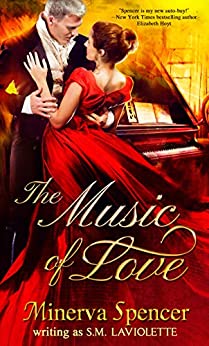
The Music of Love
I have to confess that The Music of Love is one of those little catnippy books that grabbed me by the collar and made me laugh, even though it’s got enough problems to keep it far from a recommended grade. You will roll your eyes at the character names or be annoyed by the haughty push and pull between the leads; the heroine does things that someone of her maturity level should never, ever do, there are two – count ‘em, two – mistaken infidelity plots, but some of its more sensationalist portions are still amusing. Though, of course, your level of suspension of disbelief may vary – especially when the hero and heroine bang for the first time after watching his stallion mount a mare. But that’s putting the proverbial horse before the cart.
Portia Stefani (and yes, I kept hearing the strains of No Doubt in the back of my head whenever I read her last name) is in dire straits. Her philandering ex-husband had once been a great pianist, but his arm was crushed in an accident, ruining his career. He drained her finances while in the process of fleeing their marriage before being presumed dead in an accident, forcing the closure of the music academy for young women which bore his name but which Portia ran. So now Portia needs to go out into the world in search of enough cash upon which to live without assistance from her estranged relatives.
An offer comes through the Stark Employment agency from a Mr. Eustace Harrington of Cornwall, which offers Ivo Stefani a hefty sum to privately tutor a gentleman in the art of playing piano. Portia has no recourse but to take the offer herself, a decision which causes her anxiety, but which means she might eventually be able to afford to create a household with three other teachers with whom she has a close friendship.
Eustace – called Stacy within the family, which is just as well, because he thinks “Eustace” sounds like an “undertaker’s name” – didn’t expect a woman to show up, and feels betrayed that the famous Ivo Stefani has not after all been engaged to teach him piano. Stacy has lived in seclusion within his family home, hiding from the gaze of his tenants for all of his thirty-five years because of his albinism.
Fearing that others will find his physical appearance monstrous, his maiden aunt, Frances, has been taking care of him his whole life. He wants Frances to have a life beyond him but she’s never managed to grasp one, nor has Stacy managed to truly do the same. The appearance of Portia throws him off course, and his response is to bait her.
But Portia is exactly what she told him she is – a highly skilled pianist with classical training. And Stacy is moved by her music – and her other attributes. His aunt likes her, and she soon begins fitting into the household. Portia and Stacy soon begin a physical affair which is complicated by her pregnancy – and their subsequent engagement. Will a dark secret cloud their happiness?
Music of Love is a truly mixed-up bag, with more good than horrifying parts, and some cartoony over-the-top notes that don’t go with the rest of the composition, landing it on the negative side of a C grade.
I liked that Portia had experience – a lover before marriage, a bad marriage, but a sexual desire and orgasmic history that caused her to have wants and desires that she wanted – nay, demanded – Stacy fulfill. But I didn’t like the way she leaped to various conclusions, and she does something in the middle of the book that was at first understandable, then jaw-droppingly foolish, and her choices afterward are perfectly ridiculous and show the reader that her marriage to Stacymay have been far too hasty.
Stacy, meanwhile, has depth but strikes a few too many annoying alpha notes, ultimately coming in several notches below some of the author’s other roguish but loving heroes. Yet he’s also the guy who talks aloud to his anxious stallion, Geist. You cannot say he’s without his charms.
While the central relationship moves quickly, it packs a lot of heat and banter between its covers. Stacy gets a boner when Portia plays the piano – that’s true love. Though I could have done without them getting hot and bothered after watching his stallion mount a mare, which was an eyebrow-raiser even if it’s a traditional trope. Sex does seem to be the tie that binds them together however, aside from a shared love of music and sense of humor.
They’re married before the book’s halfway point and the narrative scrounges for false dusk moments, from a mysterious stalker to a surprise twin brother to a mistaken affair. The plot truly is Music of Love’s own worst enemy. And several of its twists fail to make sense. Prime example: Stacy doesn’t want any of the locals to gossip about his albinism – yet he regularly visits houses of ill repute in other areas, because of course he does.
In the end, Music of Love is campy and may scratch a few old school itches for some. For the rest, it’ll be too rich a desert to sample.
NOTE: this book includes discussion of underage sexual activity. And on-page horse breeding. Yes.
Buy it at: Amazon or shop at your local independent bookstore
Visit our Amazon Storefront
Recent Comments

Going back to read this review now (after having read the book a little while ago and enjoying it in almost exactly the same way you did) I have to say you hit all the beats perfectly in this review.
I read your review nodding my head, (yes, yes, exactly, yes) through the whole thing. From the inadvertent Gwen Stefani imagery to the wtfery of the last part of the book.
And like you, there was a lot I enjoyed about it. I really wish that the author had either a strong editor or beta reader or someone who could have said “this part is excellent, here’s where you start to lose the plot and here is where it’s just a nutty free for all”.
Sometimes you read a book and it’s just a mess from the first sentence- but this one I really dug into and thought for sure it was going to be an “A” read (and it could have been) but it just fell apart.
I can’t read this author after reading her first one where Muslim characters existed as exotic and one-dimensional villains who prey upon white people. I took my time two years ago and wrote a review of Spencer’s appalling racial politics in Dangerous, posted it on GRs, and until I saw this review today, I forgot she existed.
That why you called it a mixed bag?: https://www.goodreads.com/review/show/2422177055?book_show_action=true&from_review_page=1
@TiradesRFun- Love your screen name!
Yes, because the first part of the book was deceptively engaging and didn’t provide many clues for me where it was heading. I optimistically thought from the first chapters that the theme of two people defined by society as outcasts would lead to a sympathetic treatment of what being “Othered” is about – along gender lines, certainly. But nope, the Othering is a castigation of racial others, it turns out. Pirates, harems, harem women, Muslims — all fit into a ugly narrative of discrimination.
“I optimistically thought from the first chapters that the theme of two people defined by society as outcasts would lead to a sympathetic treatment of what being ‘Othered’ is about.”
I haven’t read the book in question, although I can see why you would be disappointed. However, I must say that outcasts can be often cruel to other outcasts, even though it doesn’t make sense on a rational level. This brings to my mind how gay provocateur Quentin Crisp not only got beaten up by homophobes, but was often shunned by other gays who considered his campy effeminacy a “bad image” of homosexuality- which caused him to be thrown out of gay bars for being “too gay.” Go figure.
Again, since I haven’t read the book, I can’t say if Ms. Spencer handled the “ugly narrative of discrimination” with any sort of nuance or historically believable attitudes. But it certainly wouldn’t surprise me if two outcasts found reasons to dislike others. I would think a historical woman held captive for 17 years would have an especially hard time being enlightened toward the race/religion/culture of her captors- especially if she was initially raised in a society that looked down on others as a general rule and she never saw anything significant to refute her ingrained attitudes. I’m sorry to say I have met people today (in the 21st century!) who despise this group or that group because a member of that group killed one of their family members in a war. So the tendency to “other” people with sweeping statements is, unfortunately, quite natural and sadly believable- irrational as it is. And probably even more harsh and believable in a historical setting.
None of this is to say the pirates, harem members, Muslims, whoever couldn’t have been portrayed as three dimensional. But not having read the book in question, I reserve judgment on this.
The last book I read with a plot that centered around music was Cadenza, by Stella Riley. I really like harpsichord, and the novel blew me away. (Plus, I discovered a composer whose work I was unfamiliar with.) I also think it can easily be read as a stand-alone, even though I went through her books in order.
That book firmed my conviction that love of music makes a historical romance better overall at keeping my interest. Mary Balogh’s Simply Unforgettable was another plot with extra appeal for me, particularly since I love Handel and could hear those arias in my head. One of my favorite scenes from Lisa Kleypas is when Helen plays a Welsh song for Winterbourne, in the novel that precedes Marrying Winterbourne.
This review does not inspire me to read something that sounded promising in the beginning. I don’t think the music is enough to get me through it. I think having an albino hero works, but I have vague recollections of reading something else that maybe handled albinism better. And I am not sure that albino eye color (the lack thereof, as I understand it) and skin color tones appeal to me personally. Which exposes an interesting hypocrisy on my part, given that I tend to defend heroes who are injured, handicapped, or just not conventionally good looking, and be pleased with writers who make them convincing heroes on other points independent of height and handsomeness.
I like your reference to Cadenza, etc. Sometimes when I read really well written HR, particularly someone like Georgette Heyer, I can almost hear a harpsichord which is my favourite instrument tinkling in the background of my mind. Or a quiet string quartet providing the dance music in a scene set at Almacks. I always enjoy well done dance scenes in TV or film productions of Jane Austen’s novels.
Just to warn you, the piece front and center in Cadenza is “Vertigo,” by Royer, which does not tinkle or flirt with the keys. It storms and thunders. It makes the Harmonious Blacksmith sound like a nursery tune. It’s on YouTube played by Jean Rondeau, if you want to listen to it.
As a musician, I’m very picky about the way music and performing is presented in novels. But Cadenza does it very well – it helps that Stella Riley is something of a musician herself.
Albinism has to be one for the books, as the expression goes. Not heard of that one in a “beauty snd the beast” trope before. I just thought the guy was a silver fox after looking at the cover.
Yeah, I wouldn’t have guessed albinism either based on the cover, but I imagine it is difficult to find albino models for romance covers. But kudos to the author for not shying away from making him the hero. I do wonder though if she referenced any of the challenges he might face beyond people reacting to his physical appearance, such as vision problems and easily burning in the sun.
“Stacy gets a boner when Portia plays the piano – that’s true love.” LOL! If hearing the piano turns him on, what would an orchestra do?
“Though I could have done without them getting hot and bothered after watching his stallion mount a mare, which was an eyebrow-raiser even if it’s a traditional trope.” This is a traditional trope now?
Thanks for the review, Lisa.
All I can hear in my head is The Lonely Island singing “Jizz in my Pants.”
In old skool romances! Or maybe I’m just thinking of Ryan’s Daughter.
You’re welcome!
I was sad to read this :( I’ve enjoyed other books by this author and was pleased to see she was branching out into self-publishing. Let’s hope this was a one-off misfire.
I have high hopes for the next book in the series!
The review is a fair take, although I enjoyed it more (B-), and I did like the next installment better.
That said, I read the first novel in the next series by LaViolette (aka Minerva Spencer), which she warned was erotic romance. I consider myself pretty unshockable, but there is a scene in His Harlot that I still can’t bleach out of my mind. It was gross, gross, gross, and even though the heroine is supposed to hugely (and ridiculously) get off on pain, it was so emotionally mean, selfish, and sexually squicky on the hero’s part that as a reader I recoiled. Most UNerotic thing I’ve ever read. It was a huge DNF for me.
@Vivi- Erotica is definitely a mixed bag. As someone once said, “One person’s yuck is another person’s yum.”
@Nan, get it. A heads up, nonetheless!
Oh, I am definitely agreeing with the problems in your description. Double that yuck!
And I didn’t mean to imply that you *didn’t* get it. Sorry if it sounded that way! I was just sharing a quote I liked about differences in erotica taste. :)
Nan, it’s a good quote ;-)
Thanks, Vivi. :)
HARD PASS!
Eeew. Just… eeeew. I mean whatever floats your boat, but that would sink mine!!
I think I was disturbed because there really isn’t consent from all three parties. YMMV. It’s still not my jam but it would make a difference to me. Spencer’s writing can be OTT, like old skool romance, but she is a good writer, which unfortunately made the scene especially vivid!
Anyway, thank you all for letting me share because I’ve been screaming silently in my head for the last two days
My laughing crying emoji didn’t load, lol. Seriously, thanks ladies!
That is a…writing choice there.
I was bouncing between a B and a C for a long time, but the last string of nonstop misunderstandings just wore on me!