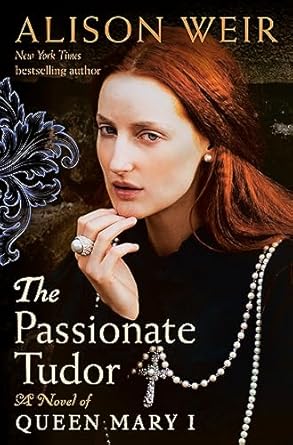
The Passionate Tudor
Alison Weir has written plenty of excellent books covering Tudor England, so fictionalizing the life of ‘Bloody’ Mary would seem to be right up her alley. But her fiction is usually a bit better than this, and the dry, stiff prose and info-dump-style explanations make the book slow going. But it also has a fire in its belly, and when it gets away from dully relating historical events it really sings.
Following Mary Tudor from her birth to her death, The Passionate Tudor covers many steps in Mary’s life, from her time as an innocent princess and Henry’s only living heir to the deposition of her mother and her removal from the line of succession to her eventual ascension to the throne. Weir takes the time to humanize Mary, giving her depth as a person and grounding her religious fervor in her close relationship with her mother and Catherine’s goal of uniting Mary in marriage with a Spanish prince. Her close relationship with her sister, Elizabeth, which soon becomes bitter and fraught, as well as those with her brother, father and many of her stepmothers play out in an interesting way. Eventually, Mary’s dream of reinstating Catholicism as the religion of the English and marrying a Spanish prince come true – but the reality she faces does not match the fantasy she’s lived with for so many years.
What’s fascinating about The Passionate Tudor is the way the story is divided, with half focusing on Mary’s life before her reign and half on her reign and death, which gives us a decently balanced look at her life. Peeking at early romances, harsh imprisonments and deep loses, it makes Mary a more interesting character than she often appears in Tudor and Elizabethan fiction, where she is frequently flattened out into a Catholic fanatic haunted by her phantom pregnancies. Here, frustrated in her complicated love for Phillip and forced to cope with political machination for the five years before her death, following her is fascinating process.
But there’s a surprisingly high amount of heavy-handed discussions that come straight out of the ‘As You Know, Bob’ school. Characters directly musing to each other out loud about their pasts, world events and other situations in the world’s stiffest way usually doesn’t happen in one of Weir’s novels, but here, there’s so much of it felt like I was taking an open book history test; there’s no natural flow to it. Which is why The Passionate Tudor ranks at the lower end of a B; it’s compelling but alarmingly dry. Hopefully, Weir’s next novel will return her to a more engaging place.
Recent Comments