
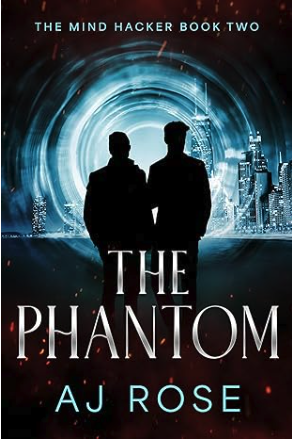
The Phantom
Having really enjoyed AJ Rose’s The Family Man (book one in The Mind Hacker series) I’ve been looking forward to reading The Phantom, which promised to be another compelling read. The suspense plot is interesting and well-constructed – I like the way the author balances the moments of action with the painstaking research and the time spent looking through files and CCTV involved in our protagonists’ line of work as behavioural analysts with the FBI – and the romance is progressing well, although there are some very real obstacles to overcome.
Note: this is a same-couple series, so there are likely to be spoilers for the previous book in this review, and reading the books in order is advisable.
The Family Man introduced readers to the members of Unit 4 of the FBI’s elite NCVAC (National Center for the Analysis of Violent Crime) division, a four-person team headed by the enigmatic Jon Anderson, one of the BAU’s most effective agents whose reputation for being cool, calm and collected has earned him the nickname ‘Ice Man’. Special Agent Tracey Smith, the newest member of the team, was shot in the leg during the take-down of the serial killer Jason Finch (aka the Family Man), and Jon suggested that Tracey should stay with him while he recovers. It’s a perfectly reasonable thing to do – Jon’s house doesn’t have as many stairs as Tracey’s three-storey townhouse, and he’ll need help getting around for a few weeks. What their teammates don’t know is that Jon and Tracey have become more than just colleagues; they’d struggled – in vain – to resist their growing mutual attraction and had hooked up a couple of times while on the case, despite the FBI’s anti-fraternisation rules. It’s been a long time since Jon has felt this kind of connection to anyone, and Tracey has never felt so strongly drawn to a guy ever; neither of them has a clear idea of where their relationship might go, but they know they want a chance to explore the possibilities in spite of the potential risk to their careers.
When The Phantom begins, Tracey and Jon have been living together for a couple of months, getting to know each other better and settling into a kind of comfortable domesticity they both enjoy. But they know it can’t last and are both unsure about what they want to happen once Tracey is cleared to drive and their last reason for ‘rooming together’ is gone. But all that has to be put on the back-burner when a new case comes their way. The body of a man found dead at a DC motel appears to be linked to a few other recent murders – two in Chicago, one in Atlanta – and the boss wants Unit 4 on the case. Tracey has been back at work for a while on desk duty, but has just been told he can ditch his crutches (despite his doctor’s concern that his leg isn’t healing as it should) and is ready to get back into the field. Accompanied by team members Sarena Mercado and Perry Vaughn, Jon and Tracey make their way to the scene to meet with local detectives and see if they can work out what might link this death to the murders in Chicago and Atlanta.
When two very different pictures of the victim emerge – one of them a conservative family man working for a publicly anti-gay lobbyist group; the other a man who regularly engaged in rough sex with anonymous men – the deep dive into his background reveals some some unsettling things about his past that could considerably widen the suspect pool. Speaking to friends and lovers of the other victims also reveals some clear similarities between them – namely that they all had to deal with some pretty horrific things in their lives because they were queer – family ostracism, physical and emotional abuse, conversion therapy – things that left indelible imprints on their psyches that ultimately made them into the perfect prey for a deeply disturbed killer.
AJ Rose states in their note at the beginning that the work of the BAU as depicted in fiction is romanticised, that the analysts are usually backroom boys whose work is to find clues by combing through crime scene evidence, witness statements and police observations, and they freely acknowledge that they, like all those other writers and producers, have taken a degree of dramatic license for the sake of telling a good story. But I like the analytical element in these stories and that we’re not jumping from one car chase or shoot-out to the next; I like reading about people who use their brains to save the day, and I enjoyed being alongside the team as they question family, friends and aquaintances of the victims, watching them think through the information they’re given and piecing it together with all the snippets they glean from other sources. There are real moments of frustration as they come up against legal brick walls that impede the investigation, and moments of hell, yeah! when things begin to fall into place and strong leads emerge.
But while the case is fascinating, The Phantom feels more relationship-centred than The Family Man, with Jon and Tracey now a couple in the early stages of a relationship that is perhaps moving a little too fast. Tracey is dealing with a lot – he’s still new to the job and the city, his injury isn’t healing properly, he’s still having nightmares about what happened to him, he’s only just realised he’s bisexual, and he’s in his first ever relationship with a man (and worrying about coming out to his parents) – so it’s no wonder he’s feeling somewhat overwhelmed by it all. He cares for Jon and knows Jon cares for him, but he comes to realise that maybe he needs some space to process everything and that living with Jon isn’t going to make that any easier. They need to choose each other, not just be together because they’ve been thrown there by circumstance – and even though they can’t be openly together at work, he doesn’t want to feel like Jon’s dirty little secret. It’s a tough ask and they both know it, so Jon arrives at a kind of halfway-house solution by intiving Tracey to meet his best friend and his new partner; he and Tracey can be out as a couple with them as they’re unlikely ever to cross paths with anyone at the FBI. (I admit that this seemed really odd – there’s a very real threat to their jobs if they’re found out so the idea that they can be seen as a couple in some places and not in others feels like they’re taking a really big risk.) And Jon has spent so many years in the persona of the Ice Man that keeping secrets has become almost second nature and he’s finding it difficult to let Tracey fully into all aspects of his life. There are things he needs to tell Tracey – things he plans to tell him – but something (and he doesn’t know quite what) is holding him back. (I have the feeling this is going to bite him in the arse fairly soon!)
Once again, there’s a great sense of camaraderie between the members of Unit 4; Perry and Sarena have important roles to play, I liked their banter and the way they all have each other’s backs no matter what. I’ll repeat some of the minor criticisms I levied at The Family Man – there’s a bit too much minutiae in some places and the pacing flags a bit in others – and add that the final take-down is perhaps a little anticlimactic, but even so, The Phantom is a solidly good read and an engaging instalment in this new(ish) romantic suspense series. I’ll definitely be back for book three.
Recent Comments



This, and The Family Man, sound interesting. Knowing my tastes, do you think I’d like them?
I don’t think they’re overly violent or tortuous, although both feature serial killers – and this one is, as I said, more relationship focused than the first. There is drama, but it’s not twist-your-guts-up-Gregory-Ashe-style drama – and the first book has a bit more action, but I don’t think there’s anything in either of them that you wouldn’t read in most romantic suspense novels – although as this is a series, there’s room and time for the central relationship to develop.