
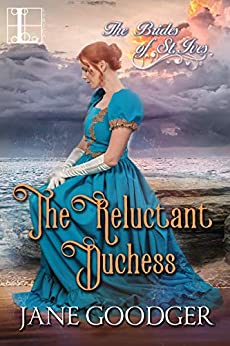
The Reluctant Duchess
I saw that Jane Goodger’s romances had received grades on AAR ranging from B+ to C-, so I picked up her book The Reluctant Duchess. It was clearly inspired by Beauty and the Beast, and I’m always hopeful there’ll be a new spin on this trope. This is the fourth book in the Brides of St. Ives series, but can be read as a standalone.
The story begins with Oliver Sterling, the Duke of Kendal, looking at the latest in a long line of portraits of beautiful women which he collects (the portraits, not the women). The woman in in this portrait is particularly intriguing. Oliver, whose parents died when he was very young, believes he’s a freakish monster and hides away from the world. He’s unbearably lonely as a result, so he tells Winters – who was previously his guardian and is now his only liaison with the world – to find the woman in the painting, marry her by proxy, and bring her back to his home. This was a promising start to the story, because it held out the hope of Oliver actually being ugly and his wife having to deal with it.
Rebecca Caine, the woman in the painting, has a father who routinely runs up gambling debts, so he pays those off by handing her over in marriage. She agrees as long as he promises he won’t gamble again, then sets off with Winters to her new residence. There, her new maid shows her into her bedroom, darkened in anticipation of the duke’s arrival, and tells her none of the (current) servants have ever looked at the duke’s face. Anyone who does so turns to stone, and the petrified remains of one such unfortunate are in the garden as evidence.
I began to wonder if this was a paranormal in which the hero was a basilisk. But it was certainly an unusual buildup, and I liked the gothic feel of the story, with the secret passageways in the house and the distant sobbing Rebecca hears now and then. She declines to consummate their marriage on the first night, but by the second night, she’s a little more comfortable – and curious about her husband. He still won’t let her see him, but by the third night, they’re talking from either side of the connecting door. Rebecca becomes more assertive with the controlling Winters, helps the tenants, and does all the good that Oliver, skulking in the shadows, has failed to do.
He does have one hobby I loved, though – he builds dollhouses with exquisite miniature furniture, and when Rebecca discovers these, she sews tiny rugs and leaves them in the houses, which was a nice touch. Unfortunately it wasn’t enough to make up for the disappointing part of the story. Anyone who wants to avoid spoilers should stop reading… oh, about right here.
Oliver has albinism. Yes, this is why all his servants behave like Perseus confronting Medusa. Rebecca finally takes a good look and tells him what’s what, but that only raises the question of why he has never seen a doctor who would set him straight. Rebecca even has to suggest that he get tinted spectacles for his light-sensitive eyes. The hilarious part is that after she enlightens him, he finds a book in his library which describes the condition. I’ve never read about a more passive hero, but of course he makes up for it by being gorgeous and sexually skilled.
And unfortunately this was not the only paper tiger lurking in the story. The happy couple decide to make their entrance into society and have Rebecca presented to the queen, especially since now Oliver won’t commit regicide with a single look. So Winters arranges for a battle-axe of a woman to beat Rebecca’s provincial accent into shape, which felt like a weird foray into My Fair Lady territory. But she’s never actually presented, because when they’re in London, a new problem crops up – a rumor that she and Oliver are not married, because of the whole proxy business, so they return home, but suddenly have a different issue to deal with. All this meant I kept reading, but more out of curiosity as to what convolutions the plot would wriggle into next, rather than because I was emotionally invested in the characters.
And then there were the other small issues. Rebecca’s maid’s name is Darlene, the word “baronet” is twice spelled “baronette”, and the writing suffers from an overuse of adverbs. Nothing stood out as really bad, but ultimately the multitude of implausibilities made it impossible for me to recommend this book.
Buy it at: Amazon or your local independent retailer
Visit our Amazon Storefront
Recent Comments


Aww, too bad this one’s disappointing.
I really hope to some day come across a Beauty and the Beast-inspired historical romance where either the hero and the heroine is ugly, and remains that way.