
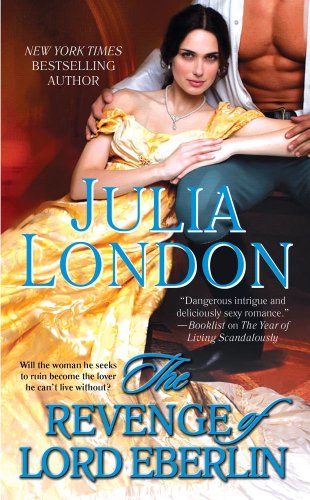
The Revenge of Lord Eberlin
Sometimes I wonder what would happen if characters in romance novels looked at things rationally, talked it out, and didn’t make huge decisions based on revenge, anger, or hate. The truth is, most romance novels would be a lot shorter, but I’d probably like the characters more. As the title suggests, The Revenge of Lord Eberlin is one of those stories centered on vengeance.
Fifteen years ago, eight-year-old Lily Boudine, the ward of the Earl and Countess of Ashwood, testified in the trial of local wood carver Joseph Scott, after seeing him ride away from the estate in the middle of the night that the Ashwood jewels were stolen. Because of her testimony, he was convicted and hanged. Now his son, Tobin Scott, is back in the small village of Hadley Green to seek revenge against Lily, now Countess of Ashwood. After being thrust into poverty because of his father’s ignominious death, Tobin has made his fortune and purchased a Danish title to become a member of the elite class that shunned him as a child. His plan now: To ruin Ashwood and destroy Lily for her role in his father’s death and the family’s subsequent tragedies.
Lily was eight, and there were many, many things happening at the time that had flown over her head, and she has always resented her role – her unwilling role, as the old earl had threatened to pin the crime on her governess or maid and see them hanged, instead – in the scandalous trial. Now Tobin, who had been her childhood playmate, is driving Ashwood into the ground by sabotaging business deals, wooing tenants away, and other tricks intended to destroy Lily. When he proposes a compromise — he will leave Ashwood alone, if he can ruin her — she decides to try to beat him at his own game, by making him fall in love with her.
Tobin is one of the more dislikable heroes I’ve read in a while: he made his fortune in trading arms, and is unrepentant about his trade, his single-minded quest for revenge, and his unwillingness to see any point of view other than his own. That said, for the most part he reforms rather well. His struggle to reconcile his own memories with the realities of Lily’s experiences was believable and naturally paced. To his credit, and Lily’s, there is no pretense between them; each is fully aware of where things are between them, and as such there isn’t a predictable and melodramatic reveal of betrayal or trickery, a plot device I find weary and trite. The development of feelings between them is honest, which is the best way for it to be.
One thing that bothered me, though, was the nature of Tobin’s fortune, in that it was earned by trading weapons. I don’t think that it was treated as seriously as it was. To me, this is a significant and damning indication of character: Tobin is so focused on earning his own wealth, he doesn’t care about the lives it takes in the process. It is hardly discussed, and then at the very end in one paragraph of narration, he abruptly decides to stop. It was too sudden, and deserved more attention as an indicator of his evolving character development.
This is the second book in a trilogy, so the mystery of the missing jewels and the tragic events fifteen years ago is not fully resolved. I’m intrigued to see how it all ends up in the next book, The Seduction of Madam X. Julia London is a good writer, and I’m looking forward to the resolution of the trilogy.
Recent Comments
