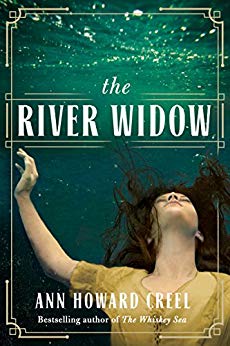
The River Widow
Ann Howard Creel’s southern gothic mystery tale The River Widow combines homespun drama with wicked mystery. It’s a superb tale, but it’s not without its problems.
When we first meet Adah Branch, it’s 1937, the Great Depression is ongoing, and she’s trying to salvage what she can from an oncoming flood ready to decimate her Kentucky farmhouse. She has no real fondness for the house, or the man she is married to – Les, an abusive creep who sickens her – but in her attempt at salvaging things that are precious to her and Daisy, her young stepdaughter, Adah runs up against Les’ violent demands and even more abusive actions. For the first time, she physically fights back – and kills him. Adah knows she’s doomed to prison – or at least subject to the violent revenge of her powerful in-laws – and so she drags the body to the swollen river and throws him in, only to trip and fall into the chilly water herself.
While she tries not to drown, Adah thinks of her past. Life as an orphan, dumped on a doorstep in the Bowery after her parents died from the 1918 flu epidemic. Life bouncing from the care of a kind priest to a barren couple, to the excitement of jumping trains with a couple of male friends, who taught her the power of self-reliance. Eventually her wanderings landed her Kentucky, where she both finished her education and fell into the life of a fortune teller who taught her the ropes before dying and leaving the business to Adah. Reading tarot cards, she met Les. Initially charmed by his handsomeness, only after she marries him and gives up the carnie life to become his wife does she realize what a mess she’s gotten herself into.
By sheer determination, Adah escapes the river and begins lying about Les’ whereabouts, saying he drowned while they both tried to rescue their milk cow from the flood. Her intention is to go to Lone Oak, where Daisy is lodged with Les’ parents, and then for the two of them to disappear before someone figures out the truth. But instead, she’s found by Jesse, Les’ older brother, and driven to Lone Oak – where she’s stuck until she can think up a way to safely leave with Daisy in tow. The family instantaneously disbelieves Adah’s story and becomes more and more suspicious of her as they try to drag the river for Les’ body. The Branches have always mocked Adah for her previous occupation, feeling that it’s only two steps above witchcraft; which, they think, is one step away from murder by a woman they’ve been suspicious of for years. Soon that abuse spreads along to Daisy. When Les’ is body’s finally found, Jesse’s suspicions strengthen, and Mabel continues to try to countermand Adah’s parenting of Daisy.
Yet Adah has steel determination, and even as her in-laws try to claim vengeance for their son’s life, she makes contact with a neighbor, Jack Darby, who hates the Branches for their evil ways – and it seems that romance, safety, and a sweeter life might be right within her reach. Though Adah’s been cheated out of her claim on the family farm, though the Branches have custody of Daisy, Jack holds a trump card in his hand – he has information about how Les’ first wife – Daisy’s mother – died, and it wasn’t in horse riding accident as claimed. Will Adah and Daisy survive, or will Adah drown under the weight of her own sins?
The River Widow provoked strong emotions in me, which is why I’ve graded it so highly, even though it’s got a number of blemishes that annoyed me. The novel is southern gothic to its core, and if you thrill to tension and mysteries it will be just your cup of tea.
Its biggest problem, in general, is the Branches. As a unit, this family encapsulates the worst of all hick stereotypes; talking out of the sides of their mouths about God and faith and family, they relentlessly abuse anyone they deem to be an outsider with the zest and glee of a bunch of Miss Hannigans and seek vengeance with impunity. There’s no dimension to their behavior, and there’s very little about them that’s commendable or redeemable, so that eventually their cardboard evil becomes wearing. Jesse has his moments of reason, and Mabel loves her sons, but they’re too cruel to be believed sometimes, especially anti-intellectual, slovenly dad, Buck. The stereotyping got so bad that I kept waiting for an incest plot to descend and I was not shocked when they were revealed to be moonshining Klan members.
As for Daisy, she seemed very much the typical moppet. Not much about her really stands out to make her special, although her average ‘kidness’ definitely makes the danger surrounding her seem all the more frightening.
But Adah, ultimately, is what kept me reading; her steely determination to survive Kentucky, the Branches and even the murder rap descending over her. She’s steady, smart and worthwhile, which makes being in her head for the entirety of the novel a treat at its toughest points.
One other character surfaces later in the novel to add interesting layers to the proceedings; Esther, an indomitable school board member and spinster who has a near-businesslike hope of marrying Jesse and finally establishing a household of her own. As for Adah’s romance with Jack, which is consummated through food metaphors, it’s charming and well, hungry, but very fraught.
Ultimately The River Widow works as a character study, a story of strength and of determination, and survival from abuse. It’s a satisfying read that will haunt you, fill you with tension and leave you with hope.
Buy it at: Amazon
Visit our Amazon Storefront
Recent Comments