
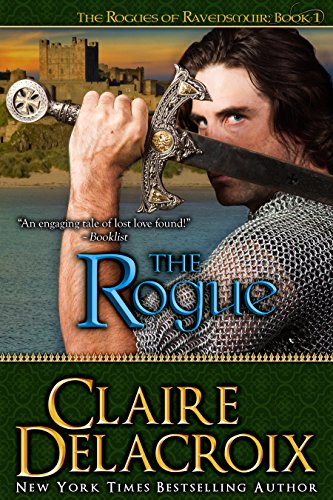
The Rogue
The Rogue is one of the few books that I bought and then reviewed. I’d read Ms. Delacroix’s previous book Double Trouble (written under her Claire Cross pseudonym) and loved so much about it. I loved that it was told in the first person, I loved the much edgier than usual heroine, I loved that the author took a twin story that could have been lame and unoriginal and made it into something that was just the opposite. I plain loved the book. So of course I sought out her new one. And though I found some of those same elements, they didn’t work as well this time around. Not because of the elements themselves, but because the story was both unnecessarily complicated and too frequently repetitive.
The first person narrator is Ysabella of Kinfairlie. Reading an historical romance in the first person is an interesting experience. Many of the early modern genre romances were either written in the first person or told from the heroine’s point of view. All those heroes were enigmatic because we didn’t see how they thought or felt. Years ago, though, the pendulum swung the other way so that the reader knows how the heroine feels, how the hero feels, how the supporting characters feel, and occasionally how the horses are feeling. The Rogue is part of a small trend (did Joan Wolf start it in 1996’s The Deception?) of first-person romances wherein we can only know what the hero has told and shown Ysabella.
Ysabella is the wife of Merlyn Lammergeier. She hasn’t seen him in the five years since she left him, after finding out he wasn’t the honest merchant she thought he was. What she was told was that he was a purveyor of fake religious artifacts and that he not only helped to create and sell them, he also assisted his brother and father in stealing and reselling them. Though theirs was not truly a love-match, she did come to trust and believe in him. Finding out he had lied to her drove Ysabella to leave his castle Ravensmuir and return to her village of Kinfairlie. In Kinfairlie, as the daughter of a less then respectable woman and the non-wife of the local lord, she has almost no options. She struggles to support her sister and brother by making and selling ale.
The book opens with Merlyn reappearing in Ysabella’s life. Merlyn has come to ask for aid and to promise Ysabella he will reform. She scoffs at the idea, though a kernel of hope is kindled, which is dashed the next day when she hears that he has been murdered. Merlyn’s death means Ravensmuir is now hers and she quickly moves her impoverished family into the castle. Ysabella quickly learns her change in circumstance isn’t going to work out as well as she’d hoped. Merlyn isn’t dead, though he was attacked, and he wants Ysabella to figure out who attempted to kill him. If she doesn’t, he’ll reveal his non-dead existence and she’ll be right back where she started from.
For a good part of the book every facet of this romance was working very well. The dialogue sparkled, the very-real-coming-off-the-page chemistry between Merlyn and Ysabella was perfect, and the tensions and difficulties that brought them to this pass were all credible and natural for the time period. The fact that the reader couldn’t know why Merlyn had acted as he had because Ysabella doesn’t know also worked wonders to create a certain level of suspense. And though the stated reason for Merlyn’s current deception was so that Ysabella could figure out who wants him dead, very little of the first two-thirds of the book were about that. That’s a good thing, because it’s when all the players in this mystery were brought into the picture that the book reached the too complicated stage.
The too complicated, and not very well explained, plotting around Merlyn’s danger bogged the latter third of the book down. What also began to frustrate was the repetitive nature of Ysabella and Merlyn’s personal battles. He’d open up and let her explore his past a bit so that she could understand his life and choices, she’d start to trust him, then two scenes later she was back to her mistrust and bitter feelings. She has good reasons for the feelings, but after the third or fourth scene like this, I began to lose patience and the characters lost some of their integrity.
Those frustrations aside, I applaud the author for her ability to reinvigorate for me what has become a fairy tired romantic time period. Given my experience with her Cross book and this one, I’ll definitely be looking for the next.
Recent Comments
