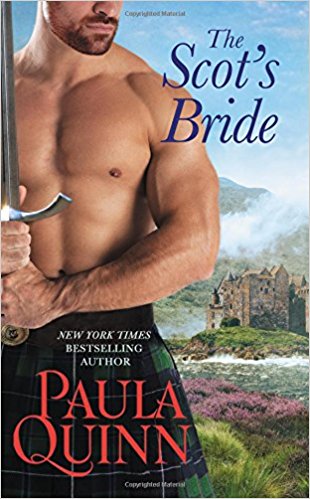
The Scot’s Bride
The latest MacGregor boy gets his bride in this charming and adventuresome but uneven addition to Paula Quinn’s Highland Heirs series, The Scot’s Bride.
Patrick MacGregor – the latest Devil of the Highlands – is having a great time carousing his way across Scotland on his way to see his uncles, fighting for money under an assumed name and sleeping with each and every willing tavern wench he can get his hands on. It’s a good, carefree life, and one he has no plans of changing. Until, that is, he sets eyes on a young woman bathing in a river wearing nothing but a crown of daisies and bearing nothing but a slingshot – which she quickly uses to knock him unconscious.
Charlotte – Charlie – Cunningham has reasons for avoiding the constraints of proper society. She’s still mourning Kendrick Fergusson, a man whom she’d loved intensely since childhood and lost to a misplaced clan feud when he was murdered by her two brothers at the order of her father. She fills her time looking after her beloved younger sister Elsie, who is in delicate health, and looking out for a chance for them both to get away from their hateful father. She’s attracted to Patrick at first sight – even though that first sight involves his botched seduction of a tavern wench – but she isn’t one to be wooed by a man whose behavior reminds her so much of her aggressive sire, even when he tries to ply her with sweet words.
The Cunninghams take Patrick hostage, presuming he’s a member of the hated Fergusson clan (which, in fact, he is through distant relation). Fortunately, however, a chance encounter gives him the opportunity to lie about his connection to the powerful Campbell clan, which gains him his release. But he opts to stay with the Cunninghams, and as Patrick becomes more enmeshed into Charlie’s family, they grow enchanted with one another and must fight their developing feelings. If all of those old Cunningham and Ferguson secrets come to light there will be hell to pay.
The Scot’s Bride is at heart a solid story with a good romance and enjoyable characters. I liked Patrick a lot; he’s roguish, but not in a harmful way; his over the top blandishments are pretty amusing, and Charlie doesn’t fall for them even when she’s admiring his masculine beauty. As his fear putting down roots eases, he must learn prudence and self-sacrifice; and his movement toward greater maturity really works. I enjoyed his evolving relationship with Charlie’s brother Duff, and the plot twist that deepens their bond.
Charlie is a wonderfully fully-rounded out character. Her love of her lost Kendrick is well-imparted, as is her conflicted love for Duff and her father, as well as her understandable dislike of her other brother Hendry. Elsie and Charlie are lovely kindred spirits, and their search for freedom for Elsie is a delightful thing to see; Elsie taking her life into her own hands is even better. I completely believed Charlie’s crusading dual life; what I didn’t believe was the notion of her fainting in pure fright over the idea of falling in love with Patrick.
Charlie is firmly uninterested in Patrick when he’s at his most roguish, which forces him to open his eyes about his own behavior and act more naturally. The device Quinn chooses to allow this growth is a bit faulty (more on that later), and the relationship is very slap-slap-kiss-kiss at first, but slowly develops into something more interesting. Patrick allows Charlie to be herself, and she doesn’t try to rein in his behavior in as his family has. They’re both good people who believe in justice and their strengths are complimentary. The romance sings.
The book does have a number of flaws though. Quinn indulges in a lot of plot advancement through inner monologing, a flaw I’ve noticed in other books of hers; here entire emotional changes in characters are imparted this way. I didn’t find it terribly off-putting, but I imagine it might be for some readers. A subplot wherein Patrick and Charlie become involved in the lives of one of Charlie’s tenant families is clichéd and saccharine, and exists only to enable a few unnecessary plot contrivances. This might have left more room to develop a wonderfully shocking plot twist that happens far too late into the book to build up proper narrative ripples, even though it isn’t totally lacking in impact.
Yet all of these quibbles are worth ignoring, simply because The Scot’s Bride is a good story with great characters and a good romance in spite of its weak points. It’s well worth your time, and well worth a recommendation.
Buy Now: A/BN/iB/K
Recent Comments