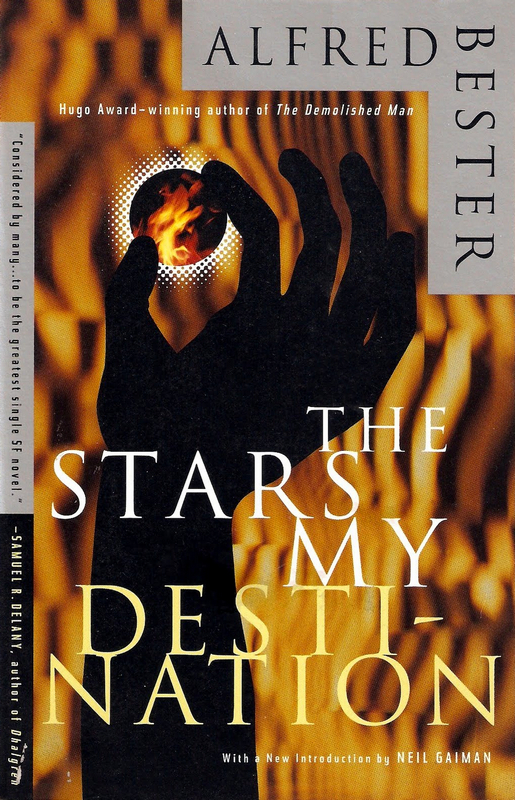
The Stars My Destination
If I was told I had to go live on a desert island and could take only one romance with me, I would immediately begin to plan how I could smuggle all of Carla Kelly’s books in as one long work. But if the powers that be got firm and said I could take only one science fiction novel with me, I would have no problem at all choosing which one I’d take. It would be Alfred Bester’s The The Stars My Destination.
The Stars My Destination was first published in 1957 and has maintained its reputation as a classic for over 40 years. Even though the book is not as well known as some of the more popular science fiction classics like Dune or Stranger in a Strange Land, I have enjoyed this book more than any science fiction novel I have ever read, and I have read science fiction since I was in junior high school.
The Stars My Destination has everything I ask for in science fiction. The story features many ideas, is incredibly exciting, and characters are convincing and magnetic – the book improves each and every time I re-read it. Bester borrowed his basic plot from Dumas’ The Count of Monte Cristo, in which Edmond Dantes was wrongly imprisoned and escaped to wreak vengence on his enemies. In this book, Gulliver (Gully) Foyle is abandoned on a crippled spaceship and escapes to wreak vengence on those who left him to die.
This bare-bones one sentence description of the plot cannot even begin to describe the richness of this book. The future society where Foyle lives is one where teleportation (called jaunting in this book) is common. So is telepathy. There is much sly satire poked at the corporate cut-throat business tactics of this future society and the desperate search of the rich and decadent for fun and stimulation to relieve their boredom. A good example of Bester’s satire is the party scene. In a society where jaunting has made instant travel to anywhere on the globe available to the masses, the very rich have taken to conspicuous consumption in transporation to show their removal from the common people. The scene where Gully Foyle in his disguise as the nouvou riche Fourmyle arrives at a party utilizing every form of transporation he can, is as funny as any scene I have ever read.
Even though The Stars My Destination was first published in 1956 at a time when women in science fiction were mostly screaming babes in brass brassieres, the women in this book are fully realized characters. There is Jisbella McQueen, Gully’s fellow prisoner who falls in love with him but is repulsed by his single-minded quest for vengence. Then there is Robin Wednesbury, a telesend (she can project her thoughts, but cannot hear the thoughts of others), and Olivia Prestigen – a blind albino snow-princess who can “see” in the infra-red, and whom also proves to be a formidable foe.
The climax of the book comes when Gully is trapped and suffering from synesthesia. His senses are scrambled so that he sees colors, hears odors, smells tastes, etc. Bester uses words and images on the printed page to try and convey this to the reader, and darned if he doesn’t succeed! Bester’s experimental writing, unlike some of the more self conscious literary writing of this type (William Burroughs for example) is understandable and accessable to the reader while succeeding in conveying the “otherness” of Gully’s scrambled senses.
Alfred Bester was not a prolific science fiction writer. He wrote one other very good novel, The Demolished Man – a mystery science fiction novel that treats a murder case in the future where the police are telepaths. His later novels are not very good, but he did write a number of excellent and thought provoking short stories, most notably Fondly Fahrenheit.
The Stars My Destination does not show its age in the slightest. Every time I read it I discover something new and it never fails to thrill me. It is not only my favorite science fiction novel of all times, it is one of my favorite books – period. I envy anyone who experiences the thrill of reading this wonderful book for the first time.
Recent Comments