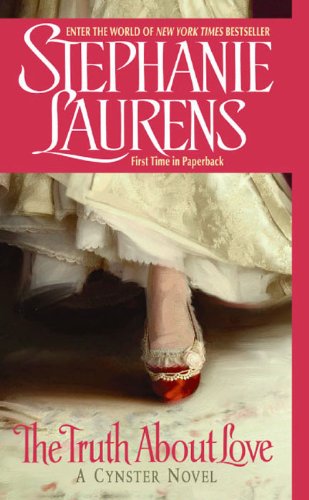
The Truth About Love
I used to be a great fan of Stephanie Laurens and her Cynster family series. But it has been almost four years since I read a Stephanie Laurens novel. I am one of those who felt that her writing had become derivative, just a rehashing of the same characters and plot and I tired of it. When I saw The Truth About Love languishing on the AAR reviewers book list – it has just been released in paperback and had been passed over by every reviewer when it came out in hardcover last year – and that its hero was Gerard Debbington, brother of Patience, the heroine of the second Cynster novel, A Rake’s Vow and a character I liked very much, I thought I’d give it a try. How was it reading a Stephanie Laurens after all these years? The same and better than I thought it would be.
The young, artistic Gerard Debbington has grown up to be “the ton’s foremost landscape painter.” (Really? And what is JMW Turner – chopped liver?) But Gerard is a “gentleman painter” – it is his hobby, he is not paid for his work, so it’s okay. Like every Laurens hero, Gerard has a reason for avoiding marriage; his is the fact that his art is all-consuming. He is afraid that the equally consuming nature of love and marriage will detract from his energies and ability to paint. Yes, I know. Pretty flimsy excuse, but these excuses generally are.
Gerard wishes to paint Lord Tregonning’s famous, and never before painted, gardens in Cornwall, but Lord Tregonning refuses to allow it unless Gerard will also paint a portrait of his daughter, Jacqueline. Grumbling, and sure that Jacqueline will prove to be just another empty-headed chit, Gerard takes his friend Barnaby Adair with him for company. Barnaby is “a student of crime” – something that will soon come in handy.
Gerard is pleasantly surprised by Jacqueline and very eager to paint her. He sees character and a depth of emotion in her, as well as hints of a tragic secret. As a subject, she is irresistible. As a woman, she is even more so. There is an immediate sexual awareness and attraction between the two that takes both by surprise.
Several years ago Jacqueline’s suitor disappeared off the face of the earth, having last been seen with Jacqueline in the gardens. A year ago, Jacqueline’s mother died of a fall from the terrace and into the gardens, and again, was last seen arguing with Jacqueline. Her death was ruled an accident, but there are unanswered questions and unspoken accusations that Jacqueline is responsible for both deaths. The fact that she knows what everyone thinks and so has shut down emotionally, showing a blank façade to all, only fuels the general opinion that she has something to hide.
This is when Gerard learns that there was an ulterior motive behind the Tregonnings procuring his services for Jacqueline’s portrait. He has a reputation for delving deeply into the character of his subject, for exposing the soul of the sitter to the viewer. It is important that Jacqueline’s true self be exposed, that her innocence clearly shows in the portrait. She and her father believe that once everyone has seen the portrait, and acknowledged her innocence, the authorities can then start looking for the real killer. I didn’t buy into the whole soul-revealed-through-the-eye-of-the-artist thing, but Gerard – and everyone else – is absolutely certain that this will be the case, and they wait for the finished painting with bated breath.
While Gerard has the Cynster clan’s characteristic confidence and elegance, he is more open about his feelings than most of them. When he and Jacqueline realize that their interest and attraction is mutual, they openly discuss whether to pursue it, to see where it might lead. Jacqueline is eager to do so. She feels that her future was robbed from her, that she is in a state of limbo, and is ready to feel alive again. An affair with Gerard would fill the bill nicely. For his part, Gerard knows that if he pursues a more intimate relationship with Jacqueline, that it is very likely that he will fall in love with her, and regardless of his wariness about it affecting his art, he is ready to take that step. I found this to be a refreshing difference from other Cynster books.
However, Gerard makes love like a Cynster with his “demons clamoring” and alternately being “leashed” and then “unleashed.” All the standard Laurens love scene staples are here – and there are plenty of them. I’m a big fan of steamy love scenes, but you could change out Gerard and Jacqueline for any other hero and heroine in a Laurens novel and the love scenes would be the same. They’re good love scenes, but they are cookie cutter love scenes. Been there, done that…have the rug burns to prove it.
If the territory covered in The Truth About Love is well-trod territory, I still found that I was interested in the mystery and in discovering “whodunit” and why. And Gerard was just different enough that I couldn’t predict his every move – though I could most of them – and Jacqueline had a bit more depth to her than the last several Laurens heroines I’d read. If this is not quite a ringing endorsement of the book, it is at least an appreciation of the fact that the formula can still work.
Recent Comments