
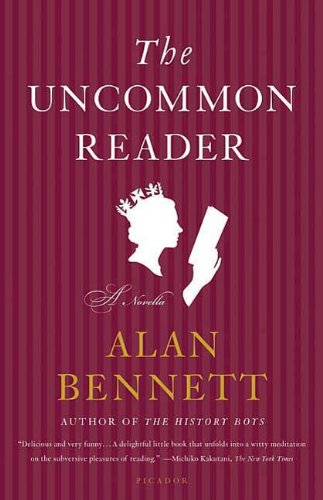
The Uncommon Reader
This is such a charming book about Queen Elizabeth II and the subversive power of reading. Alan Bennett is one of England’s foremost writers, and while this short novel is a departure from his usual fare of plays, he certainly has the flair for quiet, amusing, and sharply observant tales.
“Now that I have you to myself,” said the Queen, “I’ve been longing to ask you about the writer Jean Genet.”
“Ah, oui,” said the President of France.
”Was he as bad as he was painted? Or, more to the point,” and she took up her soup spoon,” was he as good?”
Unbriefed on the subject of the glabrous playwright and novelist, the president looked wildly about for his minister of culture. But she was being addressed by the Archbishop of Canterbury.
“Jean Genet,” said the Queen again, helpfully. “Vous le connaissaez?”
“Bien sûr,” said the president.
“Il m’interesse,” said the Queen.
“Vraiment?” The president put down his spoon. It was going to be a long evening.
One fine morning, out in one of the yards of Buckingham Palace, the Queen finds her precious dogs yapping their heads off at the City of Westminster traveling library. When the startled librarian-driver asks her, “What does Your Majesty like?”, the Queen is at a loss since she’s never before taken much interest in reading. In general, her job is to take an interest in things, not to be interested herself. Besides, to her reading is a passive activity, and she’s a doer. She assiduously devotes herself to the duties of a monarch.
While she decides how to answer the librarian, she questions the boy browsing in the library van, Norman Seakins, about his choice in books. Eventually, she borrows an Ivy Compton-Burnett. In the meantime, young Norman has made an impression on the Queen, and she elevates him from his job in the kitchens to her personal page, an advisor on fiction and nonfiction.
A week later, the Queen seizes on the excuse of returning her library volume to escape from a detailed discussion of her duties by her overzealous and over-conscientious personal secretary Sir Kevin Scatchard. He is left scratching his head as to why she would need a traveling library when she has several of the stationary kind of her own.
Luckily for the Queen, her second library choice is an entertaining Nancy Mitford. As Bennett says:
Had her Majesty gone for another duff read, an early George Eliot, say, or a late Henry James, novice reader that she was she might have been put off reading for good and there would be no story to tell.
And so begins the Queen’s adventure with books. With Norman as her sidekick, she discovers all kinds of tomes. Being a newcomer, she has no preconceptions as to what she should read and what she should avoid, so she reads indiscriminately, which is to her advantage. As time goes on, she develops a sophisticated and educated palate and an open mind about books. But the development of this well-informed taste requires endless hours spent in solitude or with Norman for company, and she starts resenting her duties because they take her away from her newly-found passion. While her acute sense of what is required of a monarch means that she doesn’t shirk her job, she is, for example, two minutes late to the opening of the Parliament, because her current book could not be found.
At first, Sir Kevin tries to harness this habit of hers.
“It would help if we were able to put out a press release saying that, apart from English literature, Your Majesty was also reading ethnic classics.”
“Which ethnic classics did you have in mind? The Kama Sutra?”
Sir Kevin sighed.
“I am reading Vikram Seth at the moment. Would he count?”
Though the private secretary had never heard of him, he thought he sounded right.
“Salman Rushdie?”
“Probably not, ma’am.”
Soon, this habit of hers is deplored by him as well as the equerries. It is uncharacteristic of her, and while she embraces this new hobby with uncommon zeal, her hidebound underlings try various ways and means to prevent her from doing it. For example, on her visit to Canada, her carefully curated trunk of books ends up weeks later in Calgary, carefully diverted there by her secretary. Everyone around Norman disapproves of his influence on her, and on one of her trips abroad, Sir Kevin gives Norman no option but to accept a scholarship to the University of East Anglia.
When the Queen comes back, she is downcast about his inexplicable loss, but she takes it without complaint. People and things have a habit of disappearing on her. Monarch, she may be, but her life is so scripted, so controlled by others, that she has no free will. I thought this look into her life was heartbreaking. We think of the Queen as wealthy, pampered royalty with nothing to do but enjoy her life, but as Bennett shows, she’s allowed to have no opinions, no preferences, no hobbies, only duties and pleasing the people. So long as she behaves in a characteristic manner, she is accorded due deference, but in reality, she is powerless; even her prime minister has no compunction in lecturing her in their weekly audiences.
But despite all the disapprobation, the Queen’s interest in reading continues unabated, and it starts influencing her thoughts and actions, in minor ways in public – “what are you reading?” she asks the people she meets, which always ends up in awkward, tongue-tied silence – and in major ways in private within the pages of the notebook in which she shares her thoughts and observations. Ever present is the feeling that she is running out of time: there is so much she wants to learn but age is catching up with her – a familiar feeling to us all, isn’t it?
(I am delighted that in this story, the Queen patronizes the London Library, one of my favorite libraries.)
I highly recommend this novel to all readers, whether or not you’re fond of QEII. We all share a love of reading and recognize the power of books to enthrall, to teach, and to change our way of thinking. As American poet Charles William Eliot has said, “Books are the quietest and most constant of friends; they are the most accessible and wisest of counselors and the most patient of teachers.”
Buy Now: A/BN/iB/K
Recent Comments


I loved Beyond the Fringe, too! Much hysterical laughter, many decades ago. Also, loved The History Boys, which I saw as both play and movie. This book is a charmer–an utterly plausible fantasy. Read it and enjoy.
Thank you. I have added Beyond the Fringe to my list, and I’m looking forward to reading it.
This book is a delight. Long ago, Alan Bennett was part of the “Beyond the Fringe” satiric revue, along with Peter Cook, Dudley Moore and Jonathan Miller. I am old enough to have seen it back in the 1960s, and I still remember it as one of the funniest revues I have even seen.
Oh, how wonderful. I would’ve loved to have seen that. How is History Boys? The Uncommon Reader is my first introduction to Alan Bennett, and I’m delighted by it.