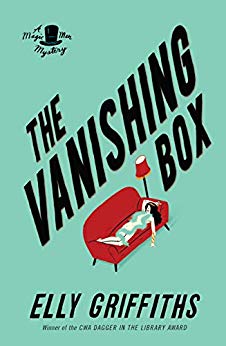
The Vanishing Box
The popular teaming of cool minded inspector General Edgar Stephens and his best friend, the old-school magician Max “Mephisto” Miller continues with this fourth volume, The Vanishing Box, set in 1953 during the Christmas season.
Max and his daughter (who is also his assistant) Ruby are currently headlining an exciting holiday show at the Brighton Hippodrome. But to Max’s embarrassment and thanks to the machinations of his agent, they’re stuck sharing the bill with a tableau of half-dressed ‘statues’ which magically come to life while telling stories of the classical variety – a clever way to skirt the Lord Chamberlain’s rule about onstage nudity in an age where live performance is poised to be eclipsed by the dawn of the age of television. This portion of the show is managed and run by lothario Vic Cutler, who’s constantly trying to talk Max into incorporating one of his girls into his magic act. But with a TV show of his own poised to hit the airwaves, Max’s dignity is a little wounded by the spectacle that might distract from his tricks and the friction-filled banter between himself and Ruby that keeps the audiences coming to watch their live act.
Meanwhile, Edgar Stephens is on the scene of a murder of a Brighton flower seller, whose carefully staged death tableau resembles a painting of Lady Jane Grey at her execution. The scene is carefully detailed, and the nearby window kept open a crack to slow the body’s decay. Lily Burtenshaw, was only nineteen and seemed to be sweet and quiet, a stark contrast to her brutal death by strangulation. Lily has friends in the Hippodrome show, which causes Edgar to turn to his father-in-law-to-be-and ex-fellow soldier, Max, for help cracking the case. When Edgar manages to connect Lily to Cutler and his sordid way of life, Max is promptly dragged into the investigation, and he and Edgar are soon back to their investigative beat.
As the case coils around Cutler and his starlets, Max is forced to choose between his ongoing relationship with his erstwhile landlady and one of the tableau actresses, Florence. – and then between the TV show and a movie offer presented by a Hollywood agent, putting pressure on his relationship with Ruby, who thinks her father only cares for the money their act generates and not her personally. Edgar, meanwhile, is positioned still between outrageous Ruby and fearless but much more proper fellow inspector Emma Holmes – who is still in love with Edgar in spite of his engagement to Ruby. The shy and somewhat judgmental Bob Willis assists on the case, and finds himself repulsed and intrigued by the starlets he’s assigned to guard. The entire team must pull together to solve the murders before nosy reporters, eager chronies and forbidden family dealings lead to more dead bodies.
The Vanishing Box is a beautifully constructed mystery with some wonderfully memorable characters. The mystery is incredibly well done, putting on a guessing game that will surprise the reader right to the last word.
Griffiths is excellent at bouncing differing personality types off of one another. Emma, Bob, Max and Edgar are completely dissimilar yet they work together beautifully, and the hardboiled nature of the crime contrasts interestingly with their tender, softer points.
The setting informs every single bit of the book beautifully; you can see the dust on the stage and picture the heavily painted, gaudy nude tableaux in between Max and Ruby’s acts; you can smell the greasepaint, and the damp of the snowy cold of the seaside town. The Hippodrome is a real place that’s actually among Britain’s most endangered historical landmarks at the moment, and Griffiths makes an impassioned plea for its revival in the notes afterward. Even four volumes into the series, its conception feels fresh; the dying days of music hall are rarely plumbed for such tension. The Vanishing Box in general does an excellent job of cross-sectioning the cutthroat theatre world and the surprisingly mundane universe of homicide investigation.
Max’s impassioned grumpiness makes for a truly beautiful contrast to the more thoughtful Edgar; if anything, my biggest complaint is that they don’t get to work together enough in the book. Long-term storylines, like Max’s emergence from the mothballs after his music hall glory days and the ongoing Ruby/Edgar/Emma triangle continue well here.
The novel’s biggest disappointment, at least for me, was the narrative’s choice to turn smart, strong, capable, Emma – who does a lot of the legwork – into a damsel in distress. That’s not to detract from the book’s many, many strong female characters – my favorite was Sam, a brilliant newspaperwoman who employs a gender-neutral name and baggy pants and jackets to allow her freedom to roam on the crime beat. I’d just rather it had been more forward thinking. It didn’t help that Ruby becomes something of an afterthought for most of the narrative, pouting in the background all too frequently.
But misdirection is the book’s biggest theme. The mystery itself is the main attraction, and in this the book succeeds with flying colors. The Vanishing Box is one of the most unique mysteries I’ve read this year, and readers should be spellbound and fascinated as the audience watching Max make Ruby disappear.
Buy it at: Amazon/Apple Books/Barnes & Noble/Kobo
Recent Comments