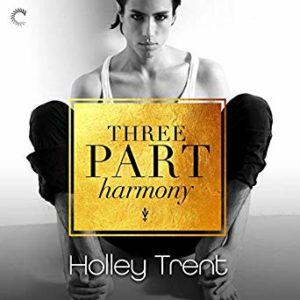
Three Part Harmony
Narrated by Sean
Crisden, Danny Boston & Natalie Eaton
Three Part Harmony is the second in Holley Trent’s Plot Twist series. I have Writing Her In (book one) on the TBL but as I had this for review, I loaded it first. Initially I wondered if that would be a mistake but Three Part Harmony is fairly self-contained and it’s not at all necessary to listen in order.
All of the books
in the series are/will be polyamory stories involving three people. I at first
thought this book might fall into the erotic romance category but the sex
scenes are not so frequent as that; the heat level (in terms of language and
number of sex scenes) is about what I’d expect from a contemporary so I think
the book best fits in that subgenre.
Raleigh McKean
is a publicist at Athena Publishing in New York. For some years he has been
frustrated by the blatant nepotism displayed by the boss, Tom Shannon, in
hiring his daughter Everley into the business. Everley has no relevant
experience – her education was in mathematics.
Raleigh is a
cynic, having grown up in a political family. He has plenty of experience with
being screwed over by people who are only interested in him for his connections
and he’s very wary of anyone messing with him. Everley has, to his mind, been
making a concerted effort to horn in on his clients and he avoids her – like
most others in the office.
Everley is
unhappy at Athena. She never wanted to work in publishing but only found
herself there after being steamrolled by her dad after being unable to find
work fresh out of college. She has been with Athena for seven long years and,
while she does a good job, she does not enjoy it. She hates that everyone at Athena
mistrusts her. She’s had a crush on Raleigh
for ages, so it is especially painful that he avoids her. Everley’s actions, borne out of kindness and
a desire for connection and friendship are constantly misinterpreted. She wants
to leave but is afraid to trust herself to take the leap into what she really
wants and she’s afraid of her father’s reaction.
Bruce Engle is a
musician and reluctant rock star. He was the lead singer and songwriter for the
band, Outward Reach. He is an unusual character, very much marching to the beat
of his own drum. He was discarded by his immediate family and mostly raised by
his beloved “Nan” in Scotland. Bruce struggles to stay focused, to express
himself clearly and concisely, to not get distracted by the shiny. He’s brilliant
and talented but has been boxed in and used for years. He feels he has no-one
in his corner, particularly since his Nan died.
As it happens, he has various diagnoses, some details of which are given
later in the book but his character doesn’t need labels. He’s well drawn and
detailed, kind and vulnerable and chaotic and the way he comes across on the
page is perfectly understandable.
Both Bruce and
Raleigh are pansexual and when the book begins, they hook up one night in LA.
Bruce, enjoying the novelty and anonymity of not being recognised for a change,
tells Raleigh his name is Theo. When the truth comes out, all the wonderful
possibility between them falls apart; Raleigh is betrayed and angry. He knows
Bruce has been querying publishers and thinks their intimacy was Bruce’s
attempt to get a book deal. Raleigh writes him off.
Later the action
moves back to New York where Athena has the book contract for Outward Reach’s
final tour diary (a different book to the one Bruce had been trying to shop).
There Bruce meets Everley and they begin a relationship.
Everley is very
soft-hearted and her own experience makes her very sympathetic to what she can
clearly see are Bruce’s struggles and isolation.
I don’t want to
give too much away but suffice it to say that at various stages in the book,
there are three distinct couples (albeit briefly sometimes) and it all ends in
a HEA between all three of them.
I liked that the
dynamic and connection between each of them was clearly established and the
time was taken to explore character and their own separate relationships, as
well as the personal growth/journey of each individual character.
The story is not
action-packed. The story is very internal and character-focused but it is not,
by any means, boring. Each of the three leads is particularly vulnerable and
those vulnerabilities speak to the others in different ways. Their connections
are formed from their broken pieces and, together they are stronger – though
they do not “fix” each other.
The narration is
a bit of a mixed bag. Mr. Crisden, who performed Raleigh’s sections, spoke very
quickly and often did not leave much gap between sentences, giving the
impression of being rushed. However, his expression was very good and I thought
his emotional delivery was also.
Ms. Eaton
doesn’t have particularly deep male character voice but there was, mostly,
enough for me to differentiate between cast members. Her accent for Bruce was
the least convincing.
Danny Boston
narrated Bruce’s sections. His was the most enjoyable for me because he struck
a good balance between accent, pacing and tone. Perhaps it’s also relevant that
Bruce was my favourite of the characters. I didn’t hate any of the performances
though – each had strengths and weaknesses.
I do wonder
though if the narrators all felt put upon by the author though – Bruce is
described as having been largely raised in Scotland, having lived also in South
Africa and his father is of mixed heritage including Dutch and Indian, with
some other things thrown in. He references that English was not his first
language. His accent is described as being extremely unusual and a peculiar
amalgam of his heritage and upbringing, not any one thing. The poor narrators
having to come up with something for that! At first I thought Bruce sounded
like a mix of Scottish, South African and something Eastern European. There was
broad consistency between the depictions of the male narrators but Ms. Eaton’s
was different again – he sounded more Irish to me, with a closed/clenched jaw
tone. Bruce also spoke quickly – no matter which narrator was doing the voicing
and the combination of accent and speed often made him difficult to understand.
The narrators were all trying valiantly to do justice to the description in the
text of the way Bruce sounded but I think in the end, they’d have been better
off to just go with something vaguely Scottish and called it good.
Recent Comments