
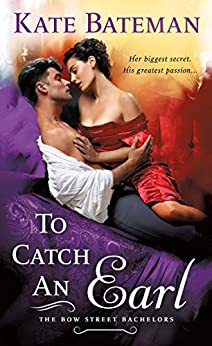
To Catch an Earl
Kate Bateman’s To Catch an Earl is complicated by a simple fact; its plot hangs on the loosest of logic threads. One tug and it all comes apart. Oh well, at least the banter is decently witty until we get there.
Emmy Danvers – formerly Emmeline Louise d’Anvers – is the daughter of Europe’s most elusive jewel thief, and a natural mistress of disguise. Approaching Alexander Harland, Earl of Melton, at a ball, they share a memorable kiss before being separated by his war service. He vows to find her and she – knowing that if he knew the real her he would disapprove – vows he’ll never learn her true identity.
After his return from war, Alex becomes a Bow Street agent, and is now searching for the mysterious (and very oddly named) Nightjar, a jewel thief who’s recently struck several London based targets – wives of foreign dignitaries who have been liberated of their jewelry, and find only a single black feather as a calling card. Initially presuming the thief to be a man, he vows to bring the Nightjar to justice.
To the shock of no one familiar with romantic fiction, Emmy is Nightjar – a thief who has mastered disguise, yet wears a distinct, uniquely-blended-for-her perfume to every crime, but that’s beside the point. Her late father – a staunch supporter of the Bourbon monarchy – had dreamed of ‘obtaining’ the royal jewels of France so they could be held until the monarchy was restored, and it seems that with Napoleon’s defeat at Waterloo this might be a reachable, tangible goal. He was not able to achieve this before his death, and now his rival is blackmailing Emmy into stealing the jewels.
Thus does Alex chase Emmy on two fronts, initially believing her to be two different people, and not quite yet recognizing her as the woman who so memorably kissed him. But soon enough those realities will collide, forcing him to choose between his main squeeze and his morals.
The plot is what contributes to To Catch an Earl’s low grade. It’s tired, the dialogue and premise too modern – especially the sex scenes, in which the dialogue feels as though it’s been lifted from a contemporary romance.
Emmy might be more interesting, if her thievery had some unique motive instead of ‘blackmailed, must keep thieving.’ Before that, it was ‘likes money’. While it’s nice to have a heroine motivated by love of family and self, her eventual amorality doesn’t make her more interesting. At least she’s the smart kind of spunky.
Alex is funniest when he’s playing Emmy’s straight man; when he’s dashing around after her in frustration it’s much better than when he’s gravely trying to seduce her.
But together they’re the typical exasperated man/adventuresome woman pairing. Sometimes their banter works, is charming, and makes you invest in the couple – which saves the book from a D grade. But mostly they feel as if they were transported to the modern era and forced to play out the events of the book in corsets and tight breeches.
And they’re not terribly interesting. The book’s minor relationship between Emmy’s brother Luc, who is missing his foot thanks to Trafalgar, and the family housekeeper – who was a dresser at Covent Garden before becoming his nurse and cook – is vastly more interesting than anything going on between Emmy and Alex.
Aside from the whole perfume/distinct feather calling card, both of which make Emmy sound the sort of stupid she’s not supposed to be, the investigation is logic-complicated, with an ending that Must Take Place in Romance, but which ignores the fact that Emmy was thieving long before she was being blackmailed. Romance dictates that she must be a karma Houdini, but justice also abhors a vacuum.
To Catch an Earl is, for these reasons alone, not quite worth reading. But the banter is strong enough to make me wonder what Bateman’s other books might be like. Hopefully her next one won’t misfire as this one did.
Buy it at: Amazon or shop at your local independent bookstore
Visit our Amazon Storefront
Recent Comments



OMG the perfume thing made me want to SCREAM. It was a TSTL move and Emmy was supposed to be smart!
What really got to me though, was Alex’s scummy morals. That scene where he asks if she’d sleep with him if he promised to let her go, while thinking there was no way he was going to let her go, was just YIKES.
I talked it out with a friend and we concluded he’s a bent cop; the sort who pulls over a car for speeding and offers to let the pretty young woman driving it go if she’ll blow him (but then writes her a ticket anyway). I hated his guts.
The perfume thing bugged me so much!
And I didn’t like Alex’s wibbly-wobbly morals, either. AND THEN HE DOES WHAT HE DOES AT THE END OF THE BOOK.
It pains me because I loved the first book. This one was a bummer for me too :(
Sorry you didn’t like it!
The classic and, to my mind, probably the best “she’s a thief and he’s in hot pursuit” book is Connie Brockway’s “All Through the Night”. Both hero and heroine move through Society, trying to keep their secrets from the world and each other, but secrets have a way of coming out and upending lives for good and ill. Loved this book.
One of my favorites too. It’s hard to find another book with a similar plot to match it.
Accurate! I love that one!
I liked this one. One of the reasons I rarely review historical romance here is that I don’t really notice the things you did – like that the sex scene dialogue is too modern.And I would be dreadful at determining what is historically inaccurate without having to do research, which, since I read for pleasure, is something I’m unlikely to do. I enjoyed their banter and the plot and didn’t mind the holes or that I knew how things would work out for them fairly easily.I found it a fluffy, escape read and rate it a B for me.
I probably notice but I don’t care. When I want historical accuracy, I read literature from the actual historical periods. Otherwise, I give contemporary authors lots of latitude to write the books they want and I expect that historical fiction is already mediated through our current moment.
Yeah, it’s one of those books that depends on how thoroughly you can enjoy the fluff!
I have a copy of this book and haven’t been able to bring myself to read it. I did not enjoy the first book in this series for many of the reasons cited here and so I’m officially skipping the rest.
Same here. I loved her earlier books – To Steal a Heart was one of my favourite books of 2016 – but I didn’t enjoy the previous book either and decided to skip this one. From the sound of it, I made the right decision.
Oof, I’m sorry the rest of the series is like that.
I enjoyed the Secrets & Spies series, but hated The Devil to Pay. That was my last Bateman and I’m doubtful I’ll read any of the books in this series. I’m reluctant to ‘quit,’ an author who showed this much early promise…but Bateman reminds me of Kerrigan Byrne in a lot of ways. The early books were fresh and exciting, and then things just seemed to go downhill.