
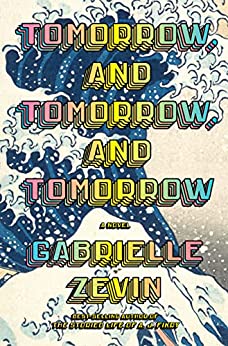
Tomorrow and Tomorrow and Tomorrow
Tomorrow and Tomorrow and Tomorrow gives its readers a perfectly flawed group of central characters to both root for and against. As they muse about mortality – the nature of partnership and the Big Stuff Of Life – a partnership forms and anchors the novel.
California native Samson Masur is a game-lover with a dream. Half-Korean, half-white, he doesn’t know who his biological father is (though he does come to suspect the truth), and his maternal grandparents often take over the raising of him while he mother pursues acting work. She finally became a big star on a network television game show, but tragedy struck in the form of a fatal car accident.
Sadie Green has been programming her own games for years. Her first, EmilyShooter, is centered around shooting your way through the poetry of Emily Dickinson to combine verses and earn your way into decorating a room in the recluse’s Amherst house. Coding became a respite from her sister Alice’s cancer treatment, and it’s because of Alice that Sadie meets Sam, who is in the hospital following the car accident that severely injured his foot and killed his mother. A misunderstanding separated them as teenagers, but a chance meeting in a busy Boston train station sparks off a conversation that turns into a partnership when Sadie hands Sam a copy of her latest RPG game.
Sam is impressed, and they sit down over a school break (he’s at Harvard; she’s at MIT) to co-create the game Ichigo: Child of the Sea. While Sam concentrates on level design, story, quality and character quality are important to Sadie; the two of them perch upon two totally different but complimentary spectrums when it comes to what they want for the game. Sam’s friend Marx Watanabe comes aboard to offer them business-related assistance and space to code in. None of them know that they’re about to change their lives, creating a hit game that will spawn a series, make them rich, open professional doors for them and complicate the romantic friendship that has colored their lives since they were children.
Throughout the years, Sam and Sadie struggle with their pasts, find love, lose love, build lives, shatter their lives, and try to cope with those old childhood hurts. Sam becomes the face of the company while dealing with having his foot amputated; Sadie deals with a relationship that goes south and another that thrives and ends tragically. All the while, Sam becomes the showboating center of their company, making Sadie resentful. Estrangement settles in, and it will take several tragic deaths to bring them back together again.
Don’t go into this one expecting Sadie and Sam to actually end up together; this is a move that Zevin wisely avoids. Tomorrow and Tomorrow and Tomorrow is too busy obsessing about the Bitch of Living to stop for their romance, though another, effective relationship does take place.
The book provides rich opportunity for representation. Sadie is proudly Jewish and Sam’s amputation, phantom limb pain and various trips to rehab are big parts of the book. The landscape shifts from Boston to California back to Boston again, with a stop in New York thrown in for good measure. The west coast settings in particular are portrayed with loving grace. Sadie grows from being a fully introverted coder to a mentor who finally sheds the image of being the brains behind Sam’s showy beauty; Sam has to learn how to grow up and think beyond gaming to relate to others.
And yet the book is imperfect. Some passages feelings almost fetishizing of Sam’s fragility, though he grows beyond these early assessments of his character. I was kind of disappointed by its treatment of bondage – it’s another way for Sadie’s boyfriend to exert control over her in the end, and something she’s not comfortable with. There are ways to portray kink, and the book completely misses the point to turn it into a way for one character to express his ‘dark side’ and abuse another.
You won’t necessarily need to be a gamer to enjoy the richness of the character work and the deep dive into Tomorrow and Tomorrow and Tomorrow.
Buy it at: Amazon, Audible or your local independent retailer
Visit our Amazon Storefront
Recent Comments





I finally managed to get a library copy and read it. I am not a gamer and have never played a single game in my life. The book shines a full bright light into the creative world of game design and the portrayals of two main characters were totally riveting and felt completely true—young, brilliant, maniacally focused and absolutely sure of their creative vision. If it was just a story about gaming world, I would have easily given it an A. However, I found the love triangle unconvincing, actually manipulative. As a literary device, a sudden violent death of the sweetest character in the story to inject pathos is not something I care for. My overall grade for the book, despite its wild popularity, is a B.
Yep this is still a solid B for me; I know Dabney adores it but the love story just didn’t work.
It’s not a love story!
Fair enough!!
I don’t think of it as a love triangle and I think the death is what gives the book its greatest meaning! What calls to us so individual, isn’t it?
I read this in March and it is still the book that has hit me hardest this year. My 27 year old son is sitting across from my in our living room, tears streaming down his face, as he reads what I think is one of the most powerful chapters I’ve ever read in a work of fiction.
I will say this book changed for me, profoundly, the way I see video games and how those who sink into them experience their joys. I can’t recommend it enough.
I’m so glad you like this more than me (I say, two years two late after it ended up on your best-of)