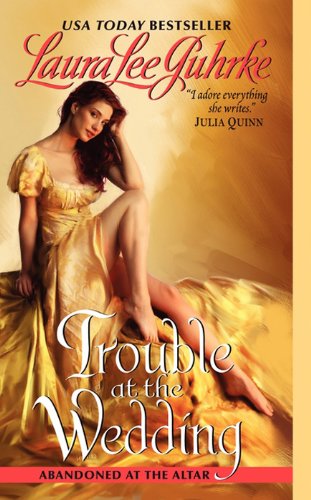
Trouble at the Wedding
J.D. Robb’s Innocent in Death has a line that really resonates with me. It’s something Mavis says to Eve when some people are speculating that Roarke is cheating: ”All guys have the small jerk gene, it makes them guys. But only some have the big jerk gene. He doesn’t.” Mavis is, of course, right. With the hero of Trouble at the Wedding, I was a little less sure.
Annabel Wheaton isn’t marrying the love of her life; that would just lead to heartache. Instead, she’s marrying an impoverished earl who can really use her American-made fortune. He’ll get the money he needs, she’ll get the respect she longs for. And her little sister Dinah will never know the pain of not fitting in. Annabel plans to marry Bernard Alastair, Earl of Rumsford, during a trans-Atlantic crossing. She figures they’ll have mutual respect and a certain fondness for each other. The only problem? Rumsford is a pompous ass.
Christian DuQuesne is an impoverished duke. He’s determined to stop the wedding – not because he wants Annabel for himself, but because Annabel’s uncle will pay him half a million dollars if he can do it. He starts out cautioning Annabel about the truth of British marriages, perhaps exaggerating a bit in the process. But he can’t deny that he’s attracted to her as well. He tells her he’ll fill her in on the secret rules of British marriage, and meets her secretly. But matters get a little out of hand the night before the wedding, when they both get a little drunk on Mississippi moonshine and share a – ahem – steamy encounter in the ship’s steam room. The resolute Annabel is still determined to go through with the wedding, until Christian objects at the ceremony – in a way that implies that he and Annabel have been intimate. Rumsford calls off the wedding, and Annabel is humiliated.
Now, Christian is eligible, available, and sorely in need of Annabel’s fortune. One would think he’d offer for her himself, but he’s of the “I’ve had a tragic marriage in the past so I’m never marrying again” school. He suggests a fake engagement to Annabel, but she has a better idea: She’ll become his ward, and he will agree to launch her into London society.
From this point, matters proceed more or less as you’d suppose, with Annabel living in Christian’s sister’s home, attending ton events, and generally making Christian jealous and horny as hell. It eventually resolves about in the way you’d think as well, though it takes Christian some time to experience his Come to Jesus moment.
That’s not to say that this is a predictable or boring book. I liked most things about it. I absolutely adored the Edwardian setting, the shipboard romance (like Titanic…but with a happy ending!), and the spirited Mississippi heroine. Waaaaay more romances should be set in the early 1900s, because it’s just plain fun.
Annabel is eminently likable. Her accent may be on the cutesy side, but I liked it. She’s also not a virgin, a state of affairs that makes her understandably cautious around men – and maybe a little too practical. She knows Christian’s a bad boy, and she knows bad boys are trouble.
Most of the time, I liked Christian too. I really couldn’t help it; he was simply delicious. My issue with him is that I kept suspecting that he wasn’t just of the “small jerk” variety. When he spoke up at Annabel’s erstwhile wedding ceremony, he was clearly being a jerk – but the kind that makes you think, “What a jerk…sigh.” But when he proposes a fake engagement, lusts after Annabel, and refuses to marry her until late in the game? I kept wondering whether he wasn’t really part of Mavis’s “big jerk” category.
Christian comes through at the end, even if it happens a little late for my taste. Nonetheless, this is a fun read, and one I’d marginally recommend. Small jerk or big jerk? You might have to decide for yourself.
Recent Comments