
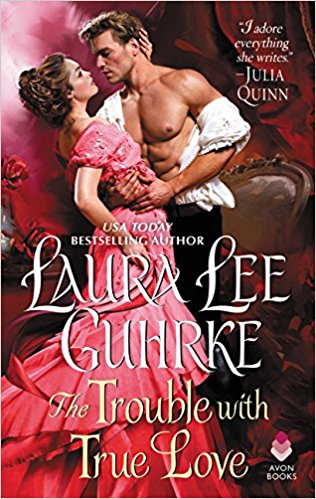
The Trouble with True Love
In book one of Laura Lee Guhrke’s Dear Lady Truelove series, we were introduced to the Deverill sisters, owners of The Weekly Gazette, the single remaining newspaper in what used to be a stable of them until their father pretty much ran the business into the ground after their mother’s death.
The sisters couldn’t be more different. Irene is opinionated, outspoken, progressive and fiercely independent, an advocate of reform and women’s suffrage, while Clara is quiet, reserved and wants the more traditional things from life, like love, romance, a home, husband and family. She has grown up very much in Irene’s shadow and has little faith in her own judgement and abilities; but Irene’s marriage (The Truth About Love and Dukes) and subsequent honeymoon mean that Clara is tasked with running the Gazette, and she worries she is not up to the task.
To make matters worse, at the beginning of The Trouble with True Love, Clara receives a telegram saying that Irene and her new husband are extending their trip by a month and that Irene is confident that Clara can handle everything until their brother Jonathan arrives to take up the reins. But Jonathan isn’t coming; he is in America, where he has struck silver and intends to stay and work his claim – which leaves Clara to deal with the obnoxious editor Irene appointed before she left for her wedding trip, AND to write the weekly column in which the famously anonymous Lady Truelove offers advice to the lovelorn. With her first deadline looming, Clara decides to head to her favourite tea-room, hoping it’ll be quieter than her office and that she’ll somehow find some inspiration.
Clara finds just that in the form of an overheard conversation between the two gentlemen at the next table. One of them – Lionel – is complaining to the other that the woman with whom he is having an affair has made clear her desire to marry him, but he isn’t sure he wants to marry her. The other man – who is easily the handsomest man Clara has ever seen – quickly disdains the idea of marriage and suggests a way in which Lionel can talk his lady love into carrying on as before without the promise of a trip to the altar.
The longer she listens to this outrageous outpouring of male connivance and duplicity, the more incensed Clara becomes. She decides there and then to use Lady Truelove’s next column to warn the woman concerned about the deception about to be practiced upon her.
Rex Pierpont, Viscount Galbraith’s views on matrimony are well known throughout society, and given the state of his parents disastrous union, his intention to never get married is hardly surprising. But his Aunt Petunia, whom he adores, won’t stop trying to find him a nice girl to settle down with and introduces him to Miss Clara Deverill one evening at a ball. Rex feels a jolt of recognition – but he can’t place her and proceeds to ask her to dance. Instead of the shy wallflower he had expected, Rex finds that Miss Deverill has a surprisingly sharp tongue and that she doesn’t appear to have any scruples about saying what she thinks, which is a refreshing change from the constant fawning and eyelash-batting to which he is normally subjected.
Later the same night, however, Rex realises exactly why Miss Deverill seemed so familiar, when his best friend, Lionel Strange, announces that his lady love has broken with him, punches Rex in the face and accuses him of disloyalty. Rex is further astonished when Lionel produces a newspaper cutting of Lady Truelove’s most recent column in which is repeated, almost word for word, the advice Rex gave his friend in the tea-room. Rex then remembers where he had seen Clara Deverill’s lovely eyes before – and a few days later marches into her office threatening to expose her. While it seems Rex has the upper hand, Clara manages to turn the tables on him and proposes a mutually agreeable alliance…
The set up for The Trouble with True Love isn’t original and at first I was almost yawning my weariness at the same-old, same-old; but the story woven around it turned out to be much more engaging than I’d expected, in large part due to the likeability of the protagonists and the way that Rex, in particular, is revealed to be nothing at all like the heartless rake society thinks him to be. So many marriage-shy bachelors in historical romance cite the misery of their parents’ marriages as the reason they don’t wish to wed, but in Rex’s case, the author has taken the time to flesh those reasons out a bit, and – through his relationship with his social butterfly of a mother – to show that he’s a kind and honourable man. He finds Clara’s honesty refreshing, and, realising she defines herself in terms of everything she is not – she’s not beautiful (like Irene), she’s not clever (like Irene), she’s not confident (like Irene) – determines to show her that she’s a wonderful person in her own right.
Clara blossoms during the course of their friendship, but it’s a gradual and subtle change and, with Rex’s gentle encouragement and support, she gains confidence and a sense of self as she finds her own inner strengths and the ability to meet challenges head on. The attraction between Rex and Clara is palpable from the very beginning, and their romance is a lovely slow-burn that evolves naturally out of the genuine and unexpected friendship that grows between them. Ms. Guhrke does a great job of showing Rex falling head-over-heels in love without his having a clue he’s doing it as he discovers that the trouble with true love is that one never knows when it is going to strike – and that it’s all he never wanted.
I ended up enjoying The Trouble with True Love much more than I thought I would, given my ambivalence towards the set up. If you can get past that, it’s a lovely character-driven romance in which the author takes the time to explore her characters’ motivations and to develop their relationship in a way that feels natural and unhurried. For all his (supposedly) rakish ways and antipathy towards marriage, Rex is an adorable hero who wants to do the right thing for those he loves; and I applaud Ms. Guhrke for writing a heroine who chooses to be a wife and mother and doesn’t see those as ‘lesser’ ambitions. I’m pleased to recommend this one to fans of well-written, character-driven historical romance.
Buy it at: A/BN/iB/K
Recent Comments



I’m not quite sure how I missed the first book in this series! Shall have to rectify that ASAP.
I’d suggest this is better… I found the heroine too implausible and unlikeable for most of the last one.