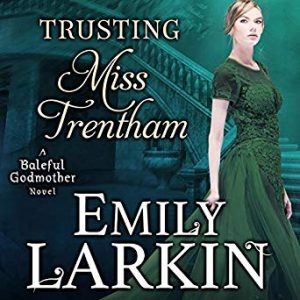
Trusting Miss Trentham
Narrated by Rosalyn Landor
Trusting Miss Trentham is the second full-length novel in Emily Larkin’s historical-with-a-touch-of-the-paranormal Baleful Godmother series, which features a group of young women who have been granted magical ‘gifts’ by their faerie godmother. (There is a novella – Resisting Miss Merryweather – between book one, Unmasking Miss Appleby, and this one, but it’s not necessary to have read or listened to either of them to enjoy this instalment). Each of the ladies is allowed to choose their gift – although they must choose carefully, as the aforementioned faerie godmother is not the benevolent sort so often found in fairy tales and will trick them if she can – and in this story, our heroine, Leticia Trentham, has chosen to be able to hear when someone is lying to her.
There’s a good reason for this choice. Letty
is heiress to a massive fortune and knew that she would need to be able to tell
the difference between a man who wanted her for herself and one who wanted her
for her money. Now aged twenty-eight, the more than two hundred marriage proposals
she has received in the years since her come out at twenty-one have all been
made by fortune hunters, and now, she rather despairs of ever finding a man who
can tell her honestly that he isn’t just after her money. She knows she doesn’t
have much else to recommend her; she’s not pretty or possessed of the other
sorts of qualities likely to attract a husband. She doesn’t simper or defer and
she’s intelligent and not afraid to show it – which isn’t exactly a
sought-after quality on the marriage mart. She has just turned down yet another
would-be suitor when she is approached by a tall, gaunt man with a military
bearing and an undeniable air of exhaustion who has heard of her uncanny
ability to be able to tell truth from lies – and who asks for her help.
Icarus Reid – formerly a major in Wellington’s
army – resigned his commission after the Battle of Vimeiro, and although not
fully recovered from a debilitating illness, has returned to England intent on
seeking out a traitor, the man who betrayed him, a fellow officer, and three
local scouts to the French before the battle. He explains that he is the only
one who survived their captivity and asks Letty to accompany him when he
questions the two men he suspects could have been responsible for telling the
French where to find them.
Sensing Reid is a dangerous man, one who is
close to the end of his tether, Letty is naturally wary. But she can hear the
desperation in his voice as well as the ring of absolute truth, so she agrees
to do what she can to help – and when the information gleaned provides Reid
with three new potential suspects, she finds herself eager to continue to
investigate. The need to find ways to meet Reid in secret so as not to
compromise her reputation has given her a newfound feeling of freedom,
something she has never really experienced before, and she finds she likes this
newer, bolder version of herself. However, Reid is reluctant to take up her
offer of further help for fear of damaging her good name; she’s already risked
ruin by meeting him in secret and entering a prison (one of the original
suspects was in the Marshalsea debtor’s prison) and Reid is not feeling
particularly comfortable about his insistence she accompany him there. But
Letty has a plan – and even though he knows he should not allow her to become
any more involved, Reid’s desire to root out the traitor is stronger than his
gentlemanly instincts.
Letty and Reid are well-rounded,
three-dimensional characters, and their romance progresses in a quietly
understated manner, which fits both them and their circumstances. It’s clear
right from the start that Reid is suffering from what we’d today call PTSD, and
that all that’s keeping him going is his desire for revenge against whomever
caused the deaths of his four companions on that fateful day at Vimeiro. As
they travel together, Letty begins to form her own ideas as to what is
distressing Reid so deeply, but he steadfastly refuses to tell the truth about
what happened to him or to let her get close. Yet her quiet, steadfast care of
him every night when he wakes, sick and disorientated from horrific nightmares
starts to break down his resistance and he slowly begins to reassess her, to
value her intelligence, her kindness and her determination and discovers –
against his better judgement – that he can’t bear the idea of being without
her.
Letty falls into an infatuation quite
quickly, but as their time together continues, she starts to see past the man
burdened by misdirected guilt and self-hatred to the good-natured, easy-going
and confident man Reid could – and should – be; the man with whom she is
falling more in love every day.
Reid and Letty are a well-matched couple
whose interactions are generally characterised by honesty and good sense. Their
mutual respect and affection are clear, even when they’re annoyed with one
another, but there is one point in their story which may prove too much of a
stumbling block for some – namely, the circumstances of their first sexual
encounter. It’s difficult to say much without spoilers, other than that Letty,
in her complete innocence and inexperience, makes a serious error of judgement.
After his initial shock, Reid gently puts her straight and explains why what
she did was wrong, but it’s still a little uncomfortable to listen to.
On a more positive note, I appreciated the
way in which the author sets Reid on the road to recovery. There’s no overnight
miracle cure, and as Letty admits to herself, no guarantee that Reid will ever
be completely healed, but there IS a real sense that he’s achieved closure and
is ready to move forward with his life. And if Letty’s love and unconditional
support give Reid something worth living for, in return, he provides her with
the love and happiness she’d never thought to have.
It’s always a great pleasure to listen to
Rosalyn Landor. I know she’ll deliver a polished, highly accomplished
performance and that I can just sit back and enjoy the story without having to
worry about any mangled words or vocal ticks that will take me out of the
story! Her enunciation is perfect, her pacing is just right, and she
characterises both leads extremely well; Reid’s deep world-weariness is evident
in his voice, and Letty is softly spoken but clearly not a pushover. There are
quite a few supporting characters here, including servants, Letty’s friends and
relatives, and all the various military men whom Reid questions; Ms. Landor
differentiates skilfully and effectively between all of them, assigning
regional accents to some of the servants, and giving suitably pompous airs and
graces to characters such as Letty’s snobbish half-brother. As ever she really
gets under the skins of the leads, unerringly pinpointing the emotional heart
of their relationship and imbuing their interactions with just the right degree
of expression and emotional nuance. It will come as no surprise when I say it’s
an excellent performance all round, and that overall – and in spite of that one
reservation I’ve expressed – I’m giving Trusting
Miss Trentham a strong recommendation.
Recent Comments