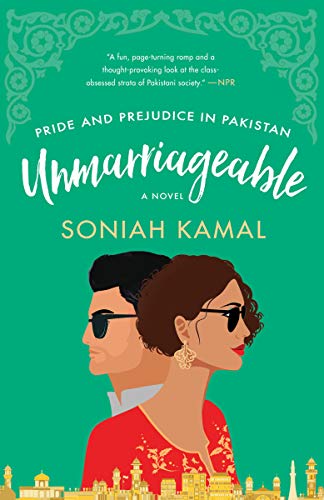
Unmarriageable
Soniah Kamal knows how to write sympathetic, beautifully thought-out romances. Unmarriageable, her modern retelling of Pride and Prejudice, is a lovely read, but it clings so closely to its Austenian roots, that there is no room for the author to fully put her own stamp on the novel, or to make any narrative deviations from the source material to surprise or intrigue the reader. If you’ve read Pride and Prejudice, you’ve pretty much read this book already.
With scandal and a bitter family feud having destroyed Alysba – Alys – Binat’s marriage prospects years ago, she’s settled in to work as a ninth-grade Urdu lang-lit teacher at the British School of Dilipabad in Pakistan. Many of her students, married off young and occasionally dropped into arranged marriages, will not often continue their education; Alys considers it her duty to, in her mother’s words, “infect them with hope”, as they wonder why she won’t wear make-up and why she’s cut her hair so severely. She’s taught Pride and Prejudice for years just to give them something to cling to. Alys’ deep belief in her feminist heroine, Jane, gives her extra courage; battling students whose worldviews are shrunken by their parents’ expectations and an administration that only sees the school as a kind of finishing establishment that will turn the girls into exemplary wives, Alys rebels happily and consistently against the limitations placed upon her.
Then good fortune finally arrives. The biggest wedding Dilipabad has seen in years is afoot, and the entire Binat family is invited to attend both it and the festivities leading up to it. Mrs. Binat is determined to marry off Alys, her slightly-older, much more romantic and beautiful sister, Jena, and their younger sisters, the vivacious Lady, the plus-sized Quitty and religious medical student wannabe Mari, during the festival.
The Binat girls are gussied up and loosed on the wedding festivities, but the only man Alys meets who sparks any form of interest in her is the stiff-necked, judgmental, shallow Valentine Darsee. While Jena works hard to land the rich Bungles, Alys and Valentine immediately clash (he mocks her for reading Good Housekeeping and Reader’s Digest; she learns quickly about his terrible breeding and family background). When she learns that he may have cheated his cousin, Jeorgeullah Wickaam, out of his inheritance she becomes angry, especially when it seems as Wickaam might be Lady’s shot at happiness. But still, there is a spark there – the question is whether or not Alys’ stubborn pride or Valentine’s prejudice against her intelligence can be tamed.
Unmarriageable is charming in places, has great, memorable female characters, does a beautiful job in grounding itself in the culture and society of modern-day Islamic small-town Pakistan and has some great dialogue – but it also has a number of problems that keep me from rating it more highly.
Alys is acid-tongued and a little mean. For much of the novel, she hasn’t a kind word for pretty much anyone in the whole universe besides her students and the majority of her family. She judges her neighbors and her bosses, and in words that are harsh. Alys is finally and mercifully softened by friendship – her relationship with Sherry (Sherry’s rushed relationship with a widowed doctor is, incidentally, the best romance in the book), a fellow unmarried thirty-year-old, which is conducted with wit, brio and humor, and I loved watching them banter about their fates and their lots in life. Alys becomes more likable as time goes on, which is something of a feat of miraculous writing, although unfortunately that twist in likability is accompanied by a light makeover involving heels, make-up and form fitting clothing. Nonetheless, by the time I closed the book, I liked her a lot and found her to be an all-to-relatable heroine.
It’s hard to redeem Valentine from his first appearance, where he declares Alys isn’t smart or good looking enough for him. As Darcy does toward Elizabeth Bennett, so does Valentine toward Alys, and he does – of course – eventually eat his words. But he spends much of the book being standoffish and aloof while staring at Alys, and when he’s not being aloof and hiding from celebrations while reading Archie comics, he and Alys are bickering. Their similarities are fairly small – they like to read (I will add a caveat that there’s a nice passage where Alys reads Valentine’s favorite book, Sunlight on a Broken Column, in order to understand him better); and they know how to see the world as it is, but their dour brooding realism can be a bit much in large doses. The trouble is that we spend so much time with Alys and so much time in her PoV that Valentine comes off as a bit of a cipher, dipping in and out of the novel at such irregular intervals it’s hard to tell how they’ve managed to fall in love at all. Everything that occurs after from her learning of the Big Secret about Jeorgeullah and Valentine’s estrangement feels like it happens on fast forward.
Another problem is the narrative’s heavy reliance on Pride and Prejudice itself. I know Unmarriageable is a retelling, but the narrative doesn’t swerve very far from Austen’s work beyond modernizing it a bit and having Jeorgeullah do things that are even worse than what George Wickham did, which eventually impacts his romance with Lady.
But here’s the most unfortunate part of the story. The book has an unappealing layer of fatphobia attached to Quitty’s weight, which the author never really does much to alleviate. Whenever Quitty is mentioned, her weight is referred to in a negative way, mostly by her mother and sometimes by her sisters. and while this might be a clear reaction to recent rebellion of Pakistani Muslim women, who want to be seen as visible and valid, the book’s tendency to use Quitty as a sight gag or an object of humor or revulsion doesn’t wash with that message. To watch Lady repeatedly call Quitty a hippo, and to have Mrs. Binhat repeatedly tell her daughter to lose pounds to catch a man is a little heartbreaking, and that the narrative calls it funny didn’t sit well with me. The book has Quitty eventually find self-love and success, but the narrative has been so relentlessly negative about her it’s hard to see it as much of a victory.
Unmarriageable frustrated me and delighted me in handfuls of ways. Its characters are so prickly and imperfect they border on unpleasant, but the deep cultural immersion is beautiful. The commentary on Pakistan in the early 2000s, the frustration the female characters feel as they’re locked into their roles, the denial, even, that they must plunge themselves into to enjoy what they’re given, are heartrendingly related. But the embarrassment humor, the Jeorgeullah part of the story (and the kind of marriage it sentences Lady to) and the weakness of Valentine and Alys’ romance mean I can’t award the book more than a very cautious recommendation.
Buy it at: Amazon/Apple Books/Barnes & Noble/Kobo
Visit our Amazon Storefront.
Recent Comments