
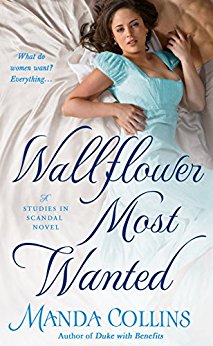
Wallflower Most Wanted
Have you ever watched a Hallmark movie? For all that I love romance stories, I haven’t sat through very many. While the characters in the show say all the right things, the language can feel a bit formulaic and predictable. There’s a certain spark between the romantic leads which is just missing. Unfortunately, that’s what I found in Wallflower Most Wanted.
Let me begin by saying that I jumped into the Studies in Scandal series with this, the third book, and while I was able to understand the plot perfectly well, there were certain aspects which struck me as odd that might have felt more natural with the buildup of the two prior books.
Miss Sophia Hastings is one of four lady scholars chosen by Lady Celeste Beauchamp as heirs to her estate, Beauchamp House. Lady Celeste, being rather unconventional herself, gave each of her heirs a mystery to solve. As you can guess, the first two girls found husbands in the course of their investigations, and Sophia’s story is no different. The rash of crime in the quiet town of Little Seaford did feel a little far fetched to me, but as I’m always up for a bit of intrigue, I tried not to let that thought detract from my enjoyment of the book.
Sophia Hastings is a painter of some renown and skill, though the handicap of being a woman makes it difficult for her to have a real career. She is using her time at Beauchamp House to work on her art, and is in the process of completing a painting when she quite literally falls off a cliff. Luckily, the local vicar, Lord Benedick (Ben) Lisle, sees her fall and rushes to her aid. While the two are huddled at the base of the cliff, staring dreamily into each other’s eyes, they overhear an ominous conversation, which begins our mystery plot.
Sophia rests for all of two pages after Ben carries back to the house, before deciding that a fall from a cliff and a potentially broken ankle are not enough to stop her from going to a ball that evening. It is hosted by a newcomer to the town, Mr. Morgan, and a recent letter from a relative has her concerned about his political ambitions and potentially illicit activities. Unsurprisingly, Sophia is unable to learn much of import and manages to tire herself out, which leads to Ben swooping in and sweeping her off her feet (literally) to take her home.
Shortly thereafter Ben is asked by the Home Office to look into a potential art forgery ring in Little Seaford. Naturally, he decides to involve the only artist he knows, and so two amateurs embark on an investigation into a band of murderous criminals. Alone. While they do tell their friends – the couples who have been involved in Lady Celeste’s previous cases – about their investigation, all of the actual work is done by the vicar and his limping companion.
You may be able to tell from this description that I was not enamored of the mystery plot in the book. In point of fact, it was not the mystery itself I disliked, but rather its investigators. Neither Ben nor Sophia fits the bill of TSTL, but they also don’t show much common sense. It’s obvious from that first overheard conversation that there are dangerous games afoot, yet they rush headlong into the situation, despite their lack of experience.
Beyond this, I also had trouble with the romance and character arcs – or lack thereof. While Ben and Sophia fall in love on page, I certainly wasn’t feeling it. There is no sparkling chemistry, nothing to make me excited about their relationship. They slide easily into a betrothal and then marriage, which surprised me only because I hadn’t realized they were ‘there’ yet. There is no heightening of sexual tension, no internal debates on Ben’s part. It simply occurs to him to propose, and then he does.
Part of my dislike of the romance may have been due to the lack of character development for either Ben or Sophia. They’re nice people and decent characters, but they don’t grow much over the course of the book. Sophia has a small moment when she realizes she avoids acknowledging illness because she doesn’t want to be like her permanently infirm mother, but that’s about it. The idea that a somewhat scandalous painter would not make a good vicar’s wife is brought up and quickly glossed over. Then it’s on to happily-ever-after.
In spite of the problems I had with Wallflower Most Wanted, I can see myself reading another book by Ms. Collins in the future. I enjoyed her writing, but the difficulty I had in connecting with the characters prevented me from enjoying this particular book. Fans of the series may like it, but I wouldn’t suggest anyone new to Ms. Collins begins here.
Buy it at: A/BN/iB/K
Recent Comments


I’ve had similar issues with this author. Her writing is engaging, but she falls short on characterisation and plot.
I agree that this series seems to work better when read as a unit; I didn’t have any problem understanding what was going on in the volume I reviewed, and found the premise and writing in general super charming, but they seem to suffer a bit when read as individual volumes. It’s a shame that the series seems to be getting harder to enjoy the longer it gets.