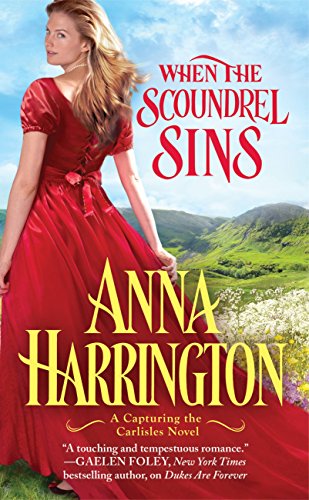
When the Scoundrel Sins
I’ll say straight off that When the Scoundrel Sins, the second in Anna Harrington’s Capturing the Carlisles series is a better book than the last one of hers I read, How I Married a Marquess. Mind you, I gave that a D+, so in a sense saying that this one is an improvement might not be saying much given that my expectations were pretty low. While this book is certainly flawed, it hangs together more cohesively, and while the romance depends on a couple of pretty tired tropes, there is at least a sense of it actually developing rather than having been skipped in favour of a string of love scenes. On the downside however, there are some fairly large inconsistencies in the characterisation of the hero, the heroine is too good to be true, there’s a clichéd sub-plot in which someone is out to force her hand over her choice of husband and the principal plotline about her inheritance rests – I believe – on rather shaky ground (more on that later).
Annabelle Greene, daughter of a servant and a convicted felon, was lucky enough to have been taken in and brought up by Lord and Lady Ainsley (her mother’s former employer and his wife), and trained to be a companion to Lady Ainsley – who actually treats her more like the daughter she’s never had. Under the terms of Lord Ainsley’s will, Annabelle will inherit her home, Glenarvon Castle in Cumbria, on her twenty-fifth birthday, but only if she is married. If she isn’t, the property will be given to the Church. His lordship’s intentions were good – by making sure Annabelle is married at the time of her inheritance, he thought to prevent her good for nothing father getting his hands on it. But here’s the shaky ground I mentioned before; this plotline rests on the idea that Annabelle – as a married woman – would have rights over her property. But at the time the book is set, when a woman married, everything she owned automatically became her husband’s to dispose of as he saw fit (so she could own property, but not have any say in its management). Even if there were a clause in the bequest stipulating that a husband could not interfere with Annabelle’s management of the estate, it would be invalid because – in my understanding – the law that a woman becomes her husband’s property upon marriage trumps everything.
Obviously, Lord Ainsley was hoping Annabelle would have been married before her birthday, to a man she loved who would be content for her to continue to manage the place, or to run it jointly with him; but in any case this becomes redundant because later in the book a family secret turns into a deus ex machina which negates the clause anyway. And if we’d known it earlier, there would have been no reason for this book to exist.
But back to the story. Still unmarried and with just a month to go before her twenty-fifth birthday, Annabelle is running out of time, but Lady Ainsley comes up with a plan that will enable Annabelle to keep her beloved home. The fact that she is an heiress has been kept under wraps, so Lady A. proposes they now let that fact be known, and, in order to sort the wheat from the chaff, informs her that she has invited her great-nephew, Quinton Carlisle, youngest of the three sons of the late Duke of Trent, to visit and vet all the applicants for Annabelle’s hand.
Annabelle is appalled. Years earlier when she was just sixteen, an ill-judged kiss with the very same Quinton Carlisle in a darkened arbour pretty much ruined her when they were discovered and Quinn punched the man who made disparaging remarks about her. The prospect of seeing him again leaves her conflicted; they’d been friends of a sort, in spite of his propensity to tease her, and that kiss has remained in her memory ever since. But it had disastrous consequences for her, and she’s never really forgiven him… although when she learns of his plans to depart almost immediately for America, where he intends to settle and make his own way independent of his brother, the new duke’s influence, she realises he could provide the ideal solution for her dilemma. If she marries Quinn, she will secure her inheritance and in return, she’ll pay him a percentage of the estate’s profits every year. He can head off to America as planned, leaving her to happily manage Glenarvon and it’s a win-win for both of them.
Sadly, however, it’s not so simple, for Quinn is yet another in the long, loooooong line of marriage-shy bachelors who inhabit the pages of historical romance (his father’s death so devastated his mother that it nearly killed her, so love is a big no-no as far as he’s concerned). I have to say that I was with Annabelle on this one – her solution would have been perfect for them both but for the fact that marriage-averse though Quinn is, he is adamant that he would never get married and then leave his wife behind. I couldn’t make sense of it. He doesn’t want a wife and yet has thought sufficiently about the idea to be sure he wouldn’t leave her behind if he had one. Inconsistencies – Quinn has them.
He rejects Annabelle’s proposal, which both annoys and angers her – yet within minutes, they’re sucking face and fondling each other like there’s no tomorrow – and not for the first time. There are three (?) such encounters in the first two-thirds or so of the book, and they all follow the same pattern of stubborn-Annabelle glaring at Quinn and facing him down while simultaneously trembling at his oh, so sexy nearness followed by passionate snogging and whatever, followed by ‘oh, no! What am I doing?! He’s so damn hot but I must resist and this can never happen again!’ (my paraphrasing.)
Want him or don’t want him, Annabelle, but stop with the self-recrimination. There’s getting swept away by passion and there’s being dumb – and Quinn, if you don’t want to marry her, learn to keep your hands to yourself.
In the space of a week or so, Annabelle sees the rakish scapegrace she has known transform into “a mature and responsible man”, someone capable of managing a large estate, making sensible suggestions about improvements, willing to muck-in with the farmhands and tenants as well as become her closest confidante and ally. (Did he run into a phonebooth and rip his shirt open or something?) They spend time together about the estate during the day and exchanging stories and playing chess in the evenings – it’s all very lovely and domestic, but she’s still got to find someone to marry or lose her home. One of the best moments in the book comes when he suggests perhaps she should find somewhere else to live rather than risk being shackled to a man she doesn’t love, and Annabelle lets him have it:
“While you were in your nursery, watched over by your nanny, I was being woken in the middle of the night to flee in the darkness because my father had gambled and drunk away the rent money. Again. I remember nights sleeping in doorways and in abandoned buildings, going without food for days, clothes worn to rags…hearing rats gnawing in the walls, picking out maggots from the flour so we could make bread, feeling the lice—”
…
“So don’t talk to me of home and what that means when you’ve always had one. Or how I should simply walk away from mine.” Her hand swiped angrily at her cheek to wipe the tear away. “Because you don’t know what you’re talking about.”
This is an emotional high-point in the story and the first (and probably only time) I found myself warming to Annabelle, who is good at everything and pretty much perfect. When all’s said and done though, both principals are bland and don’t transcend their respective stereotypes, and there is little discernible chemistry between them in the various love scenes. The writing is generally solid; I just wish Ms. Harrington had found a plotline that didn’t require her to obfuscate and gloss over certain aspects of it.
To sum up – When the Scoundrel Sins (another title that has little to do with the book’s content) is a mostly decent read that needed a stronger and more plausible plotline and more fully-rounded characters. It contains flashes of humour and I liked the author’s explanation of Annabelle’s deep attachment to Glenarvon and her eventual decision to go her own way, together with Quinn’s intention to prove himself by becoming his own man away from his brother’s shadow; but the flaws in the plot and somewhat lacklustre romance make this a book I can’t, in all honesty, recommend.
Buy Now: A/BN/iB/K
Recent Comments