
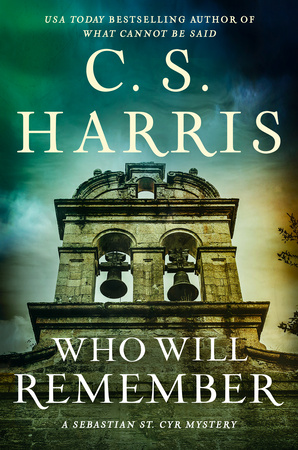
Who Will Remember
Who Will Remember, the twentieth instalment in the long-running series of historical mysteries starring Sebastian St. Cyr, is another engrossing, clever, and superbly researched tale full of twists and turns as our favourite aristocratic amateur sleuth attempts to solve a very unusual murder.
This story takes place around a year after the events of What Cannot Be Said (book nineteen), during the summer months of 1816, now known as ‘the year without a summer’ because of the abnormally cold temperatures experienced across the Northern Hemisphere. In England – as it did across Europe – this strange climatic event caused widespread crop failure, leading to higher food prices and much discontent, and it, coupled with the economic disruption caused by the end of the Napoleonic Wars, meant that the prospect of bloody revolution was never far from the minds of those in power.
We’re plunged into the mystery right away when, late at night, Sebastian is approached by a young lad who nervously informs him that he needs to come to a nearby ruined chapel right away because there’s a dead man hanging inside. When the boy explains that the man is hanging upside down, suspended from one foot with his hands tied behind his back, Sebastian knows something is badly wrong, and agrees to take a look.
The boy goes with Sebastian to the ruins and directs him to the back where, sure enough, there is the body of a man – obviously a gentleman judging by the quality of his clothing – hanging exactly as described. It’s a gruesome sight; blood from the gory mess someone had made os his head had dripped down to pool on the worn pavinstones beneath him and congealed there. It looks as though the material of the dead man’s own cravat was used to tie his right foot to his left knee and to tie his hands together, and the discoluration of the skin and distortion of the features aren’t enough to disguse his identity. He was Lord Preston Farnsworth, a man widely known and respected for his dedication to worthy causes and for living an upright and moral life. He was also part of a major scandal some years earlier, when his wife, Lady Tess, left him for a young cavalry officer – and close friend of Sebastian’s – by the name of Hugh Chandler. Farnsworth refused to divorce her – a woman could not divorce her husband at this time – and instead obtained an ecclesiastical separation (i.e, they separated but were still legally married) and then proceeded to sue Chandler for such a large sum of money it almost ruined him. Hugh is the obvious suspect in Farnsworth’s murder – the man’s death means Hugh and Tess can finally be married and that Tess’ substantial dowry will revert to her; and while Sebastian would like to believe absolutely in his friend’s innocence, but knows he can’t afford to discount the possibility that Hugh could be guilty. With the deceased’s brother, the Duke of Eversfield, being one of the Regent’s boon companions, the pressure on the London magistrates for fast action is immense – and there is little regard for whether or not the right man is arrested.
Having recognised the unusual way the killer posed the body as copying that on the tarot card Le Pendu, The Hanged Man, Sebastian pays a visit to Madame Blanchette, a French cartomancer residing in London. She informs Sebastian that while the image of Le Pendu is most often associated with betrayal and treason, it has other, more subtle meanings as well, such as indicating the need to reevaluate a situation or the need to accept one’s fate. The visit gives Sebastian a lot to think about – not least of which is to wonder exactly what the enigmatic Frenchwoman isn’t telling him.
The plot is clever and superbly constructed, peppered with red herrings and symbols and knotty conundrums, as Sebastian’s investigations reveal the victim to have been a bigot and a hypocrite with no charitable instincts behind the charming, pious exterior he presented to the world. When two more bodies are found, both with sinister tarot cards placed on them, it appears that whoever is responsible is sending a macabre message – and Sebastian is running out of time to decode it.
As with all the books in this series, the historical background is superbly researched and woven very skilfully and securely into the story, which is also full of a lot of pertinent social commentary. Sebastian’s wife, Hero, is an important lens through which readers come face-to-face with the less pleasant side of English society of the Regency era; there are no glittering balls or soirées here (other than when attending one is necessary for Sebastian to gather information or meet someone related to his investigations), and it’s through Hero’s work with the underprivileged that the author explores the conditions endured by the least fortunate in society. Soldiers returning from war, men who had served their country and often paid a hefty price, came home to find themselves ignored and forgotten by those they’d fought for and fought under. Working women who did what they had to do to earn a living who were locked up in “houses of correction” known as Bridewells, where hard labour and prodigious use of the whip were common. And even the ladies of the ton were barely second-class citizens, many of them unable to forge their own paths and completely dependent on the whims of the men in their lives.
The St. Cyr mysteries almost always go to some dark places, and the darkness at the heart of Who Will Remember is clearly reflected in the setting; it’s August, but it’s cold and damp, the skies are unremittingly grey and gloomy, the rain barely lets up and it seems as though the sun will never be seen again.
Most of the secondary characters will be familiar to anyone following the series; surgeon Paul Gibson is on hand to examine the bodies and offer his professional opinion, magistrate Henry Lovejoy provides a useful sounding-board, Sebastian’s aunt, Lady Henrietta, offers amusement and useful insight, and the repellent Jarvis is his wily, nasty self. And there’s an intriguing secondary plotline running through the story about a French assassin recently arrived in London on behalf of the new Bourbon régime, and his search for a man who may turn out to be a very important figure in Sebastian’s life.
All of this adds up to another thoroughly engaging and satisfyingly complex read and one I’m happy to recommend and add to my keeper shelf. If you haven’t read any of the Sebastian St. Cyr Mysteries, then you could probably pick up Who Will Remember and enjoy it, although reading at least some of the earlier books in the series would provide a stronger sense of who Sebastian is and what he’s been through to have brought him to this point in his life. Jumping in at book one of a series of (so far) twenty may be a daunting prospect, but the books are so good, it won’t be long before you find yourself completely hooked and racing through them to get up to date!
Recent Comments

This series used to have a nice mix of mystery and romance. Romance has now completely disappeared and Sebastian and Hero now read like staid married couple—increasingly, they don’t even show up on the same page for a long time. For a while, their family life, especially fun details of Sebastian’s interaction with his son were nicely woven into the story line. In the last few novels, that has been missing too. Sometimes the mystery plot lines are grim too (book 19 was a DNF for me). I agree that historical setting and the research alone make her books worth reading. But are they worth their double digit price?
This is the only historical mystery series I keep up with these days; I stopped reading Lady Julia (Raybourn) and Lady Darby (Huber) when the romances disappeared because I didn’t find the mysteries all that compelling. But I do like these mysteries (no matter how grim!), and I like that while, as you say, Sebastian and Hero are now a staid married couple, Hero often has a part to play in the investigations through her work with the underprivileged.
I’m not sure any genre fiction book is worth** a double digit price, tbh. I know we’ve had discussions here about book pricing, and I certainly agree that authors deserve to be paid for their work (and not have it stolen by AI!) but I couldn’t afford to buy most of the traditionally published books I review, and libraries just aren’t an option for me. This one is £9.49 in the UK, so narrowly avoids double digits, but that’s still out of my price range. Thankfully, most of the books I read nowadays are self-published and authors seem to be working hard to keep them affordable.
** I mean compared with all the other things we need to spend our money on. A great book might well be worth more than 10 quid in terms of the enjoyment it brings, but it’s hard to justify spending that much on a book when the household budget is tight.
This one’s is priced at $11.06 in the US. The books in this series have always been priced in double digits and take a long time to come down in price (book 19 is $9.59). I don’t understand the business logic of this kind of pricing. According to Amazon, I own 6 books in this series and way back I used to buy them at their double digit price. My top limit for genre books is $6 now. The libraries no longer carry the e-versions of this series. So, unless something changes, I am unlikely to read this anytime soon.